
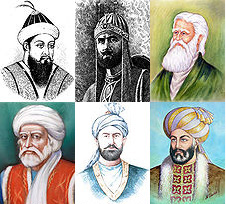
Pashtuns People
Pashtuns (Pashto: پښتون Paṣ̌tun, Pax̌tun,
also rendered as Pushtuns, Pakhtuns, Pukhtuns), also called Pathans
(Urdu: پٹھان, Hindi: पठान Paṭhān) or ethnic Afghans, are an Eastern
Iranian ethno-linguistic group with populations primarily in
Afghanistan, North-West Frontier Province (NWFP), Federally
Administered Tribal Areas (FATA), Mianwali District, Attock District
and in the Balochistan Province of Pakistan. The Pashtuns are
typically characterized by their usage of the Pashto language and
practice of Pashtunwali, which is an ancient traditional living by
special codes that has been preserved until modern day.
Ibrahim Lodi ·
Sher Shah Suri ·
Rahman Baba
Khushal Khan ·
Mirwais Hotak ·
Ahmad Shah Durrani
Ayub Khan ·
Abdur Rahman Khan ·
Amanullah Khan
Abdul Ghaffar Khan ·
Abdul Ahad Momand ·
Hamid Karzai
Pashtun society consists of many tribes and clans which were not
politically united until the rise of the Hotaki followed by Durrani
Empire in the early-18th century. Pashtuns played a vital role
during the Great Game from the 19th century to the 20th century as
they were caught between the imperialist designs of the British and
Russian empires. For over 300 years, they reigned as the dominant
ethnic group in Afghanistan with nearly every ruler being a Pashtun.
More recently, the Pashtuns gained worldwide attention during the
1980s Soviet war in Afghanistan and with the rise and fall of the
Taliban, since they are the main ethnic contingent in the movement.
Pashtuns are also an important community in Pakistan, where they
have attained the presidency, high positions in the military, and
are the second-largest ethnic group.
Demographics
The Pashtuns are the world's largest (patriarchal) segmentary
lineage ethnic group. The total population of the group is estimated
to be around 42 million, but an accurate count remains elusive due
to the lack of an official census in Afghanistan since 1979. There
are an estimated 60 major Pashtun tribes and more than 400
sub-clans.
The vast majority of Pashtuns are found in an area stretching from
southeastern Afghanistan to northwestern Pakistan. Additional
Pashtun communities are found in the Northern Areas of Pakistan and
in the Khorasan Province of eastern Iran. There is also a sizeable
community in India, which is of largely putative ancestry. Smaller
Pashtun communities are located in the countries of the Arabian
Peninsula, Europe and the Americas, especially in North America.
Important metropolitan centers of Pashtun culture include Kandahar,
Quetta, Peshawar, Jalalabad and Swat. Kabul, Ghazni, and Kunduz are
ethnically mixed cities with large Pashtun populations. The city of
Karachi in Pakistan hosts one of the largest Pashtun populations in
the world. In addition, Rawalpindi, Islamabad, and Lahore also has
sizable Pashtun population.
Pashtuns comprise roughly 15.42% of Pakistan's population, or 25.6
million people. In Afghanistan, they make up an estimated 42% of the
population, according to the CIA World Factbook.[20] The exact
numbers remain uncertain, particularly in Afghanistan, and are
affected by approximately 1.7 million Afghan refugees that remain in
Pakistan, a majority of which are Pashtuns. Another 937,600
registered Afghans live in Iran, according to United Nations High
Commissioner for Refugees (UNHCR). A cumulative population
assessment suggests a total of around 42 million across the region.
History and Origins/
The history of the Pashtun people is ancient, and much of it is not
fully researched. Since the 2nd millennium BC, cities in the region
now inhabited by Pashtuns have seen invasions and migrations,
including by Indo-Iranians, Iranian peoples, Indo-Aryans, Medes,
Achaemenids, Mauryas, Scythians, Kushans, Hephthalites, Greeks,
Arabs, Turks, Mongols, British, Russians, and more recently by the
NATO forces.
There are many conflicting theories about the origin of Pashtuns,
some modern and others archaic, both among historians and the
Pashtuns themselves. Ahmad Hasan Dani, a popular Pakistani historian
from Islamabad, believed that Gandhara was an ancient land of the
Pashtuns. However, according to other historians and experts, the
true origin of the Pashtuns is unknown.