
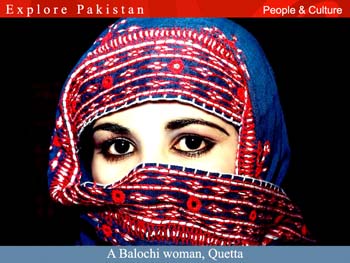
PEOPLE OF BALOCHISTAN: THE BALOCH
The Baloch or Baluch (بلوچ) are the majority ethnic inhabitants of the region of Balochistan in the southeast corner of the Iranian plateau in Southwest Asia, including parts of Iran, Afghanistan, and Pakistan. It is believed that they belong to the larger Iranian peoples.
The Baloch people speak Balochi, which is a branch of the
Iranian languages. They mainly inhabit mountainous terrains,
which have allowed them to maintain a distinct cultural
identity and resist domination by neighboring rulers. The
Baloch are predominantly Muslim, with most belonging to the
Hanafi school of Sunni Islam. Some 60 percent of the total
Baloch population live in Pakistan. About 25 percent inhabit
the contiguous region of southeastern Iran. In Pakistan the
Balochi people are divided into two groups, the Sulaimani
and the Makrani, separated from each other by a compact
block of Brahui tribes.
Despite contrasts and a variety of economic and cultural patterning – the Baloch social structure remains tribal. Tribal society is in all cases governed by a very definite constitution and system of laws regulating marriage, inheritance, religious observance, dispute resolution, decision-making, duties, rights and so forth. The Tribal society is the social system organized around extended family relations where rights and duties are conferred by tribal law, based on relationships of kinship. Baloch society has been formed through many influences; among the most important are tribalism and nomadism.
HISTORY / ORIGIN:
The South-Western region of Pakistan surrounded by the Afghan and Iranian borders is Balochistan. This is the largest province by area of the country. Historians suggest that Balochi people are directly descended from Amir Hamza, one of Muhammad's uncles and they migrated into the transnational area of Balochistan from Syria. These migrations from Syria mainly occurred in about 5th century and were almost completed by the end of 7th century. Until the 12th century, Balochistan was inhabited by independent semi-nomadic groups, organized under respective clans. With the passage of time, the population of this region increased giving rise to the present tribal system in the area.
Officers of the 27th Bombay Native Infantry (1st Balochis), made up of Balochs, from the British Indian Army circa 1867.
Historians have several opinions about the origin of the name Baloch. Some suggest that with the arrival of Iranian tribes called Baluch, the province began to be known as Balochistan and its inhabitants were called Balochis. Others also maintain that the Baloch owe their name to Babylonian King 'Belus', also the name of their god. Some researchers also claim that the word Baloch is made up to two Sanskrit words Bal meaning strength or power and Och meaning high or magnificent.
Baloch men in their national dress, 1910.
LANGUAGES:
The language spoken by Baloch people is Balochi.
Today only about 3% of Pakistani population speaks this
language. This language is mainly spread by nomadic tribes
and is mostly oral with rich poetry and legends passed down
by word of mouth. Jam Darang is known as the most important
Balochi writer of love ballads in Balochi culture. Balochi
is unfortunately one of the most neglected languages in the
country. Most of the inhabitants are immigrants or
government officers who don't speak Balochi, which leads
Balochi to be rarely spoken in most of the province.
Brahui is the second most common language amongst
Balochi people. It is a language of unknown origins with
many Iranian words. Pashto is another
language spoken by the Balochs.
FESTIVALS:
The Baloch people celebrate several social and religious festivals. The two major Religious festivals of Eid-ul-Azha and Eid-ul-Fitr are celebrated in the region. On these occasions people embellish their houses, wear new dresses, prepare special means and arrange get-togethers. One of the most popular festivals of the region is Sibi festival that has its roots to Mehergar, an archaeological site of ancient human civilization. Folk music performance, traditional dances, handicrafts stalls, cattle shows and other amusing activities attract the people from all over the country. Buzkashi is another popular festival demonstrating the valor of Balochs. It is celebrated by two teams riding on horses showing their skills to snatch goat from the other.
ARTS AND MUSIC:
Baloch has a rich musical culture. Music has a significant role on all occasions except ceremonies of death. Most of the Balochi Music is based on Zaheerag which is a kind of melancholic music. The instruments used are mainly a flute, locally called Nal, Tamboora and Soroz. Thanksgiving dances are made of joy at the time of positive weather changes and harvests, which are collectively performed in groups. A special religious dance is carried out by a Baloch sect known as Chogaa. Another common Baloch folk dance is known as Dochaap. In this dance men gather and dance in groups, clapping hands with the movement of foot, neck and head with rhythmical music on drums. On various occasions, women also move in a circle clapping their hands. Other dances include the Lewa, which is thought to be of Arabic origin, along with Latti and Hambo said to be of ancient Balochi origin, are also very popular.
Baloch people give a great importance to the occasion of birth. The occasion is celebrated by music, singing and dancing. Women visit and sing domestic songs such as ‘Sipath' praise songs to the mother.
RELIGIOUS INFLUENCE:
According to researchers, no sophisticated religious institutions are evident in Baloch society. There are regular tribal institutions instead of religious priesthoods. Baloch people are distinguished for their attitude towards religious tolerance. They have a more liberal and secular mindset compared with the other nations across the country. Despite the fact that Baloch are considered to be secular, Baloch society is dominated by tribal chiefs, locally called Sardars. Honor killings for violating the laws are common. These traditional tribal punishments, which contradict Pakistani as well as International Laws, have come to the light due to awareness campaigns of NGOs and Government Agencies.
LIFESTYLE:
Due to the rugged and irregular terrain, agricultural activities are difficult to carry out. The scarcity of a plentiful supply of water is another reason for this province to remain neglected in agricultural developments. As a result, people mainly lead a nomadic lifestyle bringing up their animals and moving from place to place in search of pastures. Lower Coastal Region of the province also gives chance for productive fishing activities and these are mostly exported. The province is rich in mineral resources, which provide most of the job opportunities for local people. The entertainment in Baloch culture is limited to games, music and dancing. The most popular among the games for the adults is horse racing and archery. Betting on the games by participants themselves or by on-lookers is in fashion.
Baloch people are extremely hospitable. A guest is a mark of respect and held in honor. Even the enemy, once entered in the house, would get the treatment of an honored guest. On the other hand, bravery and courage are the only criteria for getting respect from the common folk. Everybody fully praises the men who fall in battle, or die in avenging a wrong done to him or his neighbor
CULTURAL DRESSES:
The cultural dressing in Baloch tradition is very much similar to that of Pashtuns tribes with some dissimilarity. Men usually wear a turban, a headdress consisting of a long cloth wrapped around head. They also wear a wide loose trouser, locally called a shalwar with knee long shirts, locally called qamis. The dress of women also consists of shalwar and qamis with a delicate embroidery work on mirror pieces. A long piece of cloth, termed as chaddar is worn by women cascading down the shoulders and used to cover their heads