
Punjabis have traditionally and historically been farmers and
soldiers, which has transferred into modern times with their
dominance of agriculture and military fields in Pakistan. In
addition, Punjabis in Pakistan have been quite prominent
politically, having had many elected Members of Parliament. As the
most ardent supporters of a Pakistani state, the Punjabis in
Pakistan have shown a strong predilection towards the adoption of
the Urdu language but nearly all speak Punjabi, and still identify
themselves as ethnic Punjabis for the most part. Religious
homogeneity remains elusive as a predominant Islamic Sunni-Shia
population and a Christian minority have not completely wiped out
diversity since the partition of British India. A variety of related
sub-groups exist in Pakistan and are often considered by many
Pakistani Punjabis to be simply regional Punjabis including the
Seraikis (who overlap and are often considered transitional with the
Sindhis) and Punjabi Pathans (which publications like Encyclopædia
Britannica consider a transitional group between Punjabis and
Pathans.
Language:
Due to vast area of land where Punjabi is spoken, different local
variations or dialects have developed.
Majhi: Spoken in the heart of Punjab i.e., Lahore , Sialkot,
Gujaranwala, Gurdaspur, Amritsar. Most of the population of Punjab
lives in this area and linguists also say that Majhi dialect is the
"Tixali boli" i.e., it has been influenced by all other dialects.
Malwi: Spoken in the east Punjab area of Ludhiana, Ambala,
Bathinda, Ganganagar, Maleerkotla Fazilka, Ferozepur. This area (Malwa)
is the southern and central part of present day Indian Punjab. Also
includes the Punjabi speaking areas of Haryana, viz. Ambala, Hissar,
Sirsa, Kurukhetra etc. (northern parts of Haryana mainly).
Doabi: Land between the rivers of Beas and Satluj is called
Doaba. Do Aaba lierally means "the land between two waters" in
Persian. It includes Jalandhar, Hoshiarpur, and large number of
Punjabis from this area have gone out to U.K., USA, Canada or
elsewhere.
Pothohari: The area where Pothohari is spoken extends in the
north from Kashmir to as far south as Jehlum and Gujar Khan and
includes the capital of Pakistan, Islamabad. The whole area (i.e.
the north-west of Punjab) is beautiful scenic area. It's here that
the beautiful hilly resorts of Murree, Ayubia, Nathia-Gali lies.
This dialect is similar to some extent to the Hindko dialect of
Punjabi which is spoken in Peshawar, Nowshehra, Mansehra all these
areas lie in the North West Frontier Province of Pakistan where
majority language is Pashto, but Hindko speakers area also found in
sizable numbers.
Jhangvi: The region where Jhangvi is spoken stretches from
Khanewal to Jhang and includes the cities of Faisalabad, Chiniot.
Jhangvi dialect is also called the "Jangli" dialect of Punjabi. This
is the land of Heer/Ranjha. Their tomb is located in Jhang city.
Sultan Bahu is an important saint of this area.
Multani: The dialect spoken in Multan, Bahawalpur, Khairpur,
Daira Ghazi Khan, Muzafar Garh i.e., southern deserts of Punjab is
called Multani (also Lehndi by some) and perhaps differs from
Punjabi more than any other dialect. This is the land of Muslim
Sufis, perhaps "Shah Shams Sabazwari" who came to Multan in 1165 AD
was the first in a long series of Sufis to base themselves in Multan.
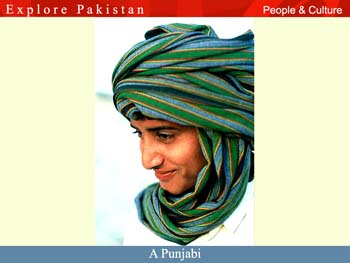
Clothing: Women's clothing normally consists of a piece of
colorful cloth that women wear around their necks. Salwar kameez's
and duppattas come in a variety of colors and designs. Many stores
specialize and sell only these articles of clothing. Men and boys
generally wear loose pants or slacks with a collared shirt or
t-shirt. Some males also wear the kurta pajama, a shirt and pant
outfit, especially the Punjabi farmer. On their head, many Sikhs
also wear bhuggs, or turbins. In winter, both women and men
generally wear a woolen shawl, a small blanket, around their necks.
Many men wear jackets and woolen caps as well.
Music: There are many different varieties of Punjabi music.
Traditional Punjabi music includes instruments such as the dhol
drum, flute, dholak, and tumbi. Singers such as Pathanay Khan mainly
based his music on the dholak and tumbi. Many other artists use dhol
drum as their primary instrument. People generally refer to Punjabi
music based on the dhol drum as Bhangra. These days, besides using
the traditional instruments, some artists use computers and Western
instruments to accompany their Bhangra music. Many races of people
and religions made up the cultural heritage of the Punjab. Punjab is
the land where spiritual aspirations arose. This heroic land bore
numerous invasions, and after all its suffering, did not entirely
lose its glory and its strength.
Culture
FindPK Archive
People & Culture | PEOPLE OF PUNJAB: THE PUNJABI
calendar_month
Listed 09 Apr 2025
tag
Ref /culture/html/people_of_punjab_.html
Pakistan Travel & Tourism Guide: Photo Bank of Pakistan, What To See, Where To Stay, What To Buy,What To Wear, What To Eat etc. and all about Pakistan
Official FindPK dossier
Culture
palette Guide