|
|
[Ethnic
Groups] [The
Baloch] [People
of Sindh] [People
of Punjab] [Saraiki
People] [Pashtuns
People] [Muhajir
Urdu-Speaking People] [Mountain
Tribes] [Religions]
[Languages]
[Festivals]
[Arts
& Culture] [Folktales
From Pakistan] [Music
& Dance] [Art
& Craft] [Art
Gallries & Museums] [Cuisine
of Pakistan] [National
Symbols of Pakistan] [Slide
Show]
Ethnic Groups
in Pakistan
About 98% of languages spoken in Pakistan are Indo-Iranian
(sub-branches: 75% Indo-Aryan and 20% pure Iranian), a branch of
Indo-European family of languages. Most languages of Pakistan are
written in the Perso-Arabic script, with significant vocabulary
derived from Arabic and Persian. Punjabi (Shahmukhi), Seraiki,
Sindhi, Pashto, Urdu, Balochi, Kashmiri (Koshur), etc. are the
general languages spoken within Pakistan. The majority of Pakistanis
belong to various Indo-Aryan-speaking ethnic groups, while a large
minority are various Iranic peoples and Dardic language groups. In
addition, small groups language isolates such as Burusho and Brahui-speaking
peoples also live in the country. The major ethnic groups of
Pakistan in numerical size include: Punjabis, Pashtuns, Sindhis,
Seraikis, Muhajirs, Balochis, Hindkowans, Chitralis and other
smaller groups.
According to the last census in late 2008, the population comprises
several main ethnic groups:
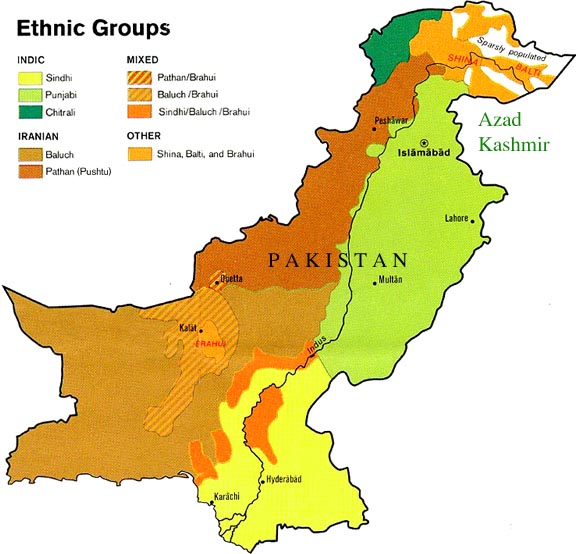
Smaller ethnic groups, such as Kashmiris, Hindkowans, Kalash,
Burusho, Brahui, Khowar and Shina are mainly found in the northern parts of
the country. The people of the Pothohar Plateau in northern Punjab,
Potoharis are sometimes listed separately from Punjabis. This would tend to
decrease the Punjabi population further.
After independence of Pakistan, Muslims from neighboring countries
have settled and they speak many languages. In Karachi, Memons, Bohras and
Ismailis speak Gujarati, Kutchi and Memoni languages. The Bengalis speak
Bengali and Rohingyas speak Rohingya. These linguistic groups are adopting
Urdu and are assimilating into Muhajir community.
Pakistan's census does not include the registered 1.7 million Afghan
refugees from neighboring Afghanistan, who are mainly found in the
North-West Frontier Province (NWFP) and Federally Administered Tribal Areas
(FATA) areas, with small numbers in the cities of Karachi and Quetta.[1]
Around 2 million Muslim refugees from Middle East, Central Asia and South
Asia (especially Bangladesh, Iran, Tajikistan, Africa, Sri Lanka, Burma,
Arab countries) and other places are also found in Pakistan.
Major ethnic
Groups of Pakistan
Punjabis
Punjabis in Pakistan are multi-ethnical group of people, and can be
divided into sub-groups. They are natives of Greater Punjab. The
Punjab has been conquered in the past by Arabs, Turks, Persians,
Afghans and they have intermarried with the local population thus
many of the clans claim origin from Arabs and Turks. One uniting
factor among Punjabis is their Punjabi language. Punjabis have many
different dialects and that depends in what region of Punjab they
are from.
Pashtuns
Pashtuns or Pakhtuns (sometimes Pathans) are Pakistan's second
largest ethnic group that are native to the land principally west of
the Indus River. However, they can be found in cities all throughout
Pakistan. The largest urban population of Pashtuns is interestingly
found in the city of Karachi with a total estimated population of
about 4 million[citation needed], this is then followed by Peshawer,
Quetta, Lahore in descending order. There are more than double the
number of Pashtuns in Pakistan than they are in Afghanistan, where
they are the largest ethnic group in the country(Afghanistan).
Pashtuns practice a unique code of conduct referred to as
Pashtunwali and are known for their tribal structure.
Sindhis
Sindhis are ancient people principally inhabiting the province of
Sindh, Pakistan from where the river Indus (in ancient times revered
to as Sindhus) runs and subsequently, from which they derive the
name Sindh from. Believed to be the inheritors of the ancient Indus
Valley Civilization, Sindhis are heavily influenced by Balochis in
Pakistan. Sindh also has considerable Arab and Persian influence. It
is estimated 35-40% of Sindhis are of Baloch origin.
Balochis
The Baloch are settled in Balochistan region of Iran, Afghanistan
and Pakistan. The Baloch are settled in Balochistan, Sindh and
Punjab provinces of Pakistan. The Baloch constitute about 6% of
Pakistani population while they constitute 44% of population in
Balochistan. It is estimated 35-40% of Sindhis are of Baloch origin.
Muhajirs
Muhajirs are a multi-ethnic community who are partly descended from
Arabs, Persians, Afghans and Turks. The Muslims of Middle East and
Central Asia have historically, travelled to South Asia as
technocrats, bureaucrats, soldiers, traders, scientists, architects,
teachers, theologians and Sufis during the Islamic Sultanates and
Mughal Empire and settled permanently. Most Muhajirs have converted
to Islam during the Muslim rule of South Asia under the influence of
Sufis. It is estimated that around 30 to 35% of Muhajirs are of
Pashtun heritage. The Muhajir community also includes peoples of
Punjabi heritage. In broader terms, it also includes Memons, Bohras
and Ismailis that spoke Gujarati, Kutchi and Memoni languages and
are now assimilating into Muhajir community. The Bengali and
Rohingya refugees in Karachi are also assimilating into Muhajir
community. The uniting factors of Muhajirs are Islam and Urdu
language.
Saraikis
The Seraikis are believed to be the transitional group of people
between Punjabis and Sindhis. The Seraikis or Multani people are
settled in southern Punjab. The Seraikis maintain that they have a
separate language, Seraiki language, and culture but their language
is often viewed as a dialect of Sindhi language in Sindh and Punjabi
language in Punjab.
Minor
ethnic groups of Pakistan
Hindkowans
Hindkowans are believed to be the transitional group of people
between Punjabis and Pashtuns. They are also known as Punjabi
Pathans. Their traditional homeland are areas around Abbottabad in
Hazara and Mianwali, Dera Ismail Khan and Dera Ghazi Khan, in Punjab
and Kohat, Peshawar in the North-West Frontier Province . Peshawar
City population is composed of indigenous people who speaks
Hindkowans and Pashtuns who one or more generation ago start
migrating to Peshawar.
Hazaras
Hazaras are a Persian speaking people residing in Quetta and as
refugees in the Islamabad area. Genetically, the Hazara are
primarily a mixture of eastern Eurasian and western Eurasian
peoples. The genetic research suggests that they are closely related
to the Mongols and the Uyghurs. The Pakistani Hazaras estimate
population believed to be more than 200,000.
Sheedis
The Sheedis are African people brought during the Arab rule in
Balochistan and Sindh provinces of Pakistan as soldiers and slaves
were brought from Africa. The descendents are also called Makranis
or Sheedis. The Sheedis (also called Habshi, from Arabic حبشي
ḥabashi) are a Negroid people in Pakistan. They number around
150,000 in Pakistan.
Tajiks
Tajiks are a Persian-speaking people, with traditional homelands in
present-day Afghanistan, Tajikistan, southern Uzbekistan, northern
Pakistan and Uyghuristan in western China. The Pakistani Tajiks are
estimated to be over 1 million. Tajiks of Pakistan are often
considered similar group of people as Dardic/Chitrali people of
Pakistan.
Baltis
Baltis are an ethnic group of Tibetan descent with some Dardic
admixture located in Gilgit-Baltistan, Pakistan and Ladakh, a region
in Kashmir; as well as scattered in Pakistan's major urban centres
of Lahore, Karachi and Islamabad/Rawalpindi. The Balti language
belongs to the Tibetan language family and is a sub-dialect of
Ladakhi.[2] Balti, Ladakhi and Burig are mutually intelligible.
|