|
|
[Ethnic
Groups]
[The
Baloch] [People
of Sindh] [People
of Punjab] [Saraiki
People] [Pashtuns
People] [Muhajir
Urdu-Speaking People] [Mountain
Tribes] [Religions] [Languages] [Festivals] [Arts
& Culture] [Folktales
From Pakistan] [Music
& Dance] [Art
& Craft] [Art
Gallries & Museums] [Cuisine
of Pakistan] [National
Symbols of Pakistan] [Slide
Show]
PEOPLE OF Sindh: THE Sindhi
Sindhis (Sindhi: سنڌي (Perso-Arabic),
सिन्धी (Devanagari)) are a Sindhi speaking socio-ethnic group of
people originating from Sindh, a province of Pakistan. Today Sindhis
that live in Pakistan belong to various religious denominations
including Muslim, Zorastrian, Hindus and Christians. After the
Partition of India in 1947, a large number of Indian Muslim refugees
(Muhajirs) flocked into Pakistan and settled in the prosperous Sindh
region. At the same time Sindhi Hindus migrated to India in large
numbers.
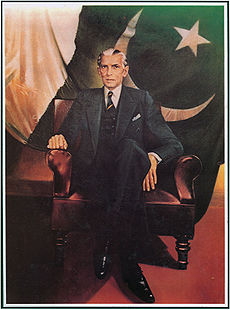
Muhammad Ali
Jinnah Urdu: محمد علی جناح
Father of The Nation Pakistan
Sindhhi refers to an Indo-Aryan language speaking socio-ethnic group
of people originating in Sindhh which is part of present day
Pakistan. Sindhhis that live in Pakistan are predominantly Muslim,
while many Sindhhi Hindus emigrated to India when British India was
divided in 1947. Some Sindhhi speaking people of formerly
untouchable castes known as Haris and practising what is generally
known as folk Hinduism are still found in rural Pakistan.
History:
Sind is one of the four provinces in Pakistan located at the
Southern border. The province of Sind has its name derived from the
famous River Indus. In Sanskrit, the province was dubbed Sindhu
meaning an ocean. Around 3000 B.C, Dravidian cultures developed and
give rise to the Indus Valley Civilization. According to the
Historians, Indus Valley Civilization declined due to the natural
disasters such as floods but the invasions of Indo- Arians caused
the sudden collapse of it.
In the recent history, Sindh was conquested by the British in 1843.
Sind province remained the part of British India until 1947 when it
was made one of the provinces of Pakistan.
Languague:
Sindhi language evolved over a period of 2400 years. The language of
the people of Sindh, after coming in contact with the Aryan, became
Indo-Aryan (Prakrit). Sindhi language, therefore, has a solid base
of Prakrit as well as Sanskrit, the language of India, with
vocabulary from Arabic, Persian, and some Dravidian - descendants
from Mediterranean sub-continent. Initially, Sindhi had close
contacts with Arabic- speaking Muslims. Therefore the language
adopted many of the Arabic words.
Sindhi language is also greatly influenced by Sanskrit and about 70%
of the words in Sindhi are of Sanskrit origin.Sindhi is a very rich
language with a vast vocabulary; this has made it a favourite of
many writers and so a lot of literature and poetry has been written
in Sindhi. It has been the inspiration for Sindhi art, music,
literature, culture and the way of life. The language can be written
using the Devanagri or Arabic script
Festivals:
The people of Sind love their religion and the two festivals of
Eid-ul-Adha and Eid-ul-Fitr are celebrated with zeal and enthusiasm.
Different domestic festivals are arranged by the local people to
provide people with new things they buy on Eid’s occasion. On
different occasions, the Folk dance of Bhagat is also performed by
professionals to entertain the visiting people. Hence, a Sindhi
Cultural Festival is a compound of folk dances, music and cheap
entertainment for local people.
Lifestyle:
People of Sindh are more inclined towards an agricultural based
lifestyle. The fertile Indus Plains provide a valuable source of
income for the local people who practice farming on these lands.
Inland fishing is also practiced along the Indus River in Upper Sind
providing further opportunities for local people. Nomadic way of
lifestyle is commonly seen in the desertic regions of Thar where
people move from place to place in search for drinking water sources
along with their animals.
Arts and Music:

Sindhi society is dominated by great Sufis, the mystics and the
martyrs. It has always been the land of peace, love, romance, and
great cultural and artistic values. There were the great theologians
of the Naqshbandi order in Thatta who translated the fundamentals of
the religion of Islam into their mother tongue. There were the great
Sufi (mystic) poets like Shah Abdul Latif Bhitai who was the
cherisher of truth and spent all his life in its propagation,
pursuit and quest. Bhitai was also an excellent musician. He
invented a new type of musical instrument, Tambura (drone
instrument), which till today, is a primary source of music in rural
Sindh. The beauty of Shah's verses is enhanced by his blending of
traditional Indian rag with the Sindhi folk songs and music.
|