Pakistan has every reason to be proud of the thousands of years old and rich tradition of its arts and crafts. In the post-independence period, the successive governments have been providing substantial state help and initiative for the uplift of arts and crafts in the country. A wider recognition of the accomplishments of crafts-people has been facilitated by the activities of the National Crafts Council and promotional plans of organizations such as the Export Promotion Bureau and Small Industries Corporations. Pakistani craftsmen are well reputed in producing quality products in clay, stone, fabrics, carpets, wood, metal, jewelry and leather.
The society and culture of Pakistan (Pronounced shmeg-mah) (Urdu:
ثقافت پاکستان ) comprises numerous diverse cultures and ethnic
groups from the Punjabis and Sindhis in the east to the tribal
cultures of the Baloch and Pashtun in the west and the ancient
Dardic in the north. These Pakistani cultures have been greatly
influenced by many of the surrounding countries' cultures, such as
those of Turkish, Persian, Afghan, and Indians of South Asia,
Central Asia and the Middle East.
In ancient times, Pakistan was a major cultural hub and the home of
ancient civilizations, such as the Indus Valley Civilization - one
of the first 'settled' peoples. Many cultural practices and great
monuments have been inherited from the time of the ancient rulers of
the region. One of the greatest cultural influences is that of the
Persian Empire. Other key influences include the Afghan Empire and
later the short lived but influential Mughal Empire.
Pakistan has a rich cultural and ethnic background going back to the
Indus Valley Civilization, 2800 BC – 1800 BC. A civilization
remarkable for its ordered cities, advanced-planned sanitation,
straight roads and uniquely structured society. Present day Pakistan
has been invaded many times in the past. it has been occupied and
settled by many different peoples each of whom have left their
imprint on the current inhabitants of the country. Some of the
largest groups were the 'Aryans', Greeks, Scythians, Persians, White
Huns, Arabs, Turks, Mongols and other Eurasian groups right up until
the British who left in the late 1940s.
The region has formed a distinct cultural unit within the main
cultural complex of South Asia, the Middle East and Central Asia
from the earliest times. There are differences in culture among
the different ethnic groups in matters such as dress, food, and
religion, especially where pre-Islamic customs differ from Islamic
practices. Their cultural origins also show influences from far afield; including from: Tibet, Nepal, India and eastern Afghanistan.
All groups show varying degrees of significant influence from
Persia, Turkestan and Hellenistic Greece. Pakistan was the first
region of South Asia to receive the full impact of Islam and has
developed a distinct Islamic identity, historically different from
areas further west.
Diwan-e-Khas: The hall of special audience with the emperor
Bahauddin ZakariyaAncient sites in Pakistan include: Zorastrian,
Buddhist, Hindu and Pagan temples and shrines, gardens, tombs,
palaces, monuments, pleasure grounds and Mughal and Indo-Saracenic
buildings. Sculpture is dominated by Greco-Buddhist friezes, and
crafts by ceramics, jewellery, silk goods and engraved woodwork and
metalwork.
Pakistani society is largely multilingual, multi-ethnic and
multicultural. Though cultures within the country differ to some
extent, more similarities than differences can be found as most
Pakistanis are of mainly 'Aryan' heritage and/or have lived side by
side along the Indus River for the past several thousand years and
coexisted. However, over 60 years of integration, a distinctive
"Pakistani" culture has sprung up especially in the urban areas.
Education is highly regarded by members of every socio-economic
stratum. Traditional family values are highly respected and
considered sacred, although urban families increasingly form nuclear
families, owing to socio-economic constraints imposed by the
traditional culture of the extended family.
Pakistan has been the cradle of a civilization that dates back more than five millennium. Over the centuries, through successive waves of migrations from the north-west, as well as by internal migrations across the subcontinent, Aryans, Persians, Greeks, Arabs, and Mughals came and settled in this region. However, it was Islam and Islamic traditions that finally took roots and formed the mainspring of Pakistan's cultural heritage.
Muslims from the earliest days, built
cities,
forts, palaces,
mosques
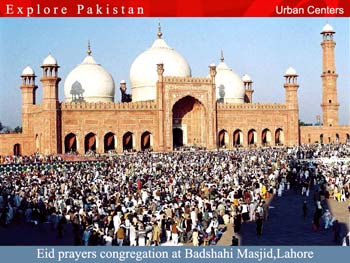
& shrines, madrassas (religious schools), tombs and mausoleums which are marked by simplicity and grandeur, with open spaces and abundance of light in accordance with the Islamic concept of man's direct and open relationship with the Creator. Pakistan inherits immense treasure of culture, and the government is trying its best to preserve and promote this cultural treasure. There are several government agencies such as Pakistan National Council of Arts,
Lok Virsa (Folk Heritage), National Film Development Corporation, Authority for Preservation of
Moenjodaro and National Archives of Pakistan, each to perform a given set of functions in this area.
FINDPK is the largest
Yellow Pages Network from Pakistan covering 256 countries of the world,
having global audiences. Our unique Worldwide Directories & Guides makes
us prominent in Worldwide Yellow Pages. We are continuously extending our
databases with aim of incorporating each and every business from a small
businesses to large industries with easy, affordable and professional
way. We welcome your
Comments & Suggestions.
Thank you for your support!