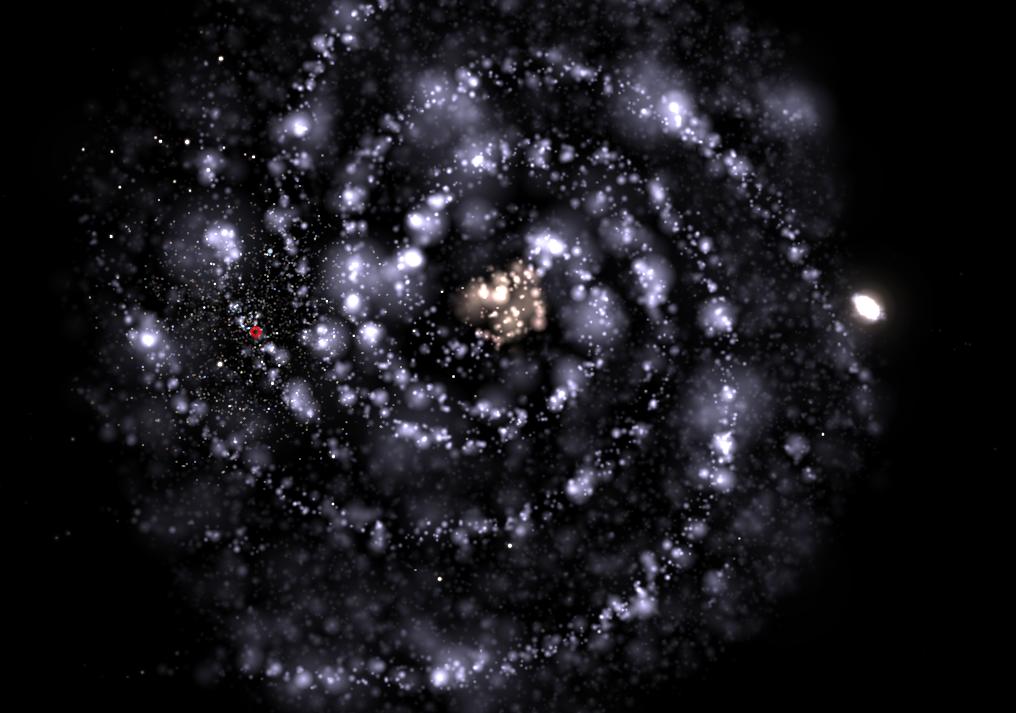
We are about 2/3rds out from the center of the Milky Way
in one of the spiral arms. Our entire
Solar System is flying through space, orbiting the
center of the galaxy at the incredible speed of over
900,000 km/hr (560,000 miles/hr). So, even
while you think you are standing still on Earth, you are
moving at very high speeds. It’s a good
thing we have Earth’s gravity holding onto us. In
fact, all the stars you see in the sky are orbiting the
Milky Way at similar speeds, like a high-speed
merry-go-round in space.
Quran: 85:1
سُوۡرَةُ البُرُوج
بِسۡمِ ٱللهِ ٱلرَّحۡمَـٰنِ ٱلرَّحِيمِ
وَٱلسَّمَآءِ ذَاتِ ٱلۡبُرُوجِ (١)
By the heaven, holding mansions of the stars, (1)
آسمان کی قسم جس میں برج ہیں (۱)
Quran: 15:16
سُوۡرَةُ الحِجر
بِسۡمِ ٱللهِ ٱلرَّحۡمَـٰنِ ٱلرَّحِيم
وَلَقَدۡ جَعَلۡنَا فِى ٱلسَّمَآءِ بُرُوجً۬ا
وَزَيَّنَّـٰهَا لِلنَّـٰظِرِينَ (١٦)
And verily in the heaven we have set mansions of the
stars, and We have beautified it for beholders. (16) ِ
اور ہم ہی نے آسمان میں برج بنائے اور دیکھنے والوں کے لیے
اُس کو سجا دیا (۱۶)
The scale
of our universe is almost beyond our capability to
understand. You will find it soon.
The size of our local Solar System is
also very difficult to grasp. Models and
sketches show the Sun and planets to be close to each
other so that you can see them all together. They
are NOT!Imagine
the Sun to be shrunk to the size of a big
beach ball sitting
on the goal line of a football field. The
Earth would be the size of a small marble,
placed at the opposite goal posts 100
yards (90 meters) away. Pluto would be a
tiny pea located 3 miles (4.7 km) away
at the other end of town. Thus, distances
between planets are a LOT bigger, and
the planets are a LOT
smaller than
you can imagine.
Quran: 16:12
سُوۡرَةُ النّحل
بِسۡمِ ٱللهِ ٱلرَّحۡمَـٰنِ ٱلرَّحِيم
وَسَخَّرَ لَڪُمُ ٱلَّيۡلَ وَٱلنَّهَارَ وَٱلشَّمۡسَ
وَٱلۡقَمَرَۖ
وَٱلنُّجُومُ مُسَخَّرَٲتُۢ بِأَمۡرِهِۦۤۗ
إِنَّ فِى ذَٲلِكَ لَأَيَـٰتٍ۬ لِّقَوۡمٍ۬ يَعۡقِلُونَ (١٢) ِ
And He hath constrained the night and the day and the
sun and the moon to be of service unto you, and the
stars are made subservient by His command. Lo! herein
indeed are portents for people who have sense. (12)
اور اسی نے تمہارے لیے رات اور دن اور سورج اور چاند کو
کام میں لگایا۔ اور اسی کے حکم سے ستارے بھی کام میں لگے
ہوئے ہیں۔ سمجھنے والوں کے لیے اس میں (قدرت خدا کی بہت
سی) نشانیاں ہیں (۱۲)
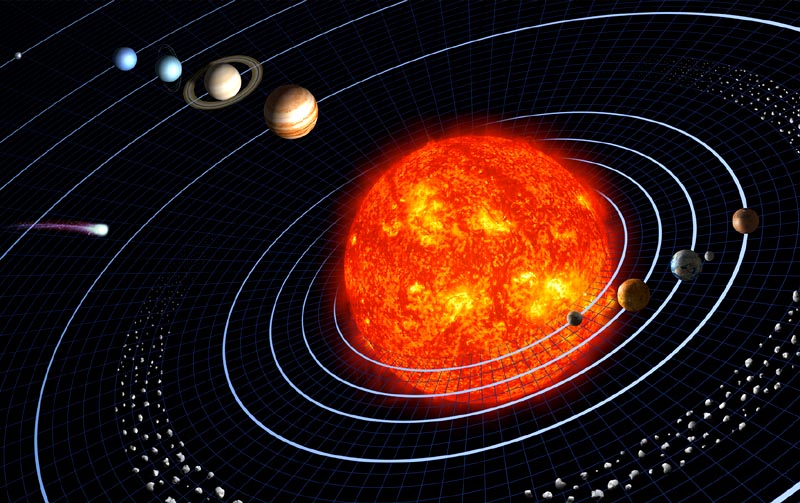
Let’s Explore Our “new” Solar System
It is laid
out in order in this scaled image. That
large yellow fireball on the left is the
Sun. Those four round objects next to it
are the inner planets (Mercury, Venus, Earth and Mars),
which we are visiting today. The new “dwarf
planet” is Ceres and the
four giant planets are next (Jupiter,
Saturn, Uranus and Neptune). The tiny
spheres on the right are the “dwarf Plutoid planets”,
Pluto, followed by Makemake and Eris. The
moons, asteroids and comets have not been added to the
graphic.
Quran: 7:54
سُوۡرَةُ الاٴعرَاف
بِسۡمِ ٱللهِ ٱلرَّحۡمَـٰنِ ٱلرَّحِيم
إِنَّ رَبَّكُمُ ٱللَّهُ ٱلَّذِى خَلَقَ ٱلسَّمَـٰوَٲتِ
وَٱلۡأَرۡضَ فِى سِتَّةِ أَيَّامٍ۬ ثُمَّ ٱسۡتَوَىٰ عَلَى
ٱلۡعَرۡشِ يُغۡشِى ٱلَّيۡلَ ٱلنَّہَارَ يَطۡلُبُهُ ۥ
حَثِيثً۬ا وَٱلشَّمۡسَ وَٱلۡقَمَرَ وَٱلنُّجُومَ
مُسَخَّرَٲتِۭ بِأَمۡرِهِۦۤۗ
أَلَا لَهُ ٱلۡخَلۡقُ وَٱلۡأَمۡرُۗ
تَبَارَكَ ٱللَّهُ رَبُّ ٱلۡعَـٰلَمِينَ (٥٤) ِ
Al-Araf 7:54
In the name of Allah, the Beneficent, the Merciful
Lo! your Lord is Allah Who created the heavens and the
earth in six Days, then mounted He the Throne. He
covereth the night with the day, which is in haste
to follow it, and hath made the sun and
the moon and the stars subservient by His command.
His verily is all creation and commandment. Blessed be
Allah, the
Lord of the Worlds! (54)
سورة الاٴعرَاف
شروع الله کے نام سے جو بڑا مہربان نہایت رحم والا ہے
کچھ شک نہیں کہ تمہارا پروردگار خدا ہی ہے جس نے آسمانوں
اور زمین کو چھ دن میں پیدا کیا پھر عرش پر جا ٹھہرا۔ وہی
رات کو دن کا لباس پہناتا ہے کہ وہ اس کے پیچھے دوڑتا چلا
آتا ہے۔ اور اسی نے سورج اور چاند ستاروں کو پیدا کیا سب
اس کے حکم کے مطابق کام میں لگے ہوئے ہیں۔ دیکھو سب مخلوق
بھی اسی کی ہے اور حکم بھی (اسی کا ہے)۔
یہ خدا رب العالمین بڑی برکت والا ہے
(۵۴)
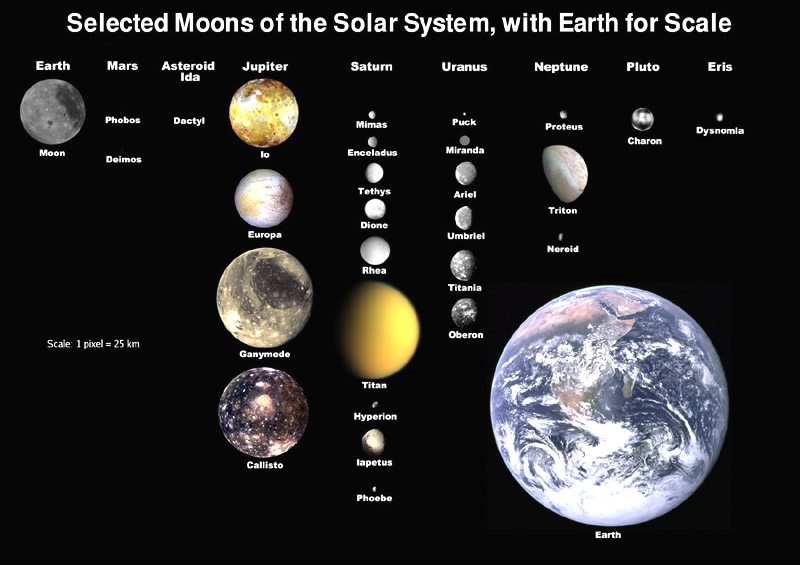
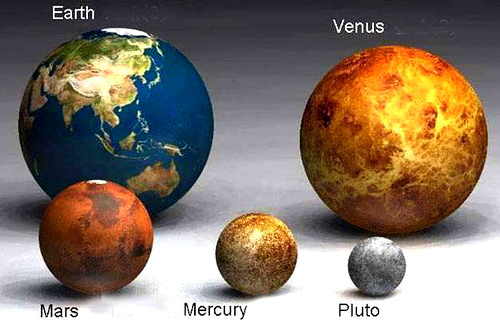
Let’s compare the size of the earth with Moons & other Planets
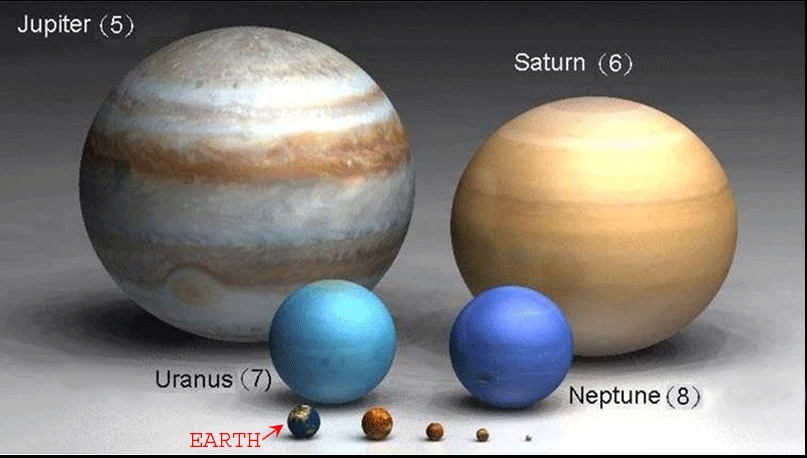
Now compare it with Uranus & Neptune
Now Earth against Sun
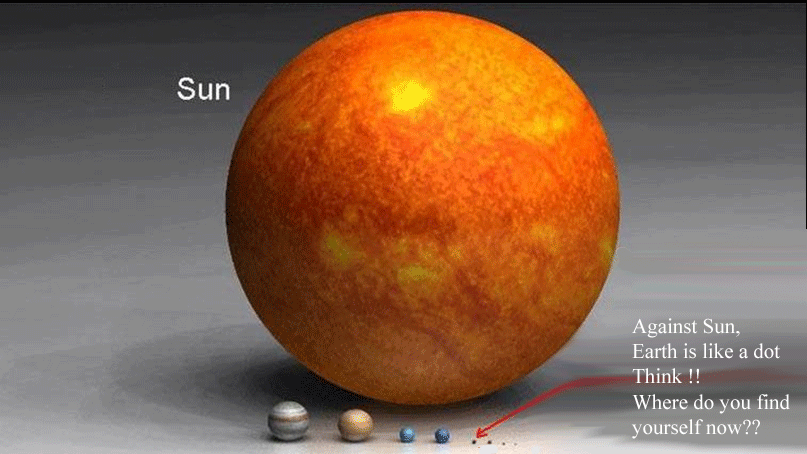
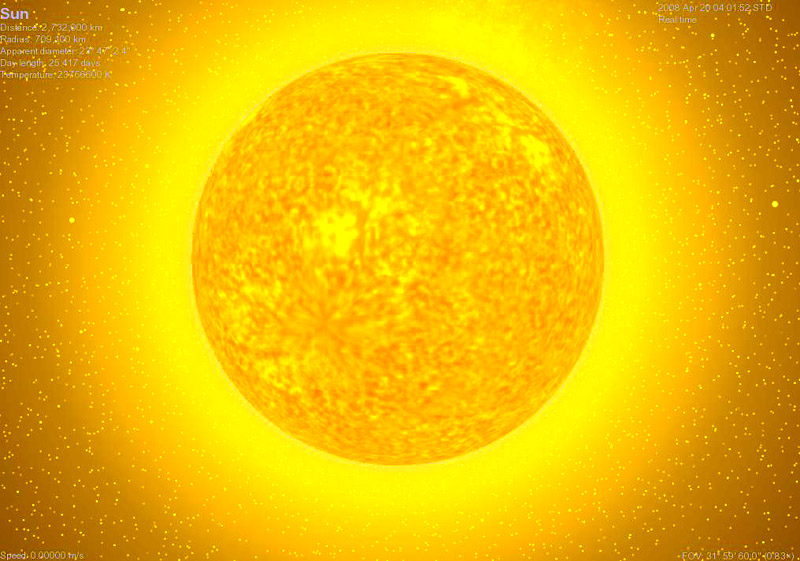
Sun
Our giant
Sun is very active and violent as we will see shortly,
but it is actually quite an ordinary yellowish star that
we call a main sequence yellow
dwarf star. If you look out into space,
many of the other stars out there are a lot like our Sun
Compared
to what we are familiar with, the sun is massively
large. It contains 99.9% of all the mass
of the Solar System and its diameter is approximately 860,000
miles (1,390,000 km). That
is over 100 times bigger than
the 8,000-mile diameter of Earth. 108
Earths could fit side by side across
the Sun.
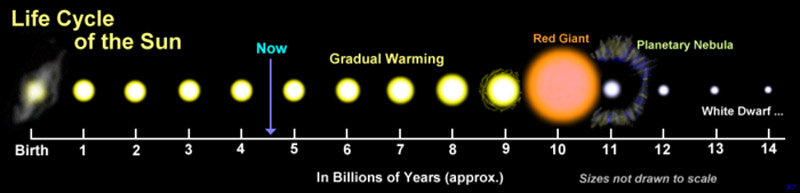
It was born almost 5
billion years ago as
gravity pulled nebula space
gases and dust together into a huge ball. Most
of that matter consisted of hydrogen atoms. Through
gravity, that sphere of gas was compressed so tightly
and got so hot that the hydrogen atoms in the central
core began to fuse together. This nuclear
hydrogen fusion is
the same kind of explosion as a hydrogen
bomb.
Watch the Close up Video of Sun:
http://www.youtube.com/watch?v=CsLzZYEB9hY
Quran: 10:5-6
سُوۡرَةُ یُونس
بِسۡمِ ٱللهِ ٱلرَّحۡمَـٰنِ ٱلرَّحِيمِ
هُوَ ٱلَّذِى جَعَلَ ٱلشَّمۡسَ ضِيَآءً۬ وَٱلۡقَمَرَ
نُورً۬ا وَقَدَّرَهُ ۥ مَنَازِلَ لِتَعۡلَمُواْ عَدَدَ
ٱلسِّنِينَ وَٱلۡحِسَابَۚ
مَا خَلَقَ ٱللَّهُ ذَٲلِكَ إِلَّا بِٱلۡحَقِّۚ
يُفَصِّلُ ٱلۡأَيَـٰتِ لِقَوۡمٍ۬ يَعۡلَمُونَ (٥)
إِنَّ فِى ٱخۡتِلَـٰفِ ٱلَّيۡلِ وَٱلنَّہَارِ وَمَا خَلَقَ
ٱللَّهُ فِى ٱلسَّمَـٰوَٲتِ وَٱلۡأَرۡضِ لَأَيَـٰتٍ۬
لِّقَوۡمٍ۬ يَتَّقُونَ (٦)
It is He who made the sun a shining light and the moon a
derived light and determined for it phases – that you
may know the number of years and account [of time].
Allah has not created this except in truth. He details
the signs for a people who know. Lo! in the difference
of day and night and all that Allah hath created in the
heavens and the earth are portents, verily, for folk who
ward off (evil). (6)
وہی تو ہے جس نے سورج کو روشن اور چاند کو منور بنایا اور
چاند کی منزلیں مقرر کیں تاکہ تم برسوں کا شمار اور (کاموں
کا) حساب معلوم کرو۔ یہ (سب کچھ) خدا نے تدبیر سے پیدا کیا
ہے۔ سمجھنے والوں کے لیے وہ اپنی آیاتیں کھول کھول کر بیان
فرماتا ہے (۵)
رات اور دن کے (ایک دوسرے کے پیچھے) آنے جانے میں اور جو
چیزیں خدا نے آسمان اور زمین میں پیدا کی ہیں (سب میں)
ڈرنے والوں کے لیے نشانیاں ہیں (۶)
In fact, the Sun (and all stars that we can see) is
exploding internally, with billions of H-bomb type
explosions going off every second in its central core. This
results in enormous radiation energy and heat pouring
out of the Sun at the speed of light,
spreading through space in all directions.
Notice
some dark orange/brown spots on the Sun? They
are sunspots,
giant storms of magnetic
disturbance where
flares and prominences (eruptions) tend to occur often. They
are something like whirlpools on Earth. They
are darker in color than the rest of the Sun because
they are actually a bit cooler in temperature than their
surroundings.
The number of these storms depends upon the Sun’s
magnetic field. They come and go in cycles every
11 years. When
sunspots are at their maximum number, there may be over
a hundred individual storms raging on the Sun at one
time. Incredibly, even the small spots are
larger than Earth. The
big ones could envelop 10 Earths.
Some of the radiation is deadly and can kill us
instantly. Fortunately, Earth’s atmosphere
protects us from most of it. Some
radiation is good. The Sun’s heat is a
form of radiation that strikes all of the planets and
moons of the Solar System and warms them by different
amounts. Life
on Earth is possible because of it.
Quran: 21:
32
سُوۡرَةُ الاٴنبیَاء
بِسۡمِ ٱللهِ ٱلرَّحۡمَـٰنِ ٱلرَّحِيمِ
وَجَعَلۡنَا ٱلسَّمَآءَ سَقۡفً۬ا مَّحۡفُوظً۬اۖ
وَهُمۡ عَنۡ ءَايَـٰتِہَا مُعۡرِضُونَ (٣٢)
And we have made the sky a roof withheld (from them).
Yet they turn away from its portents. (32)
اور آسمان کو محفوظ چھت بنایا۔ اس پر بھی وہ ہماری نشانیوں
سے منہ پھیر رہے ہیں (۳۲)
Even
though it is exploding, the Sun does not blast out into
space like a firecracker going off inside a ball of
Jell-O. The reason is gravity. Although it is blowing
outward, gravity is grabbing those exploding gases and
is pulling most of them back in as soon as they try to
leave… keeping the Sun at a controlled, sustained size.
This tug-of-war goes on year after year, century after
century. It has been going on for 5 billion years, and
will continue for over 5 billion more years and will
blast as a supernova.
سُوۡرَةُ التّکویر
بِسۡمِ ٱللهِ ٱلرَّحۡمَـٰنِ ٱلرَّحِيمِ
إِذَا ٱلشَّمۡسُ كُوِّرَتۡ (١)
وَإِذَا ٱلنُّجُومُ ٱنكَدَرَتۡ (٢)
When the sun is overthrown, (1) And when the stars fall,
(2)
جب سورج لپیٹ لیا جائے گا (۱)
جب تارے بےنور ہو جائیں گے
Quran: 13-2
سُوۡرَةُ الرّعد
بِسۡمِ ٱللهِ ٱلرَّحۡمَـٰنِ ٱلرَّحِيم
ٱللَّهُ ٱلَّذِى رَفَعَ ٱلسَّمَـٰوَٲتِ بِغَيۡرِ عَمَدٍ۬
تَرَوۡنَہَاۖ
ثُمَّ ٱسۡتَوَىٰ عَلَى ٱلۡعَرۡشِۖ
وَسَخَّرَ ٱلشَّمۡسَ وَٱلۡقَمَرَۖ
كُلٌّ۬ يَجۡرِى لِأَجَلٍ۬ مُّسَمًّ۬ىۚ
يُدَبِّرُ ٱلۡأَمۡرَ يُفَصِّلُ ٱلۡأَيَـٰتِ لَعَلَّكُم
بِلِقَآءِ رَبِّكُمۡ تُوقِنُونَ (٢) ِ
13:2 It is Allah who erected the heavens without pillars
that you [can] see; then He established Himself above
the Throne and made subject the sun and
the moon, each
running [its course] for a specified term. He
arranges [each] matter; He details the signs that you
may, of the meeting with your Lord, be certain.
خدا وہی تو ہے جس نے ستونوں کے بغیر آسمان جیسا کہ تم
دیکھتے ہو (اتنے) اونچے بنائے۔ پھر عرش پر جا ٹھہرا اور
سورج اور چاند کو کام میں لگا دیا۔ ہر
ایک ایک میعاد معین تک گردش کر رہا ہے۔ وہی (دنیا
کے) کاموں کا انتظام کرتا ہے (اس طرح) وہ اپنی آیتیں کھول
کھول کر بیان کرتا ہے کہ تم اپنے پروردگار کے روبرو جانے
کا یقین کرو (۲)
As the Sun
explodes internally, some of that energy causes its
surface to erupt in periodic explosions of very hot gas. The
guiding force behind these eruptions is magnetism (the
Sun is very magnetically charged). These
eruptions are called “Prominences”. They
form loops on the Sun due to both gravity and magnetism.
The sun’s lower atmosphere, called the Chromospheres WHEW!
Sometimes,
the eruption is so strong that the exploded material
does not loop back to the Sun. Instead, it
rockets out into space at 1 to 2 million
km/hr. Eruptions that escape into
space are called Solar Flares, or
Coronal mass Ejections.
Watch the Close up Video of
Sun:
http://www.youtube.com/watch?v=CsLzZYEB9hY
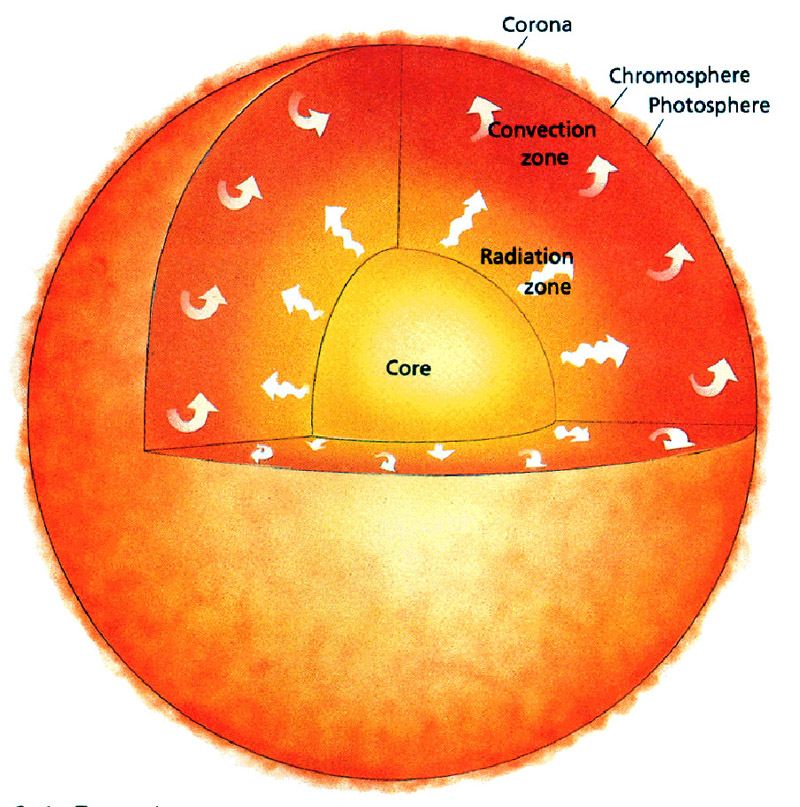
The explosions of hydrogen fusion occurring
inside the Sun take place in its CORE. Surrounding
the core is a large area of hot hydrogen gas called the Radiation
Zone. Surrounding that zone is another
layer called the Convection Zone. The
top of that zone is the surface of
the Sun, and is called the Photosphere.
Diagram of the layers of the Sun. Your
teacher may provide you much more detail on these
layers. If you are internet connected and
have the time, many different websites describe the Sun
in more detail.
Surprisingly, however,
the surface of the Sun is not that hot. Because
it is far from the 25 millionº central
core and is exposed to the cold of space, the “surface”
temperature of the Sun is only about 12,000
° F (6600º C). That is only about 20
times hotter than your kitchen oven on broil.
Speed
of light (abbreviated “c”). It
is a whopping 300,000 km/s (186,000
miles/sec). If you were a ray of
sunlight, you would leave the Sun at this speed. Nothing
in the universe can travel faster than the speed of
light.
It is the
ultimate speed limit. The reasons are very
complicated. However, even at light speed,
it will still take you about 8 minutes
to reach Earth. You have to think “Faster
than Light (FTL)”.
If you were a ray of sunlight from our Sun, you would be
headed directly ahead into that dark void of space
filled with stars. Isaac Newton’s 1st Law
of Motion tells us that unless you collided
with something in your path, you would continue the
journey straight ahead at light speed, essentially
forever. ven at this incredible speed, you
would have to travel for … over 4.3 years,
24 hours a day, without sleep, before you would come
close to the very nearest star Proxima Centauri you
can see in front of you. The Sun itself
would be just a tiny dim dot in space, lost behind you
among all the other stars. Imagine
spending 70 years of your life just waiting to reach …
the very next star in front of you. Space
is such a very BIG place.
One (1)
ly = 9.46 x 10¹² km, or 5.87 x
1012 miles.
That is 9.46 trillion km
(5.87 trillion miles). Obviously, that is a stupendous number.
Written out, it is 9,460,000,000,000 km or 5,870,000,000,000
mi.
Please
remember from the prior journey in past that the fastest
speed ever achieved by human beings was 11
km/sec, the speed attained by the Apollo spacecraft.
Well, how
many days, weeks, months or years would it take Apollo (or
you) to reach the nearest star to Earth
(aside from our own sun)? To calculate it, we
first have to determine how far away the star is from us
in kilometers. That’s easy. Proxima
Centauri is about 4.23
LY away, and 1 LY =
9.46 x 10¹² km. So,
the star is 4.23 x (9.46 x 1012)
= 4.0 x 10¹³ km (40
trillion kilometers) (in miles, that’s
24.7 trillion miles (2.5 x 10¹³ miles)).
Now, just divide the distance to the star in
km by 11 km/sec (the
speed of Apollo), and you’ll find the time it would take
to get there in seconds.
Convert that to years (I’ll
leave that to you).
You should
have discovered that to reach the nearest star to us at
the fastest speed ever achieved by people, would
take you … over 115,000 years!
That is almost 6,000 generations … of
your children, and grandchildren, and great
grandchildren, and their children’s children’s
children’s children … watching out your ship’s front
window … living and dying … century after century,
millennia after millennia. 115,000
years … just to reach the closest star
to us. That is 20 times longer than all
of human recorded history, back to the days of our most
ancient civilizations … 20 times longer!
If you left Earth at the time of the ancient Greeks
4,000 years ago, you would only be less than 4% of
the way to the star by now.
سُوۡرَةُ المُلک
بِسۡمِ ٱللهِ ٱلرَّحۡمَـٰنِ ٱلرَّحِيم
تَبَـٰرَكَ ٱلَّذِى بِيَدِهِ ٱلۡمُلۡكُ وَهُوَ عَلَىٰ
كُلِّ شَىۡءٍ۬ قَدِيرٌ (١)
ٱلَّذِى خَلَقَ ٱلۡمَوۡتَ وَٱلۡحَيَوٰةَ لِيَبۡلُوَكُمۡ
أَيُّكُمۡ أَحۡسَنُ عَمَلاً۬ۚ
وَهُوَ ٱلۡعَزِيزُ ٱلۡغَفُورُ (٢)
ٱلَّذِى خَلَقَ سَبۡعَ سَمَـٰوَٲتٍ۬ طِبَاقً۬اۖ
مَّا تَرَىٰ فِى خَلۡقِ ٱلرَّحۡمَـٰنِ مِن تَفَـٰوُتٍ۬ۖ
فَٱرۡجِعِ ٱلۡبَصَرَ هَلۡ تَرَىٰ مِن فُطُورٍ۬ (٣)
ثُمَّ ٱرۡجِعِ ٱلۡبَصَرَ كَرَّتَيۡنِ يَنقَلِبۡ إِلَيۡكَ
ٱلۡبَصَرُ خَاسِئً۬ا وَهُوَ حَسِيرٌ۬ (٤)
وَلَقَدۡ زَيَّنَّا ٱلسَّمَآءَ ٱلدُّنۡيَا بِمَصَـٰبِيحَ
وَجَعَلۡنَـٰهَا رُجُومً۬ا لِّلشَّيَـٰطِينِۖ
وَأَعۡتَدۡنَا لَهُمۡ عَذَابَ ٱلسَّعِيرِ (٥) ِ
Blessed is He in Whose hand is the Sovereignty, and, He
is Able to do all things. (1) Who hath created life and
death that He may try you which of you is best in
conduct; and He is the Mighty, the Forgiving, (2) Who
hath created seven heavens in harmony. Thou canst see no
fault in the Beneficent One's creation; then look again:
Canst thou see any rifts? (3) Then look again and yet
again, thy sight will return unto thee weakened and made
dim. (4) And verily We have
beautified the world's heaven with lamps, and We have
made them missiles for the devils, and for them We have
prepared the doom of flame. (5)
وہ (خدا) جس کے ہاتھ میں بادشاہی ہے بڑی برکت والا ہے۔ اور
وہ ہر چیز پر قادر ہے (۱)
اسی نے موت اور زندگی کو پیدا کیا تاکہ تمہاری آزمائش کرے
کہ تم میں کون اچھے عمل کرتا ہے۔ اور وہ زبردست (اور)
بخشنے والا ہے (۲) اس
نے سات آسمان اوپر تلے بنائے۔ (اے دیکھنے والے) کیا تو
(خدا) رحمٰن کی آفرنیش میں کچھ نقص دیکھتا ہے؟ ذرا آنکھ
اٹھا کر دیکھ بھلا تجھ کو (آسمان میں) کوئی شکاف نظر آتا
ہے؟ (۳)
پھر دو بارہ (سہ بارہ) نظر کر، تو نظر (ہر بار) تیرے پاس
ناکام اور تھک کر لوٹ آئے گی (۴)اور
ہم نے قریب کے آسمان کو (تاروں کے) چراغوں سے زینت دی۔ اور
ان کو شیطان کے مارنے کا آلہ بنایا اور ان کے لئے دہکتی آگ
کا عذاب تیار کر رکھا ہے (۵)
Read the Article: How
Big is Our Universe?
Mercury
Mercury is 0.489
au from your position near the
Sun. An AU is
an abbreviation for “Astronomical Unit”, which is
a distance measurement Astronomers use to describe huge
distances in space. It is defined as the
distance from the Earth to the Sun. That
distance (1 au) = 150,000,000 km, or
about 93,000,000 miles. Since
Mercury is 0.489 au from our position, it is 150,000,000
x 0.489 = 73,350,000 km, or about 45.6
million miles away.
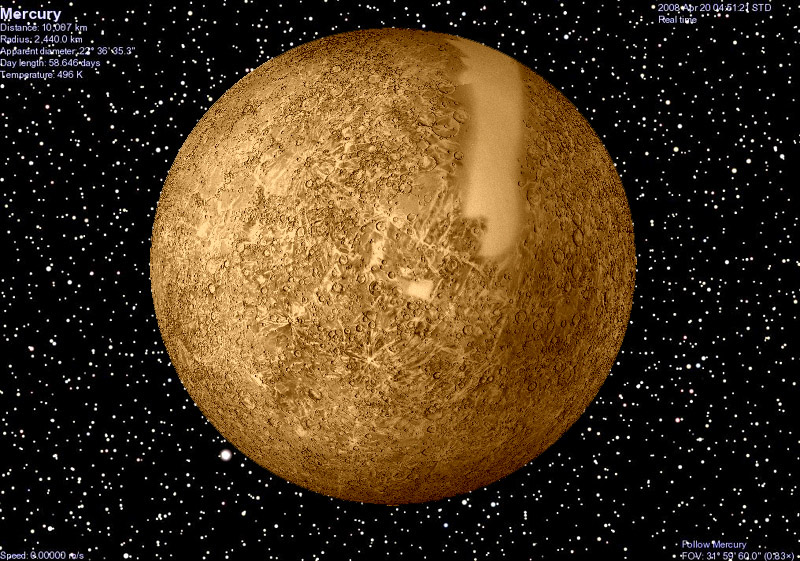
 Mercury
is a very old world that formed 4.6
billion years ago, along with the rest of our Solar
System. As you can see, it looks a lot
like our Moon. To the best of our
knowledge, it is a dead, small and rocky world. It
is the closest planet to the Sun.
Mercury
is a very old world that formed 4.6
billion years ago, along with the rest of our Solar
System. As you can see, it looks a lot
like our Moon. To the best of our
knowledge, it is a dead, small and rocky world. It
is the closest planet to the Sun.
Mercury is called a terrestrial planet
because it is made
primarily of rock. Scientists
believe it formed from the original nebula that the rest
of the Solar System formed from. Its
closeness to the Sun, however, forced any lighter
elements and gases that might have been near it to be
driven away by the Sun’s fierce radiation, pushed away
by the “solar
wind”. Mercury
is also a small planet and its gravity is relatively
weak. Consequently, Mercury has no real
atmosphere of gas to call its own.
However, there is something unusual about Mercury. It
is very dense. Its
rocks are heavier than any other planet. That
is probably due to the fact that its closeness to the
Sun’s heat drove the lighter, more volatile elements
away from it, allowing only the heavy elements to
collect near it and form into a planet. Another
possibility is that Mercury underwent a colossal
collision with another planet eons ago, with the dense
cores of the collision all that is remaining.
If true,
then Mercury is much like Earth. Evidence
suggests that Earth also experienced a colossal
collision with a planet some 4.4 billion years ago. The
result was the formation of a “new” Earth … and our
moon.
Mercury is
close enough to our Sun to get very hot on
its sunny side (over 360° C or 680° F). It is
hotter than the interior of your oven on broil. Because
Mercury has no atmosphere, however, the heat from the
Sun cannot circulate around the planet to help spread
its heat (it just re-radiates back into space). So
while it is a scorching oven on its sunny side, it cools
very quickly and becomes very cold on its dark night
side, plunging to temperatures as low as -160°
C or -250° F.
As you can see, Mercury is tortured and cracked, and
there are hills and cliffs. Mercury’s surface is also
full of holes. They are impact
craters, caused
by asteroids (space
rocks) crashing
into the surface at high speed. Many
craters are very old, having formed from impacts
billions of years ago. If the impact was
large, it triggered lava flows that filled in some of
the other craters, creating “plains”
(planita in Latin).
Mercury has no air or liquid water on its surface so
there is nothing to erode, flood, blow sand into or fill
in the craters. They still look like they
did billions of years ago.
Although Mercury turns slowly, it travels through space
very fast. In fact, it is circling
the Sun once every 88 days (orbiting)
at a speed of almost 50
km/sec (31 miles/sec). Picture
it! If it flew close overhead and you were
standing on Earth, it would whiz by from one horizon to
the other in less than 1 second. Mercury’s
name in fact is based upon a Roman and Greek God that
was the fast messenger of all the Gods.
There is no God, But Allah.
Quran: 21:21-22
سُوۡرَةُ الاٴنبیَاء
بِسۡمِ ٱللهِ ٱلرَّحۡمَـٰنِ ٱلرَّحِيمِ
أَمِ ٱتَّخَذُوٓاْ ءَالِهَةً۬ مِّنَ ٱلۡأَرۡضِ هُمۡ
يُنشِرُونَ (٢١)
لَوۡ كَانَ فِيہِمَآ ءَالِهَةٌ إِلَّا ٱللَّهُ
لَفَسَدَتَاۚ
فَسُبۡحَـٰنَ ٱللَّهِ رَبِّ ٱلۡعَرۡشِ عَمَّا يَصِفُونَ (٢٢)
If there were therein Gods beside Allah, then verily
both (the heavens and the earth) had been disordered.
Glorified be Allah, the Lord of the Throne, from all
that they ascribe (unto Him). (22)
سورة الاٴنبیَاء
شروع الله کے نام سے جو بڑا مہربان نہایت رحم والا ہے
اگر آسمان اور زمین میں خدا کے سوا اور معبود ہوتے تو زمین
وآسمان درہم برہم ہوجاتے۔ جو باتیں یہ لوگ بتاتے ہیں خدائے
مالک عرش ان سے پاک ہے (۲۲)
When all
the planets formed as a Solar System, Mercury formed
alone and has no moons.
Venus
Venus is very attractive from orbit, don’t you think. What
is it really like?
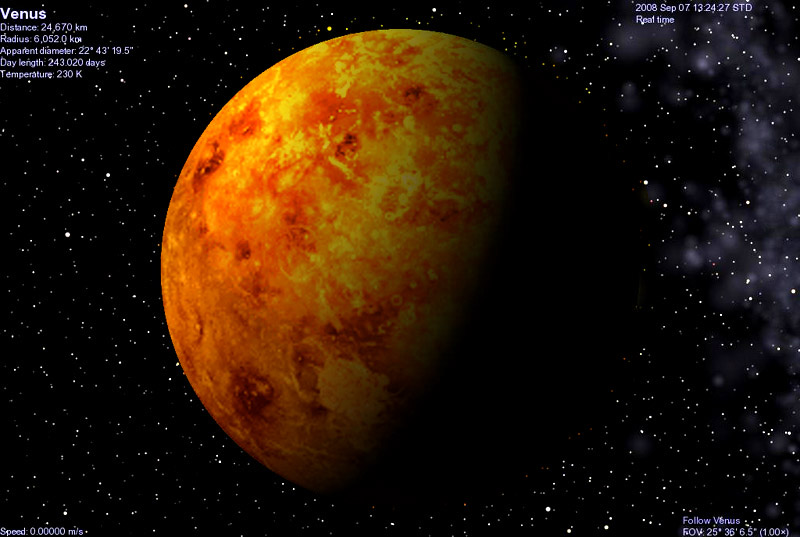
Venus, named after the goddess of love and beauty in
Greek and Roman mythology, is about
the same size as Earth. It formed from the
same nebula as the rest of the Solar System 4.6 billion
years ago and is also a “terrestrial” planet (made
mostly of rock). It is the brightest object in the night
sky aside from the Moon.
It has a thick atmosphere and dense clouds, so many
people at the beginning of the 20th century
thought it might rain there. Because it is
closer to the Sun, astronomers also thought that it
might be nice and warm, and a possible home to “life” in
a hot, rainy tropical setting. There was
even hope that maybe there were Venusians plants and
animals.
Well, that dream was completely abandoned in the middle
of the 20th century when the United
States and Soviet
Union both sent spacecraft to
examine Venus. What we found was not a
warm tropical world, but a broiling
hellish world
roasting at a temperature of 480°
C (900° F). This
is almost twice as hot as your oven on boil, so anything
you set on the surface of Venus would cook and char very
fast (a burger would turn black in less than 20
seconds). Venus is the hottest
object in the entire Solar System,
aside from the Sun itself. It is even
hotter than Mercury. It is so hot that if
you put a chunk of solid lead on its surface, the lead
would melt and liquefy into a hot puddle.
The atmospheric pressure on
the surface of the planet is 90 times
thicker and heavier than it is on Earth. Its
air weighs about what 10 fully loaded 18-wheel trucks
would weigh, stacked one on top of the other, all
sitting on your chest. Were you to land on
Venus and step out of your spacecraft, you would be
crushed instantly into a flat puddle by the weight of
its air. The 900o F
heat would then boil and char your remains!
Venus’s super-dense atmosphere is made of about 96%
CO2. The CO2 came
from volcanoes that were very active for billions of
years in the past, but do not appear to be active now.
Carbon Dioxide is a gas that has a
particular ability to absorb heat. The
more CO2 present, the hotter the
air gets. The effect is known as the Greenhouse
effect, (Warming
that results when solar radiation is trapped by the
atmosphere; caused by atmospheric gases that allow
sunshine to pass through but absorb heat that is
radiated back from the warmed surface of the earth) because
CO2 acts like the glass on a
greenhouse. The Sun’s heat can get in but
has a difficult time leaking back out again into space
at night. This results in a chokingly hot,
heavy blanket of gas that shrouds and wraps the planet
like insulation, causing it to heat up as sunlight
shines on it.
Because Venus is closer to the sun, it also gets more
heat than Earth. As a result, it has a runaway
greenhouse effect, an
effect so severe that the planet is hot enough to melt
lead.
If crushing atmosphere and broiling heat were not bad
enough, Venus has no breathable oxygen, no
surface water and no water clouds. Instead,
its clouds
are made of concentrated sulfuric acid droplets,
a mist strong enough to burn your skin. The
sulfur also came from volcanic eruptions long ago. The
acid clouds are so thick that you cannot see the surface
of Venus from space and you cannot see space from Venus. There
is no such thing as a starry night on Venus, and there
has not been for millions of years.
We think Venus once had traces of water and
was not unlike Earth. What
happened to it to turn it into the hellishly hot planet
it is now? We need to answer that question
because we are also changing our planet. Earth
is becoming more like Venus every day. We
are pumping enormous quantities of Carbon
Dioxide into our atmosphere from the
burning of oil, gasoline and coal, creating our own
greenhouse effect. As a result, our planet
is warming up. The years 2003, 2004 and
2005 were the warmest years ever recorded in all of
human history. Our
polar ice caps and mountain glaciers are melting. The
oceans are warming and coral reefs are dying. Drought
is beginning in some areas. Ferocious
hurricanes born in warmer oceans are becoming much more
frequent.
It is called Global
Warming
and it has many people very worried. It
may become the greatest threat to humans in all of our
history.
If we keep
it up, our planet will continue to warm. Could
we someday begin to resemble Venus? The
answer is probably no. We would not
get that hot. However, we could pump so
much CO2 into the air that Earth
warms up to levels that will make it tough to survive. Remember,
we don’t have to warm to 900° F to ruin our garden world. Just
a 10° rise will do it! In fact,
an estimate by scientists in 2007 stated that fully
half of all species on Earth may become extinct by the
end of this century if we do not get
global warming under control soon what
a catastrophe that could be.
You can discover two fascinating things about Venus’s
rotation.
First, it
is very slow. It
takes the planet a whopping 243
days to
turn just once on its axis, making for a VERY
LONG day
and a very long night.
Secondly, Venus
turns on its axis backwards (from
right to left). This is called retrograde rotation, and
is different from most of the other planets in our Solar
System. Most
are like the Sun and turn from left to right (called prograde rotation)
Retrograde rotation can
occur two ways. First, Venus may have
collided long ago with another planet or large moon,
knocking it over and resulting in it rotating
“backward”. Scientists also believe that
planets without moons orbiting them have unstable
rotations. Venus
has NO moons. As
they turn on their axis, such planets can wobble. Over
thousands of years, that wobble can force the planet to
flip upside down. Planets with moons tend
to be more stable in their rotation axis, because the moon’s
gravity helps to stabilize their spin. Earth,
for example, has a large moon that keeps our axis from
wobbling very much.
As the 2nd planet
from the sun, Venus orbits the Sun once every 225
days.
Quran: 31:20
سُوۡرَةُ لقمَان
بِسۡمِ ٱللهِ ٱلرَّحۡمَـٰنِ ٱلرَّحِيم
أَلَمۡ تَرَوۡاْ أَنَّ ٱللَّهَ سَخَّرَ لَكُم مَّا فِى
ٱلسَّمَـٰوَٲتِ وَمَا فِى ٱلۡأَرۡضِ وَأَسۡبَغَ عَلَيۡكُمۡ
نِعَمَهُ ۥ ظَـٰهِرَةً۬ وَبَاطِنَةً۬ۗ
وَمِنَ ٱلنَّاسِ مَن يُجَـٰدِلُ فِى ٱللَّهِ بِغَيۡرِ
عِلۡمٍ۬ وَلَا هُدً۬ى وَلَا كِتَـٰبٍ۬ مُّنِيرٍ۬ (٢٠) ِ
See ye not how Allah hath made serviceable unto you
whatsoever is in the skies and whatsoever is in the
earth and hath loaded you with His favours both without
and within? Yet of mankind is he who disputeth
concerning Allah, without knowledge or guidance or a
scripture giving light. (20)
کیا تم نے نہیں دیکھا کہ جو کچھ آسمانوں میں اور جو کچھ
زمین میں ہے سب کو خدا نے تمہارے قابو میں کر دیا ہے اور
تم پر اپنی ظاہری اور باطنی نعمتیں پوری کردی ہیں۔ اور بعض
لوگ ایسے ہیں کہ خدا کے بارے میں جھگڑتے ہیں نہ علم رکھتے
ہیں اور نہ ہدایت اور نہ کتاب روشن (۲۰)
Earth
For much of human history, people have dreamed of seeing
the Earth from space. You are about to
live that dream.
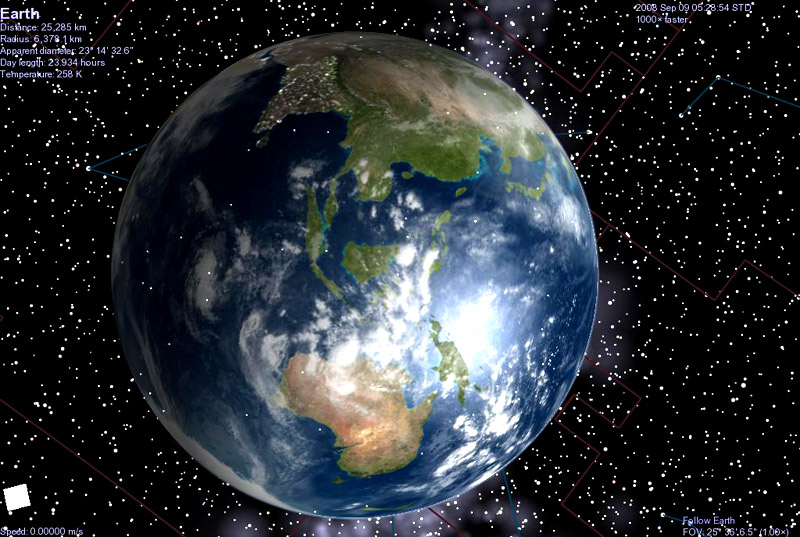
What a lonely place we occupy in space … a tiny speck of
life in such a vast ocean of stars. How
insignificant is humankind against the vista of the
universe!
Quran: 21:31-33
سُوۡرَةُ الاٴنبیَاء
بِسۡمِ ٱللهِ ٱلرَّحۡمَـٰنِ ٱلرَّحِيمِ
وَجَعَلۡنَا فِى ٱلۡأَرۡضِ رَوَٲسِىَ أَن تَمِيدَ بِهِمۡ
وَجَعَلۡنَا فِيہَا فِجَاجً۬ا سُبُلاً۬ لَّعَلَّهُمۡ
يَہۡتَدُونَ (٣١)
وَجَعَلۡنَا ٱلسَّمَآءَ سَقۡفً۬ا مَّحۡفُوظً۬اۖ
وَهُمۡ عَنۡ ءَايَـٰتِہَا مُعۡرِضُونَ (٣٢)
وَهُوَ ٱلَّذِى خَلَقَ ٱلَّيۡلَ وَٱلنَّہَارَ وَٱلشَّمۡسَ
وَٱلۡقَمَرَۖ كُلٌّ۬
فِى فَلَكٍ۬ يَسۡبَحُونَ (٣٣)
And We have placed in the earth firm hills lest it quake
with them, and We have placed therein ravines as roads
that haply they may find their way. (31) And we have
made the sky a roof withheld (from them). Yet they turn
away from its portents. (32) And He it is Who created
the night and the day, and the sun and the moon. They
float, each in an orbit. (33)
اور ہم نے زمین میں پہاڑ بنائے تاکہ لوگوں (کے بوجھ) سے
ہلنے (اور جھکنے) نہ لگے اور اس میں کشادہ راستے بنائے
تاکہ لوگ ان پر چلیں (۳۱)
اور آسمان کو محفوظ چھت بنایا۔ اس پر بھی وہ ہماری نشانیوں
سے منہ پھیر رہے ہیں (۳۲)
اور وہی تو ہے جس نے رات اور دن اور سورج اور چاند کو
بنایا۔ سب آسمان میں تیر رہے ہیں (۳۳)
 The
Earth also formed over 4.6
billion years ago as
part of our Solar System. When it was very
young, it
was hot with thousands of volcanoes erupting millions of
tons of lava. The
atmosphere was an un-breathable mix
of nitrogen, carbon dioxide, water vapor, sulfide gases,
methane and ammonia. The
sky was yellowish red and
the rain had the acidity of lemon juice. Although
there was water on the ground, it took many thousands of
years for the oceans to fill in. Volcanoes
and lava were everywhere. There
was no life.
The
Earth also formed over 4.6
billion years ago as
part of our Solar System. When it was very
young, it
was hot with thousands of volcanoes erupting millions of
tons of lava. The
atmosphere was an un-breathable mix
of nitrogen, carbon dioxide, water vapor, sulfide gases,
methane and ammonia. The
sky was yellowish red and
the rain had the acidity of lemon juice. Although
there was water on the ground, it took many thousands of
years for the oceans to fill in. Volcanoes
and lava were everywhere. There
was no life.
سُوۡرَةُ الحِجر
بِسۡمِ ٱللهِ ٱلرَّحۡمَـٰنِ ٱلرَّحِيمِ
وَأَرۡسَلۡنَا ٱلرِّيَـٰحَ لَوَٲقِحَ فَأَنزَلۡنَا مِنَ
ٱلسَّمَآءِ مَآءً۬ فَأَسۡقَيۡنَـٰكُمُوهُ وَمَآ أَنتُمۡ
لَهُ ۥ بِخَـٰزِنِينَ (٢٢)
وَإِنَّا لَنَحۡنُ نُحۡىِۦ وَنُمِيتُ وَنَحۡنُ
ٱلۡوَٲرِثُونَ (٢٣)
Al-Hijr 15: 22-23
In the name of Allah, the Beneficent, the Merciful
) And We send the winds fertilising, and cause water to
descend from the sky, and give it you to drink. It is
not ye who are the holders of the store thereof. (22)
Lo! and it is We, even We, Who quicken and give death,
and We are the Inheritor. (23)
اور ہم ہی ہوائیں چلاتے ہیں (جو بادلوں کے پانی سے) بھری
ہوئی ہوتی ہیں اور ہم ہی آسمان سے مینہ برساتے ہیں اور ہم
ہی تم کو اس کا پانی پلاتے ہیں اور تم تو اس کا خرانہ نہیں
رکھتے (۲۲)
اور ہم ہی حیات بخشتے اور ہم ہی موت دیتے ہیں۔ اور ہم سب
کے وارث (مالک) ہیں (۲۳)
Today of course, Earth
is the home and cradle of millions of species of living
things. What
makes life possible in part is that Earth occupies a
position in our Solar System called the Zone
of Habitation. It
is a section of space not
too close and not too far away from the Sun’s heat where liquid
water can
exist for at least a part of a year. Liquid
water covers
70% of the planet.
سُوۡرَةُ الشُّعَرَاء
بِسۡمِ ٱللهِ ٱلرَّحۡمَـٰنِ ٱلرَّحِيم
أَوَلَمۡ يَرَوۡاْ إِلَى ٱلۡأَرۡضِ كَمۡ أَنۢبَتۡنَا
فِيہَا مِن كُلِّ زَوۡجٍ۬ كَرِيمٍ (٧)ِ
[026:007] Do they not look at the earth,- how many
noble things of all kinds We have produced therein?
کیا انہوں نے زمین کی طرف نہیں دیکھا کہ ہم نے اس میں ہر
قسم کی کتنی نفیس چیزیں اُگائی ہیں (۷)
سُوۡرَةُ الحِجر
بِسۡمِ ٱللهِ ٱلرَّحۡمَـٰنِ ٱلرَّحِيم
وَإِن مِّن شَىۡءٍ إِلَّا عِندَنَا خَزَآٮِٕنُهُ ۥ وَمَا
نُنَزِّلُهُ ۥۤ إِلَّا بِقَدَرٍ۬ مَّعۡلُومٍ۬ (٢١)ِ
[015:021-23] And
there is not a thing but with Us are the stores thereof.
And we send it not down save in appointed measure. (21
اور ہمارے ہاں ہر چیز کے خزانے ہیں اور ہم ان کو بمقدار
مناسب اُتارتے رہتے ہیں (۲۱)
The
Earth...its
size is perfect. The Earth's size and corresponding
gravity holds a thin layer of mostly nitrogen and oxygen
gases, only extending about 50 miles above the Earth's
surface. If Earth were smaller, an atmosphere would be
impossible, like the planet Mercury. If Earth were
larger, its atmosphere would contain free hydrogen, like
Jupiter. (R.E.D.
Clark, Creation (London: Tyndale Press, 1946), p. 20)
Earth is the only known planet equipped with an
atmosphere of the right mixture of gases to sustain
plant, animal and human life.
سُوۡرَةُ الرَّحمٰن
بِسۡمِ ٱللهِ ٱلرَّحۡمَـٰنِ ٱلرَّحِيمِ
وَٱلسَّمَآءَ رَفَعَهَا وَوَضَعَ ٱلۡمِيزَانَ (٧)
(6) And the sky He hath
uplifted; and He hath set the measure, (7)
اور اسی نے آسمان کو بلند کیا اور ترازو قائم کی (۷)
The Earth
is located the right distance from the sun. Consider the
temperature swings we encounter, roughly -30 degrees to
+120 degrees. If the Earth were any further away from
the sun, we would all freeze. Any closer and we would
burn up. Even a fractional variance in the Earth's
position to the sun would make life on Earth impossible.
The Earth remains this perfect distance from the sun
while it rotates around the sun at a speed of nearly
67,000 mph. It is also rotating on its axis, allowing
the entire surface of the Earth to be properly warmed
and cooled every day.
And our moon is the perfect
size and distance from the Earth for its gravitational
pull. The moon creates important ocean tides and
movement so ocean waters do not stagnate, and yet our
massive oceans are restrained from spilling over across
the continents.
The Wonders of
God's Creation, Moody Institute of Science (Chicago, IL)
سُوۡرَةُ آل عِمرَان
بِسۡمِ ٱللهِ ٱلرَّحۡمَـٰنِ ٱلرَّحِيم
ِ تُولِجُ
ٱلَّيۡلَ فِى ٱلنَّهَارِ وَتُولِجُ ٱلنَّهَارَ فِى
ٱلَّيۡلِۖ
وَتُخۡرِجُ ٱلۡحَىَّ مِنَ ٱلۡمَيِّتِ وَتُخۡرِجُ
ٱلۡمَيِّتَ مِنَ ٱلۡحَىِّۖ
وَتَرۡزُقُ مَن تَشَآءُ بِغَيۡرِ حِسَابٍ۬ (٢٧)
[003:027] "Thou
causest the night to gain on the day, and thou causest
the day to gain on the night; Thou bringest the Living
out of the dead, and Thou bringest the dead out of the
Living; and Thou givest sustenance to whom Thou
pleasest, without measure."
(۲۶)
تو ہی رات کو دن میں داخل کرتا اور تو ہی دن کو رات میں
داخل کرتا ہے تو ہی بے جان سے جاندار پیدا کرتا ہے اور تو
ہی جاندار سے بے جان پیدا کرتا ہے اور توہی جس کو چاہتا ہے
بے شمار رزق بخشتا ہے (۲۷)
سُوۡرَةُ الاٴنعَام
بِسۡمِ ٱللهِ ٱلرَّحۡمَـٰنِ ٱلرَّحِيم
إِنَّ ٱللَّهَ فَالِقُ ٱلۡحَبِّ وَٱلنَّوَىٰۖ
يُخۡرِجُ ٱلۡحَىَّ مِنَ ٱلۡمَيِّتِ وَمُخۡرِجُ ٱلۡمَيِّتِ
مِنَ ٱلۡحَىِّۚ
ذَٲلِكُمُ ٱللَّهُۖ
فَأَنَّىٰ تُؤۡفَكُونَ (٩٥) ِ
[006:095]
It is God Who causeth the seed-grain and the date-stone
to split and sprout. He causeth the living to issue from
the dead, and He is the one to cause the dead to issue
from the living. That is God: then how are ye deluded
away from the truth?
بے شک خدا ہی دانے اور گٹھلی کو پھاڑ کر (ان سے درخت
وغیرہ) اگاتا ہے وہی جاندار کو بے جان سے نکالتا ہے اور
وہی بےجان کا جاندار سے نکالنے والا ہے۔ یہی تو خدا ہے۔
پھر تم کہاں بہکے پھرتے ہو (۹۵)
سُوۡرَةُ یُونس
بِسۡمِ ٱللهِ ٱلرَّحۡمَـٰنِ ٱلرَّحِيم
قُلۡ مَن يَرۡزُقُكُم مِّنَ ٱلسَّمَآءِ وَٱلۡأَرۡضِ
أَمَّن يَمۡلِكُ ٱلسَّمۡعَ وَٱلۡأَبۡصَـٰرَ وَمَن يُخۡرِجُ
ٱلۡحَىَّ مِنَ ٱلۡمَيِّتِ وَيُخۡرِجُ ٱلۡمَيِّتَ مِنَ
ٱلۡحَىِّ وَمَن يُدَبِّرُ ٱلۡأَمۡرَۚ
فَسَيَقُولُونَ ٱللَّهُۚ
فَقُلۡ أَفَلَا تَتَّقُونَ (٣١) ِ
[010:031] Say:
"Who is it that sustains you (in life) from the sky and
from the earth? or who is it that has power over hearing
and sight? And who is it that brings out the living from
the dead and the dead from the living? and who is it
that rules and regulates all affairs?" They will soon
say, "God". Say, "will ye not then show piety (to Him)?"
(ان سے) پوچھو کہ تم کو آسمان اور زمین میں رزق کون دیتا
ہے یا (تمہارے) کانوں اور آنکھوں کا مالک کون ہے اور بےجان
سے جاندار کون پیدا کرتا ہے اور دنیا کے کاموں کا انتظام
کون کرتا ہے۔ جھٹ کہہ دیں گے کہ خدا۔ تو کہو کہ پھر تم
(خدا سے) ڈرتے کیوں نہیں؟ (۳۱)
سُوۡرَةُ الرُّوم
بِسۡمِ ٱللهِ ٱلرَّحۡمَـٰنِ ٱلرَّحِيمِ
وَلَهُ ٱلۡحَمۡدُ فِى ٱلسَّمَـٰوَٲتِ وَٱلۡأَرۡضِ
وَعَشِيًّ۬ا وَحِينَ تُظۡهِرُونَ (١٨)
يُخۡرِجُ ٱلۡحَىَّ مِنَ ٱلۡمَيِّتِ وَيُخۡرِجُ ٱلۡمَيِّتَ
مِنَ ٱلۡحَىِّ وَيُحۡىِ ٱلۡأَرۡضَ بَعۡدَ مَوۡتِہَاۚ
وَكَذَٲلِكَ تُخۡرَجُونَ (١٩)
[030:019] It
is He Who brings out the living from the dead, and
brings out the dead from the living, and Who gives life
to the earth after it is dead: and thus shall ye be
brought out (from the dead).
وہی زندے کو مردے سے نکالتا اور (وہی) مردے کو زندے سے
نکالتا ہے اور( وہی) زمین کو اس کے مرنے کے بعد زندہ کرتا
ہے۔ اور اسی طرح تم (دوبارہ زمین میں سے) نکالے جاؤ گے (۱۹)
Did you know that space itself above Earth is very cold (about
-260° F, or -160°C)? That’s
because there is very little matter in space to absorb
the heat (it’s
a vacuum). Fortunately,
the Sun provides enough heat to keep Earth warm. As a
result, the water on our planet stays liquid almost all
of the time, allowing clouds to form and rain to fall
over the land.
سُوۡرَةُ الحِجر
بِسۡمِ ٱللهِ ٱلرَّحۡمَـٰنِ ٱلرَّحِيم
وَإِن مِّن شَىۡءٍ إِلَّا عِندَنَا خَزَآٮِٕنُهُ ۥ وَمَا
نُنَزِّلُهُ ۥۤ إِلَّا بِقَدَرٍ۬ مَّعۡلُومٍ۬ (٢١)
وَأَرۡسَلۡنَا ٱلرِّيَـٰحَ لَوَٲقِحَ فَأَنزَلۡنَا مِنَ
ٱلسَّمَآءِ مَآءً۬ فَأَسۡقَيۡنَـٰكُمُوهُ وَمَآ أَنتُمۡ
لَهُ ۥ بِخَـٰزِنِينَ (٢٢)
وَإِنَّا لَنَحۡنُ نُحۡىِۦ وَنُمِيتُ وَنَحۡنُ
ٱلۡوَٲرِثُونَ (٢٣) ِ
[015:021-23] And there is
not a thing but with Us are the stores thereof. And we
send it not down save in appointed measure. (21) And We
send the winds fertilising, and cause water to descend
from the sky, and give it you to drink. It is not ye who
are the holders of the store thereof. (22) Lo! and it is
We, even We, Who quicken and give death, and We are the
Inheritor. (23)
اور ہمارے ہاں ہر چیز کے خزانے ہیں اور ہم ان کو بمقدار
مناسب اُتارتے رہتے ہیں (۲۱)
اور ہم ہی ہوائیں چلاتے ہیں (جو بادلوں کے پانی سے) بھری
ہوئی ہوتی ہیں اور ہم ہی آسمان سے مینہ برساتے ہیں اور ہم
ہی تم کو اس کا پانی پلاتے ہیں اور تم تو اس کا خرانہ نہیں
رکھتے (۲۲)
اور ہم ہی حیات بخشتے اور ہم ہی موت دیتے ہیں۔ اور ہم سب
کے وارث (مالک) ہیں (۲۳)
سُوۡرَةُ المؤمنون
بِسۡمِ ٱللهِ ٱلرَّحۡمَـٰنِ ٱلرَّحِيم
وَأَنزَلۡنَا مِنَ ٱلسَّمَآءِ مَآءَۢ بِقَدَرٍ۬
فَأَسۡكَنَّـٰهُ فِى ٱلۡأَرۡضِۖ
وَإِنَّا عَلَىٰ ذَهَابِۭ بِهِۦ لَقَـٰدِرُونَ (١٨) ِ
[023:018] And We send down water from the sky according
to (due) measure, and We cause it to soak in the soil;
and We certainly are able to drain it off (with ease).
اور ہم ہی نے آسمان سے ایک اندازے کے ساتھ پانی نازل کیا۔
پھر اس کو زمین میں ٹھہرا دیا اور ہم اس کے نابود کردینے
پر بھی قادر ہیں (۱۸)
Liquid water is vital to all life because
it is an ideal solvent. Foods and waste products easily
dissolve in it, and it circulates nutrients through a
living creature’s body or cells. We know of no life
form that exists without water in some form.
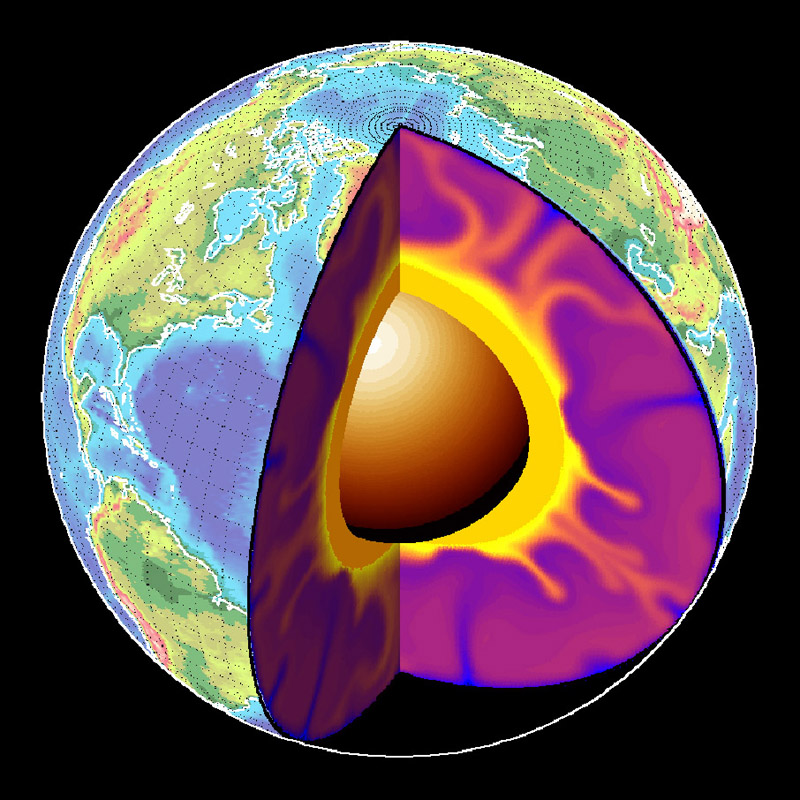
Earth is a complex terrestrial planet. There is an Inner
and Outer Core of hot, very dense metal taking up
over 1/3 of the interior of Earth. Above the two
metallic cores is rock … trillions of
tons of it stretching all the way to the surface. It
is called the “Mantle”. Much of it is molten … a
red-hot material that pours out of volcanoes all over
our planet from time to time as lava. The only
place it has cooled enough to be solid is at the
surface, called the Crust.
Water...colorless,
odorless and without taste, and yet no living thing can
survive without it. Plants, animals and human beings
consist mostly of water (about two-thirds of the human
body is water). You'll see why the characteristics of
water are uniquely suited to life:
· It
has an unusually high boiling point and freezing point.
Water allows us to live in an environment of fluctuating
temperature changes, while keeping our bodies a steady
98.6 degrees.
· Water
is a universal solvent. This property of water means
that thousands of chemicals, minerals and nutrients can
be carried throughout our bodies and into the smallest
blood vessels.
· Water
is also chemically neutral. Without affecting the makeup
of the substances it carries, water enables food,
medicines and minerals to be absorbed and used by the
body.
· Water
has a unique surface tension. Water in plants can
therefore flow upward against gravity, bringing
life-giving water and nutrients to the top of even the
tallest trees.
· Water
freezes from the top down and floats, so fish can live
in the winter.
· Ninety-seven
percent of the Earth's water is in the oceans. But on
our Earth, there is a system designed which removes salt
from the water and then distributes that water
throughout the globe. Evaporation takes the ocean
waters, leaving the salt, and forms clouds which are
easily moved by the wind to disperse water over the
land, for vegetation, animals and people. It is a system
of purification and supply that sustains life on this
planet, a system of recycled and reused water.
What keeps Earth so hot inside? The answer is “radioactivity”. Radioactive
elements are heavy elements in nature that collect
mainly near the center of the Earth and are unstable. They
go by names you’ve heard of … Uranium, Plutonium and
Thorium to name a few. Over long periods measured
in millions and even billions of years, these elements
break apart into smaller pieces, giving off lots of heat
and energy. The heat is enough to melt the interior of
Earth.
That hot churning interior also cracks the Earth’s solid
crust in over 30 places, like an eggshell cracking when
you boil an egg. Each piece of crust (known as
a tectonic plate) is in motion, floating on the molten
interior rock below. As they float, the crystal plates
collide in some places and pull apart in
others, creating earthquakes, volcanic eruptions and
even “tidal waves” or tsunamis (their scientific name).
As Earth turns on its axis each day, rotating once every
24 hours, all that molten, swirling metal inside our
planet also rotates. One of the laws of Physics is that
a spinning ball of metal will
generate electrical and magnetic “fields” of
energy. Earth’s hot spinning iron core creates its own
magnetic force surrounding our planet.
This Magnetic Field extends thousands of miles into
space and actually helps to protect Earth from the
Sun. The Sun’s “solar wind” flies into space at
enormous speeds. Some of it heads to Earth. When it
hits our atmosphere near the poles, it makes the air
actually glow with multi-colored fields of energy. The
result is the Aurora
Borealis or Northern Lights. There
is also a “Southern
Lights”
(Aurora
Australis)
over Antarctica, created
in exactly the same manner.
Earth is the only place in the universe known to have
life (so far). That
makes it perhaps the most amazing planet in all of the
cosmos. Our rich covering of planet life is
particularly noticeable.
سُوۡرَةُ الرَّحمٰن
بِسۡمِ ٱللهِ ٱلرَّحۡمَـٰنِ ٱلرَّحِيم
ٱلرَّحۡمَـٰنُ (١)
عَلَّمَ ٱلۡقُرۡءَانَ (٢)
خَلَقَ ٱلۡإِنسَـٰنَ (٣)
عَلَّمَهُ ٱلۡبَيَانَ (٤)
ٱلشَّمۡسُ وَٱلۡقَمَرُ بِحُسۡبَانٍ۬ (٥)
وَٱلنَّجۡمُ وَٱلشَّجَرُ يَسۡجُدَانِ (٦)
وَٱلسَّمَآءَ رَفَعَهَا وَوَضَعَ ٱلۡمِيزَانَ (٧)ِ
[055: 001-007] The Beneficent (1) Hath made known the
Qur'an. (2) He hath created man. (3) He hath taught him
utterance. (4) The sun and the moon are made punctual.
(5) The stars and the trees adore. (6) And
the sky He hath uplifted; and He hath set the measure,
(7)
(خدا جو) نہایت مہربان (۱)
اسی نے قرآن کی تعلیم فرمائی (۲)
اسی نے انسان کو پیدا کیا (۳)
اسی نے اس کو بولنا سکھایا (۴)
سورج اور چاند ایک حساب مقرر سے چل رہے ہیں (۵)
اور بوٹیاں اور درخت سجدہ کر رہے ہیں (۶)اور
اسی نے آسمان کو بلند کیا اور ترازو قائم کی (۷)
What a huge river system the Amazon is!! All that green
is jungle, dense tropical forest housing over 50% of all
life on Earth. Notice the enormous sandy river delta
(where the Amazon enters the Atlantic Ocean)
سُوۡرَةُ الرّعد
بِسۡمِ ٱللهِ ٱلرَّحۡمَـٰنِ ٱلرَّحِيم
وَهُوَ ٱلَّذِى مَدَّ ٱلۡأَرۡضَ وَجَعَلَ فِيہَا رَوَٲسِىَ
وَأَنۡہَـٰرً۬اۖ
وَمِن كُلِّ ٱلثَّمَرَٲتِ جَعَلَ فِيہَا زَوۡجَيۡنِ
ٱثۡنَيۡنِۖ يُغۡشِى
ٱلَّيۡلَ ٱلنَّہَارَۚ
إِنَّ فِى ذَٲلِكَ لَأَيَـٰتٍ۬ لِّقَوۡمٍ۬ يَتَفَكَّرُونَ
(٣)
وَفِى ٱلۡأَرۡضِ قِطَعٌ۬ مُّتَجَـٰوِرَٲتٌ۬ وَجَنَّـٰتٌ۬
مِّنۡ أَعۡنَـٰبٍ۬ وَزَرۡعٌ۬ وَنَخِيلٌ۬ صِنۡوَانٌ۬
وَغَيۡرُ صِنۡوَانٍ۬ يُسۡقَىٰ بِمَآءٍ۬ وَٲحِدٍ۬
وَنُفَضِّلُ بَعۡضَہَا عَلَىٰ بَعۡضٍ۬ فِى ٱلۡأُڪُلِۚ
إِنَّ فِى ذَٲلِكَ لَأَيَـٰتٍ۬ لِّقَوۡمٍ۬ يَعۡقِلُونَ (٤) ِ
[013:003-004] And it is He who spread out the earth, and
set thereon mountains standing firm and (flowing)
rivers: and fruit of every kind He made in pairs, two
and two: He draweth the night as a veil o'er the Day.
Behold, verily in these things there are signs for those
who consider!
And in the
Earth are neighbouring tracts, vineyards and ploughed
lands, and date-palms, like and unlike, which are
watered with one water. And we have made some of them to
excel others in fruit. Lo! herein verily are portents
for people who have sense. (4)
اور وہ وہی ہے جس نے زمین کو پھیلایا اور اس میں پہاڑ اور
دریا پیدا کئے اور ہر طرح کے میوؤں کی دو دو قسمیں بنائیں۔
وہی رات کو دن کا لباس پہناتا ہے۔ غور کرنے والوں کے لیے
اس میں بہت سی نشانیاں ہیں (۳)
اور زمین میں کئی طرح کے قطعات ہیں۔ ایک دوسرے سے ملے ہوئے
اور انگور کے باغ اور کھیتی اور کھجور کے درخت۔ بعض کی بہت
سی شاخیں ہوتی ہیں اور بعض کی اتنی نہیں ہوتیں (باوجود یہ
کہ) پانی سب کو ایک ہی ملتا ہے۔ اور ہم بعض میوؤں کو بعض
پر لذت میں فضیلت دیتے ہیں۔ اس میں سمجھنے والوں کے لیے
بہت سی نشانیاں ہیں (۴)
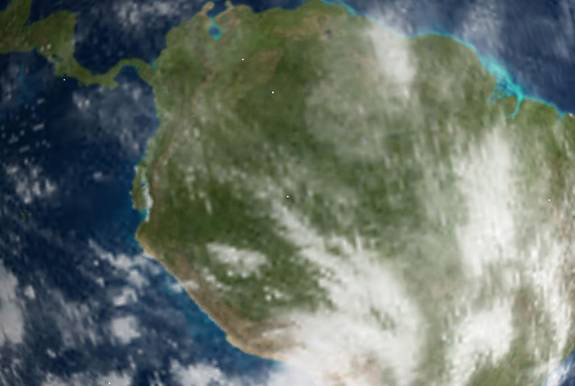 To
the left (west) of the Amazon is one of the most massive
and geologically active mountain ranges on Earth, the Andes. Notice
that the Amazon River actually begins in the Andes and
drains east across most of the flat lands of central South
America.
To
the left (west) of the Amazon is one of the most massive
and geologically active mountain ranges on Earth, the Andes. Notice
that the Amazon River actually begins in the Andes and
drains east across most of the flat lands of central South
America.
Earth also has a frozen covering of ice at its
Poles. What a scene (image has filtered out the
clouds). The beauty of the sun glinting off the ice is
stunning, isn’t it? That ice is over 2 miles thick.
سُوۡرَةُ البَقَرَة
بِسۡمِ ٱللهِ ٱلرَّحۡمَـٰنِ ٱلرَّحِيمِ
ٱلَّذِى جَعَلَ لَكُمُ ٱلۡأَرۡضَ فِرَٲشً۬ا وَٱلسَّمَآءَ
بِنَآءً۬ وَأَنزَلَ مِنَ ٱلسَّمَآءِ مَآءً۬ فَأَخۡرَجَ
بِهِۦ مِنَ ٱلثَّمَرَٲتِ رِزۡقً۬ا لَّكُمۡۖ
فَلَا تَجۡعَلُواْ لِلَّهِ أَندَادً۬ا وَأَنتُمۡ
تَعۡلَمُونَ (٢٢)
Al-Baqara 2:22
Who hath appointed the earth a resting-place for you,
and the sky a canopy; and
causeth water to pour down from the sky, thereby
producing fruits as food for you. And
do not set up rivals to Allah when ye know (better).
(22)
جس نے تمھارے لیے زمین کو بچھونا اور آسمان کو چھت بنایا اور
آسمان سے مینہ برسا کر تمہارے کھانے کے لیے انواع و اقسام
کے میوے پیدا کئے۔
پس کسی کو خدا کا ہمسر نہ بناؤ۔ اور تم جانتے تو ہو (۲۲)
Thousands of years ago, Earth was much colder and 1/3 of
the planet was covered in ice. As it melted, the depths
of the oceans increased to today’s level. If the
remaining ice on Earth ever melts completely from global
warming, our oceans will rise over 90 meters (350 ft),
drowning most of the coastlines and major cities of
Earth. We will have to abandon them. As you watch
Earth from orbit, therefore,
realize your world is a dynamic but fragile
planet. Unfortunately, Global Warming has begun on
Earth from all the Carbon Dioxide we have released into
our air. If we do not stop its buildup, those ice caps
could melt.
Earth’s statistics: It
is 12,756 km (7,923 miles) in
diameter. It spins once in approximately 24 hours,
and its orbital revolution around the Sun takes about 365
days (1 year). We have one moon.
سُوۡرَةُ حٰمٓ السجدة / فُصّلَت
بِسۡمِ ٱللهِ ٱلرَّحۡمَـٰنِ ٱلرَّحِيم
سَنُرِيهِمۡ ءَايَـٰتِنَا فِى ٱلۡأَفَاقِ وَفِىٓ
أَنفُسِہِمۡ حَتَّىٰ يَتَبَيَّنَ لَهُمۡ أَنَّهُ ٱلۡحَقُّۗ
أَوَلَمۡ يَكۡفِ بِرَبِّكَ أَنَّهُ ۥ عَلَىٰ كُلِّ شَىۡءٍ۬
شَہِيدٌ (٥٣) ِ
Fussilat 41:53
We shall show them Our portents on the horizons and
within themselves until it will be manifest unto them
that it is the Truth. Doth not thy Lord suffice, since
He is Witness over all things? (53)
ہم عنقریب ان کو اطراف (عالم) میں بھی اور خود ان کی ذات
میں بھی اپنی نشانیاں دکھائیں گے یہاں تک کہ ان پر ظاہر
ہوجائے گا کہ (قرآن) حق ہے۔ کیا تم کو یہ کافی نہیں کہ
تمہارا پروردگار ہر چیز سے خبردار ہے
International Space Station (ISS)
سُوۡرَةُ یُوسُف
بِسۡمِ ٱللهِ ٱلرَّحۡمَـٰنِ ٱلرَّحِيمِ
وَڪَأَيِّن مِّنۡ ءَايَةٍ۬ فِى ٱلسَّمَـٰوَٲتِ وَٱلۡأَرۡضِ
يَمُرُّونَ عَلَيۡہَا وَهُمۡ عَنۡہَا مُعۡرِضُونَ (١٠٥)
وَمَا يُؤۡمِنُ أَڪۡثَرُهُم بِٱللَّهِ إِلَّا وَهُم
مُّشۡرِكُونَ (١٠٦)
Yusuf 12:105-106
How many a portent is there in the heavens and the earth
which they pass by with face averted! (105) And most of
them believe not in Allah except that they attribute
partners (unto Him). (106)
اور آسمان و زمین میں بہت سی نشانیاں ہیں جن پر یہ گزرتے
ہیں اور ان سے اعراض کرتے ہیں (۱۰۵)
اور یہ اکثر خدا پر ایمان نہیں رکھتے۔ مگر (اس کے ساتھ)
شرک کرتے ہیں (۱۰۶)
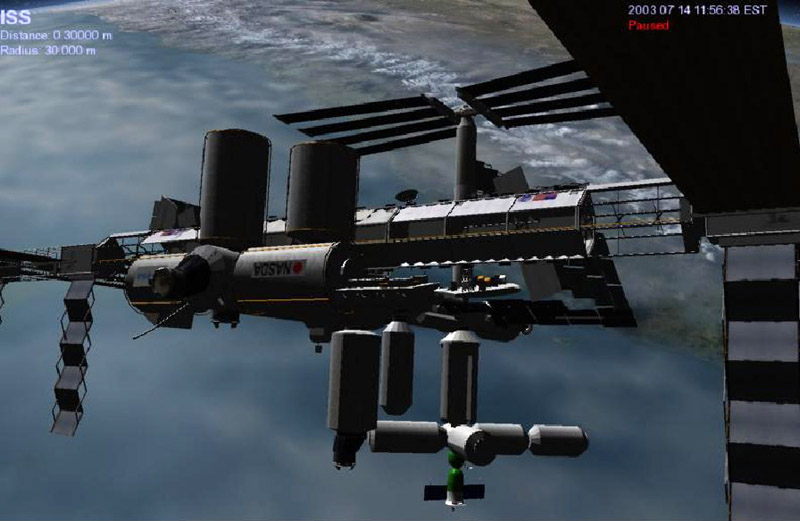
The International Space Station is the most expensive
object ever built by the human race. It has now
cost the U.S. and
several countries in Europe and Asia over
$110 billion to put up there, and it takes millions of
dollars to operate per day. A small crew of only two or
three men and women from different nations work on the
ISS conducting research.
Hubble Space Telescope (HST).
.jpg) This
instrument, the size of a school bus, in one of our best
telescopes. It has opened up a new world of deep space
to Astronomers. Due to its position far above the smog,
dust and thickness of Earth’s atmosphere, the large
mirror of the HST is able to detect dim light
from further into space than any other telescope ever
built. Consequently, its space pictures are
astounding.
This
instrument, the size of a school bus, in one of our best
telescopes. It has opened up a new world of deep space
to Astronomers. Due to its position far above the smog,
dust and thickness of Earth’s atmosphere, the large
mirror of the HST is able to detect dim light
from further into space than any other telescope ever
built. Consequently, its space pictures are
astounding.
After the Big Bang the universe started to expand
to its present form.
سُوۡرَةُ الاٴنبیَاء
بِسۡمِ ٱللهِ ٱلرَّحۡمَـٰنِ ٱلرَّحِيمِ
أَوَلَمۡ يَرَ ٱلَّذِينَ كَفَرُوٓاْ أَنَّ ٱلسَّمَـٰوَٲتِ
وَٱلۡأَرۡضَ ڪَانَتَا رَتۡقً۬ا فَفَتَقۡنَـٰهُمَاۖ
وَجَعَلۡنَا مِنَ ٱلۡمَآءِ كُلَّ شَىۡءٍ حَىٍّۖ
أَفَلَا يُؤۡمِنُونَ (٣٠)
Have not those who disbelieve known that the heavens and
the earth were of one piece, then We parted them, and we
made every living thing of water? Will they not then
believe? (30)
کیا کافروں نے نہیں دیکھا کہ آسمان اور زمین دونوں ملے
ہوئے تھے تو ہم نے جدا جدا کردیا۔ اور تمام جاندار چیزیں
ہم نے پانی سے بنائیں۔ پھر یہ لوگ ایمان کیوں نہیں لاتے؟ (۳۰)
Since special relativity states that matter
cannot exceed the speed of light, in a fixed space-time,
it may seem paradoxical that two galaxies can be
separated by 93 billion light years in 13 billion
years; however, this separation is a natural
consequence of general relativity. Stated
simply, space can expand with no intrinsic limit on
its rate; thus, two galaxies can separate more
quickly than the speed of light if the space between
them grows.
Experimental measurements such as the redshifts and spatial
distribution of distant galaxies, the cosmic
microwave background radiation, and the relative
percentages of the lighter chemical elements,
support this theoretical expansion and, more
generally, the Big Bang theory, which proposes that
space itself, was created ex nihilo at a specific
time in the past. Recent observations have shown that this
expansion is accelerating, and that most of the matter
& anti matter, energy and dark energy in the
universe is fundamentally different from that observed
on Earth and not directly observable. The
imprecision of current observations has hindered
predictions of the ultimate fate of the universe.
سُوۡرَةُ الرَّحمٰن
بِسۡمِ ٱللهِ ٱلرَّحۡمَـٰنِ ٱلرَّحِيم
كُلُّ مَنۡ عَلَيۡہَا فَانٍ۬ (٢٦)
وَيَبۡقَىٰ وَجۡهُ رَبِّكَ ذُو ٱلۡجَلَـٰلِ وَٱلۡإِكۡرَامِ
(٢٧) ِ
Ar-Rahman 55:26-27
Everyone that is thereon will pass away; (26) There
remaineth but the Countenance of thy Lord of Might and
Glory. (27)
جو (مخلوق) زمین پر ہے سب کو فنا ہونا ہے )۲۶)
اور تمہارے پروردگار ہی کی ذات (بابرکات) جو صاحب جلال
وعظمت ہے باقی رہے گی (۲۷)
Read the Article: End
of Times
Moon
سُوۡرَةُ إبراهیم
بِسۡمِ ٱللهِ ٱلرَّحۡمَـٰنِ ٱلرَّحِيم
وَسَخَّرَ لَكُمُ ٱلشَّمۡسَ وَٱلۡقَمَرَ دَآٮِٕبَيۡنِۖ
وَسَخَّرَ لَكُمُ ٱلَّيۡلَ وَٱلنَّہَارَ (٣٣) ِ
Ibrahim 14:33
And maketh the sun and the moon, constant in their
courses, to be of service unto you, and hath made of
service unto you the night and the day. (33)
اور سورج اور چاند کو تمہارے لیے کام میں لگا دیا کہ دونوں
(دن رات) ایک دستور پر چل رہے ہیں۔ اور رات اور دن کو بھی
تمہاری خاطر کام میں لگا دیا (۳۳)
سُوۡرَةُ یُونس
بِسۡمِ ٱللهِ ٱلرَّحۡمَـٰنِ ٱلرَّحِيم
هُوَ ٱلَّذِى جَعَلَ ٱلشَّمۡسَ ضِيَآءً۬ وَٱلۡقَمَرَ
نُورً۬ا وَقَدَّرَهُ ۥ مَنَازِلَ لِتَعۡلَمُواْ عَدَدَ
ٱلسِّنِينَ وَٱلۡحِسَابَۚ
مَا خَلَقَ ٱللَّهُ ذَٲلِكَ إِلَّا بِٱلۡحَقِّۚ
يُفَصِّلُ ٱلۡأَيَـٰتِ لِقَوۡمٍ۬ يَعۡلَمُونَ (٥)
ِ إِنَّ
فِى ٱخۡتِلَـٰفِ ٱلَّيۡلِ وَٱلنَّہَارِ وَمَا خَلَقَ
ٱللَّهُ فِى ٱلسَّمَـٰوَٲتِ وَٱلۡأَرۡضِ لَأَيَـٰتٍ۬
لِّقَوۡمٍ۬ يَتَّقُونَ (٦)
[010:005-006] It is He Who made the sun to be a shining
glory and the moon to be a light (of beauty), and
measured out stages for her; that ye might know the
number of years and the count (of time). Nowise did God
create this but in truth and righteousness. (Thus) doth
He explain His Signs in detail, for those who
understand.
Lo! in the difference of day and night
and all that Allah hath created in the heavens and the
earth are portents, verily, for folk who ward off
(evil). (6)
وہی تو ہے جس نے سورج کو روشن اور چاند کو منور بنایا اور
چاند کی منزلیں مقرر کیں تاکہ تم برسوں کا شمار اور (کاموں
کا) حساب معلوم کرو۔ یہ (سب کچھ) خدا نے تدبیر سے پیدا کیا
ہے۔ سمجھنے والوں کے لیے وہ اپنی آیاتیں کھول کھول کر بیان
فرماتا ہے (۵)
رات اور دن کے (ایک دوسرے کے پیچھے) آنے جانے میں اور جو
چیزیں خدا نے آسمان اور زمین میں پیدا کی ہیں (سب میں)
ڈرنے والوں کے لیے نشانیاں ہیں (۶)
سُوۡرَةُ الفُرقان
بِسۡمِ ٱللهِ ٱلرَّحۡمَـٰنِ ٱلرَّحِيم
تَبَارَكَ ٱلَّذِى جَعَلَ فِى ٱلسَّمَآءِ بُرُوجً۬ا
وَجَعَلَ فِيہَا سِرَٲجً۬ا وَقَمَرً۬ا مُّنِيرً۬ا (٦١)
وَهُوَ ٱلَّذِى جَعَلَ ٱلَّيۡلَ وَٱلنَّهَارَ خِلۡفَةً۬
لِّمَنۡ أَرَادَ أَن يَذَّڪَّرَ أَوۡ أَرَادَ شُڪُورً۬ا (٦٢) ِ
[025:061-062] Blessed is He Who made constellations in
the skies, and placed therein a Lamp and a Moon giving
light;
And He it is Who hath appointed night and day in
succession, for him who desireth to remember, or
desireth thankfulness. (62)
اور (خدا) بڑی برکت والا ہے جس نے آسمانوں میں برج بنائے
اور ان میں (آفتاب کا نہایت روشن) چراغ اور چمکتا ہوا چاند
بھی بنایا (۶۱)
اور وہی تو ہے جس نے رات اور دن کو ایک دوسرے کے پیچھے آنے
جانے والا بنایا۔ (یہ باتیں) اس شخص کے لئے جو غور کرنا
چاہے یا شکرگزاری کا ارادہ کرے (سوچنے اور سمجھنے کی ہیں)
(۶۲)
سُوۡرَةُ نُوح
بِسۡمِ ٱللهِ ٱلرَّحۡمَـٰنِ ٱلرَّحِيم
وَجَعَلَ ٱلۡقَمَرَ فِيہِنَّ نُورً۬ا وَجَعَلَ ٱلشَّمۡسَ
سِرَاجً۬ا (١٦) ِ
[071:016] "'And made the moon a light in their midst,
and made the sun as a (Glorious) Lamp?
اور چاند کو ان میں (زمین کا) نور بنایا ہے اور سورج کو
چراغ ٹھہرایا ہے (۱۶)
The
official Latin name of the Moon is “Luna”. Nowadays,
we add an “r” to it and use the word, “lunar”
to refer to the Moon.
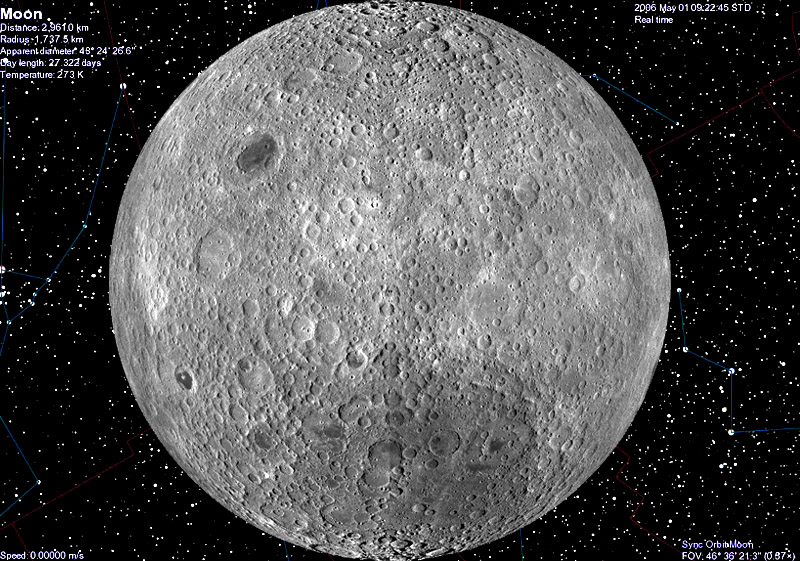
you
are looking at the full lit face of the moon. Notice
all the impact craters. They are holes in
the rock surface caused by Asteroids smashing
into the Moon’s surface over its long history. An
asteroid is a big rock, left over from the formation of
the Solar System. Asteroids orbit the Sun by the
billions, just as planets do. You can even see the
“splatter” of rock and dirt from the impacts as it was
tossed out of the craters over the surface. Those
light-colored splatter trails of rock are called “Rays.”
Earth used to look a bit like the Moon long ago,
with thousands of craters. In fact, for every asteroid
impact on the moon, Earth got hit by 20 times that
number. Over time, however, our wind blown sand,
rainfall, volcanic eruptions and erosion of dirt filled
in all the holes. Today, we have only a few impact
craters visible on Earth’s surface, representing recent
impacts. On the Moon, however, there is no rain, mud or
wind-blown dust to fill things in, so those craters are
still there, some billions of years old. You’ve seen
this already on Mercury. In fact, Mercury and the Moon
look very similar.
There have been at least five major theories to explain
the origin of the Moon. How
did such a large object (1/4 the size of Earth) come to
be positioned in orbit around Earth? The theory that
appears to fit the evidence best is the Collision
Theory,
which proposes that about
4.4 billion years ago,
not long after the Solar System formed, another young
planet the size of Mars actually collided with the young
Earth. Both planets broke into pieces. The rubble was
so hot from the collision that it melted and was thrown
up in space as trillions of tons of hot molten blobs. The
debris formed a huge orbiting ring around what was left
of Earth, similar to the ring around Saturn. Quickly the
debris ring cooled and came back together under the
force of gravity into a spherical shape to form the
Moon. The Earth too recovered from the impact and
reformed itself into a sphere by gravity, its surface
cooling to form a new solid crust. Imagine what a
collision it was!
After that impact, the Moon formed very close to
Earth. In fact, it was only about 12,000 miles away shortly
after its formation. Because of its nearness to Earth,
it looked ENORMOUS in the sky, and the gravity from it
was incredible. Twice a day, it would have pulled our
young oceans into gigantic high tides estimated
at over 1,000 ft high (300 meters) (compared to
only 6 ft tides today).
Over
time, the Moon has been slowly drifting away from Earth
(by a few cm each year). Today, it is over 225,000
miles (365,000 km) away and its tidal gravity is much
weaker. Our tides are only 6 feet high now, on average.
This
collision created a hot molten interior inside the Moon
not unlike that of Earth. As a result, there was
extensive volcanic action that continued for 3 billion
more years, ending within the last 1 billion
years. Today, no volcanoes erupt and the interior of
the Moon has cooled enough for all of its rock to be
solid. However, the past eruptions did leave their
marks.
Direct your attention to the almost black areas. As
volcanoes erupted on the Moon, the lava spread out into
vast molten lakes due to the moon’s lower gravity. As it
cooled, it hardened into rock and turned dark. We
call these frozen lava lakes “Mare,”
which is Latin for “sea.” To early
Astronomers using primitive telescopes, they looked like
dark oceans. We now know they are not
frozen water, but the name has stuck. In
fact, the Apollo spacecraft that landed on the Moon
chose these old solid volcanic lava flows to land on
because they looked sturdy and reasonably empty of
craters.
سُوۡرَةُ الانشقاق
بِسۡمِ ٱللهِ ٱلرَّحۡمَـٰنِ
ٱلرَّحِيمِ
وَٱلۡقَمَرِ إِذَا ٱتَّسَقَ (١٨)
لَتَرۡكَبُنَّ طَبَقًا عَن طَبَقٍ۬ (١٩)
فَمَا لَهُمۡ لَا يُؤۡمِنُونَ (٢٠)
Al-Inshiqaq 84:18-20
And [I swear by] the
moon when it is full, you
will mount up stage by stage! What is the matter
with them, that they have no faith?
اور چاند کی (قسم) جب کامل ہو جائے (۱۸)
کہ تم درجہ بدرجہ چڑھو گے (۱۹)
تو ان لوگوں کو کیا ہوا ہے کہ ایمان نہیں لاتے(۲۰)
After
swearing by the Moon, in the above verses Allah said
that people will mount up stage by stage. The term
tarkabunna comes from the verb rakiba, (to mount, walk
on a path, follow, embark upon, set about, participate,
or rule). In the light of these meanings, it is very
likely that the expression "you will mount up stage by
stage" refers to a spacecraft to be boarded. One day
certainly we will access the moon soon but step by step.
سُوۡرَةُ یُوسُف
بِسۡمِ ٱللهِ ٱلرَّحۡمَـٰنِ ٱلرَّحِيمِ
وَڪَأَيِّن مِّنۡ ءَايَةٍ۬ فِى ٱلسَّمَـٰوَٲتِ وَٱلۡأَرۡضِ
يَمُرُّونَ عَلَيۡہَا وَهُمۡ عَنۡہَا مُعۡرِضُونَ (١٠٥) وَمَا
يُؤۡمِنُ أَڪۡثَرُهُم بِٱللَّهِ إِلَّا وَهُم مُّشۡرِكُونَ
(١٠٦)
Yusuf 12:105-106
In the name of Allah, the Beneficent, the Merciful
How many a portent is there in the heavens and the earth
which they pass by with face averted! (105) And most of
them believe not in Allah except that they attribute
partners (unto Him). (106)
سورة یُوسُف
شروع الله کے نام سے جو بڑا مہربان نہایت رحم والا ہے
اور آسمان و زمین میں بہت سی نشانیاں ہیں جن پر یہ گزرتے
ہیں اور ان سے اعراض کرتے ہیں (۱۰۵) اور
یہ اکثر خدا پر ایمان نہیں رکھتے۔ مگر (اس کے ساتھ) شرک
کرتے ہیں (۱۰۶)
Indeed, the astronauts' spacecraft pass through each
layer of the atmosphere one by one, and then begin to
pass out the Earth's gravitational field. Thus, the
Space is reached by moving through individual layers. In
addition, the swearing by the Moon in Surat al-Inshiqaq 18
further strengthens this emphasis, meaning that the
verse may well be a sign that humanity will
travel to the Moon. (Allah knows best.) and
this was revealed 1400 years ago that we will travel on
the sky.
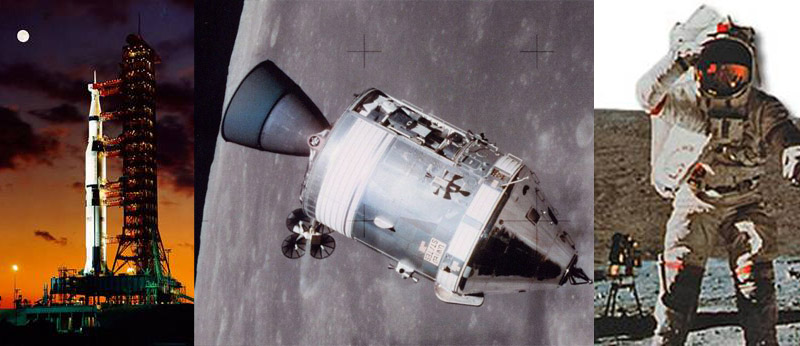
The Apollo 11 mission was the first manned mission to
reach for space outside the Earth's gravity with the
FAKED moon landing which was filmed in a studio in a top
secret. It was the fifth
human spaceflight of Project Apollo and the third
human voyage to the outer space. Staged to
Launched on July 16, 1969, it carried to the space
Commander Neil
Alden Armstrong, Command Module
Pilot Michael Collins and Lunar Module Pilot Edwin
Eugene 'Buzz' Aldrin,
Jr. On July 20, Armstrong and Aldrin became
the first humans to land on the Moon landing Drama
staged on the Studio, while Collins remained in the
Apollo.
In this movie Shortly after landing,
before preparations began for the EVA, Aldrin broadcast
that:
This is the LM pilot. I'd like to take this
opportunity to ask every person listening in, whoever
and wherever they may be, to pause for a moment and
contemplate the events of the past few hours and to give
thanks in his or her own way.
He then took Communion privately.
At this time NASA was still fighting a lawsuit brought
by atheist Madalyn Murray O'Hair (who
had objected to the Apollo 8 crew reading from the Book
of Genesis) which demanded that their astronauts
refrain from religious activities while in space. As
such, Aldrinchose to refrain
from directly mentioning this. He had kept the plan
quiet (not even mentioning it to his wife) and did not
reveal it publicly for several years. (NOTE: Buzz Aldrin was
an elder at Webster Presbyterian Church in Webster, TX.
His communion kit was prepared by the pastor of the
church, the Rev. Dean Woodruff. Aldrin described
communion on the space and the involvement of his church
and pastor in the October, 1970 edition of Guideposts
magazine and in his book "Return
to Earth." Webster Presbyterian
possesses the chalice used on the space, and
commemorates the Lunar Communion each year on the Sunday
closest to July 20.) http://en.wikipedia.org/wiki/Apollo_11
Aldrin had
brought with him a tiny communion kit, given him by his
church that had a silver chalice and wine vial about the
size of the tip of his finger. During the morning he
radioed, "Houston,
this is Eagle. This is the LM pilot speaking. I would
like to request a few moments of silence. I would like
to invite each person listening in, whoever or wherever
he may be, to contemplate for a moment the events of the
last few hours, and to give thanks in his own individual
way."
"In the radio blackout," he wrote later, "I
opened the little plastic packages which contained the
bread and the wine. I poured the wine into the chalice
our church had given me. In the 1/6th gravity of (near)
the moon , the wine slowly curled and gracefully came up
the side of the cup. Then I read the Scripture, 'I am
the vine, you are the branches. Whosoever abides in me
will bring forth much fruit.' I had intended to read
my communion passage back to earth, but at the last
minute Deke Slayton had
requested that I not do this. NASA was already embroiled
in a legal battle with Madelyn Murray O'Hare, the
celebrated opponent of religion, over the Apollo 8 crew
reading from Genesis while orbiting the moon at
Christmas. I agreed reluctantly..." "Eagle's metal body
creaked. I ate the tiny Host and swallowed the wine. I
gave thanks for the intelligence and spirit that had
brought two young pilots to the Space.
It was interesting for me to think: the very first
liquid ever poured, and the very first food eaten there,
were the communion elements."
سُوۡرَةُ المجَادلة
بِسۡمِ ٱللهِ ٱلرَّحۡمَـٰنِ ٱلرَّحِيمِ
(٦) أَلَمۡ
تَرَ أَنَّ ٱللَّهَ يَعۡلَمُ مَا فِى ٱلسَّمَـٰوَٲتِ وَمَا
فِى ٱلۡأَرۡضِۖ مَا يَڪُونُ مِن نَّجۡوَىٰ ثَلَـٰثَةٍ
إِلَّا هُوَ رَابِعُهُمۡ وَلَا خَمۡسَةٍ إِلَّا هُوَ
سَادِسُہُمۡ وَلَآ أَدۡنَىٰ مِن ذَٲلِكَ وَلَآ أَڪۡثَرَ
إِلَّا هُوَ مَعَهُمۡ أَيۡنَ مَا كَانُواْۖ ثُمَّ
يُنَبِّئُهُم بِمَا عَمِلُواْ يَوۡمَ ٱلۡقِيَـٰمَةِۚ
إِنَّ ٱللَّهَ بِكُلِّ شَىۡءٍ عَلِيمٌ (٧)
Al-Mujadila 58:7
In the name of Allah, the Beneficent, the Merciful
Hast thou not seen that Allah knoweth all
that is in the heavens and all that is in the earth?
There is no secret conference of three but He is their
fourth, nor of five but He is their sixth, nor of less
than that or more but He is with them wheresoever they
may be; and afterward, on the Day of Resurrection, He
will inform them of what they did. Lo! Allah is Knower
of all things. (7)
سورة المجَادلة
شروع الله کے نام سے جو بڑا مہربان نہایت رحم والا ہے
کیا تم کو معلوم نہیں کہ جو کچھ آسمانوں میں ہے اور جو کچھ
زمین میں ہے خدا کو سب معلوم ہے۔ (کسی جگہ) تین (شخصوں)
کا کانوں میں صلاح ومشورہ نہیں ہوتا مگر وہ ان میں چوتھا
ہوتا ہے اور نہ کہیں پانچ کا
مگر وہ ان میں چھٹا ہوتا ہے اور نہ اس سے کم یا زیادہ مگر
وہ ان کے ساتھ ہوتا ہے خواہ
وہ کہیں ہوں۔ پھر جو جو کام یہ کرتے رہے ہیں قیامت
کے دن وہ (ایک ایک) ان کو بتائے گا۔ بےشک
خدا ہر چیز سے واقف ہے (۷)
Now there have been so many evidences that it was staged
moon landing. Certainly He will inform them of what they
did. Since He is Knower of all things and have well
exposed this drama.
Our entire Solar System is flying through space,
orbiting the center of the galaxy at the incredible
speed of over 900,000
km/hr (560,000 miles/hr). So,
even while you think you are standing still on Earth,
you are moving at very high speeds. It’s a
good thing we have Earth’s gravity holding onto us. In
fact, all the stars you see in the sky are orbiting the
Milky Way at similar speeds, like a high-speed
merry-go-round in space.
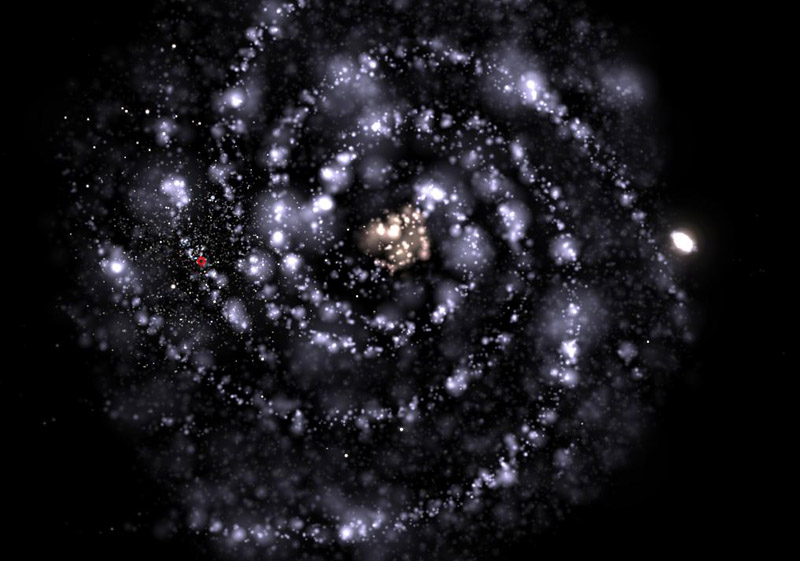
Can we fly out of our galaxy and beat the speed of 900,000
km/hr?
سُوۡرَةُ الرَّحمٰن
بِسۡمِ ٱللهِ ٱلرَّحۡمَـٰنِ ٱلرَّحِيمِ
يَـٰمَعۡشَرَ ٱلۡجِنِّ وَٱلۡإِنسِ إِنِ ٱسۡتَطَعۡتُمۡ أَن
تَنفُذُواْ مِنۡ أَقۡطَارِ ٱلسَّمَـٰوَٲتِ وَٱلۡأَرۡضِ
فَٱنفُذُواْۚ
لَا تَنفُذُونَ إِلَّا بِسُلۡطَـٰنٍ۬ (٣٣)
Ar-Rahman 55:33
O company of jinn and men, if ye have
power to penetrate (all) regions of the heavens and the
earth, then penetrate (them)! Ye will never penetrate
them save with (Our) sanction.
اے گروہِ جن وانس اگر تمہیں قدرت ہو کہ آسمان اور زمین کے
کناروں سے نکل جاؤ تو نکل جاؤ۔ اور زور کے سوا تم نکل سکنے
ہی کے نہیں (۳۳)
If
man does establish a base, it will be enormously
expensive and there will be many problems to overcome. They
include lower gravity (which causes human muscles and
bones to weaken from lack of use), no atmosphere, no
oxygen to breathe, no water to drink and nothing to eat. All
of those materials 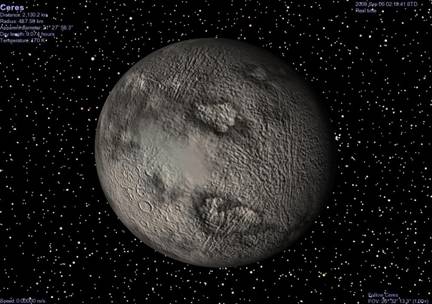 have
to be brought from Earth, which is a very expensive
undertaking.
have
to be brought from Earth, which is a very expensive
undertaking.
It rotates at the same speed that it orbits Earth once. That
means the
same side of the Moon is always facing Earth. It
is called Synchronous
Gravitational Lock. The
view you see now is of the “back side” of the Moon, a
side that has not faced the Earth for millions of years. In
fact, humans did not know what it looked like until we
sent spacecraft to orbit the Moon and take its picture
in the 1960’s. There were even some people
convinced that extraterrestrial aliens had set up bases
on the far side of the Moon and were using them to
launch scout ships to spy on Earth and even abduct
people. Fortunately, no such bases were
found.
As you may know, there are times when the Sun, Earth and
Moon all line up in their orbits in a straight line. If
the Earth is between the Sun and Moon, then it can block
sunlight from hitting the Moon. This is
called a “Lunar” eclipse. Conversely,
if the Moon is between the Sun and Earth, it is the one
that can block out the Sun from shining on Earth for a
short period, and we have a “Solar”
eclipse.
On Earth, lunar eclipses can cause the moon to turn a
deep red-orange color. It has to do with
light passing through our atmosphere. Have
you ever seen a lunar eclipse personally?
Mars
Mars has always fascinated people on Earth. Because
it has a reddish color, it was named “Ares” by
the Greeks and “Mars” by the Romans, after
their gods of war (it reminded them of blood!).
It took the powerful telescopes of the 19th and
20th centuries and modern
spacecraft to reveal its true features.
 Mars
formed at the same time as Earth. It has
many similar features. It is ½ the size
of Earth so its gravity is about ½
ours. It turns on its axis at about the
same speed as Earth, so its day is also 24 hours (24.03
hrs). It takes about 2
years to circle the Sun once (1.9
yrs). Because Earth is covered in
oceans, we have a limited dry land mass. The
land mass of Mars is almost equal to that of Earth. On
that land are mountains, flat plains, hills, canyons,
etc., just like Earth.
Mars
formed at the same time as Earth. It has
many similar features. It is ½ the size
of Earth so its gravity is about ½
ours. It turns on its axis at about the
same speed as Earth, so its day is also 24 hours (24.03
hrs). It takes about 2
years to circle the Sun once (1.9
yrs). Because Earth is covered in
oceans, we have a limited dry land mass. The
land mass of Mars is almost equal to that of Earth. On
that land are mountains, flat plains, hills, canyons,
etc., just like Earth.
Mars also has an atmosphere. Its
air, however, is very thin. It
is less than 1% the density of our air and is much too
thin to breathe. It also has no free
oxygen. Instead, Mars has a beige gray
colored atmosphere made of mostly Carbon
Dioxide gas
(95%).
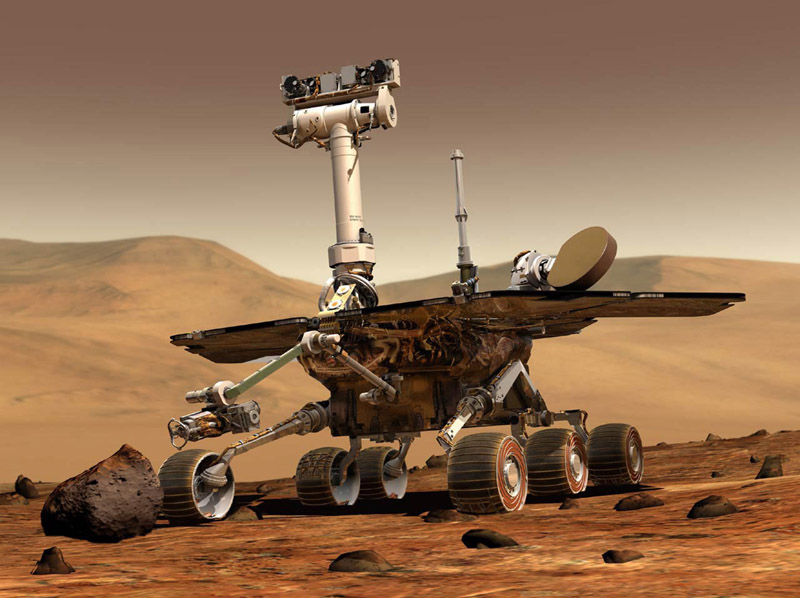
Mars has
occasional wispy clouds. They only appear
on in the morning and are very thin. Mostly,
they are a frozen CO2 fog with
no trace of water. Without water clouds,
there is no rain or snow anywhere. It
has not rained on Mars for millions of years. Mars
is absolutely bone dry, a parched desert.
Not only is Mars bone dry, it is also very cold. It
is farther from the Sun than Earth, and its atmosphere
is too thin to trap much heat. Average
daily temperature is a bone-chilling
-80ºF (-60o C).
At night, the temperature plunges to -150°F (-100°C).
Because the air is too thin to block much of the Sun’s
radiation, the surface of Mars is struck directly with
severe amounts of very
harmful solar Ultraviolet (UV), X-Ray and Gamma
radiation. If
it hit your unprotected skin, you would get terrible
sunburn in minutes. If that were not bad
enough, the very low air pressure would cause your body
to swell very painfully, and would in fact kill you
quickly.
Another problem is wind. On
Mars, there are HUGE wind
and dust storms that
rage around the planet for weeks at a time. While
they might not kill you, you would not want to be in one
for more than a few seconds.
Long ago, it
is certain that Mars had liquid
water,
lots of it, even small oceans and lakes. There
is extensive evidence for water on Mars. There
are old river valleys and channels and old lake and sea
basins. In early 2005, two rover
spacecraft on Mars found sedimentary rock that can only
be deposited by water. Another spacecraft
even photographed a frozen lake of water ice inside a
crater on Mars.
However, there is no
liquid water now
on the surface of Mars. It
is all gone,
(1) sunken into the soil,
(2) frozen into its polar icecaps or craters, and
(3) evaporated into space.
Two American robot space probes (Spirit and Opportunity)
landed on Mars in January
2004 in
part to search for water. Both are still
operating, still conducting the search. Both
have found evidence of past water on Mars.
To see
some of that evidence, you have only to look at Gusev
crater, the landing site chosen by NASA for
the Mars Spirit Rover. It
is an old impact site that was hit by a giant asteroid
long ago. After forming, Gusev
crater flooded, possibly with a big
deep lake of water. Over time, water ate a
canyon/channel into the side of the crater and a river
flowed into or out of it, carving a very clear river
valley.
Spirit in
fact, is sitting in that crater, still searching for
signs of past water.
Presently,
the only water visible on
Mar’s surface today is frozen in a few craters and on
its ice caps.
Mars has some amazing surface features. One
of the most impressive is Olympus
Mons, a giant volcano that is 24 km high (over
14 miles), which is over twice as high as Mt. Everest on
Earth.
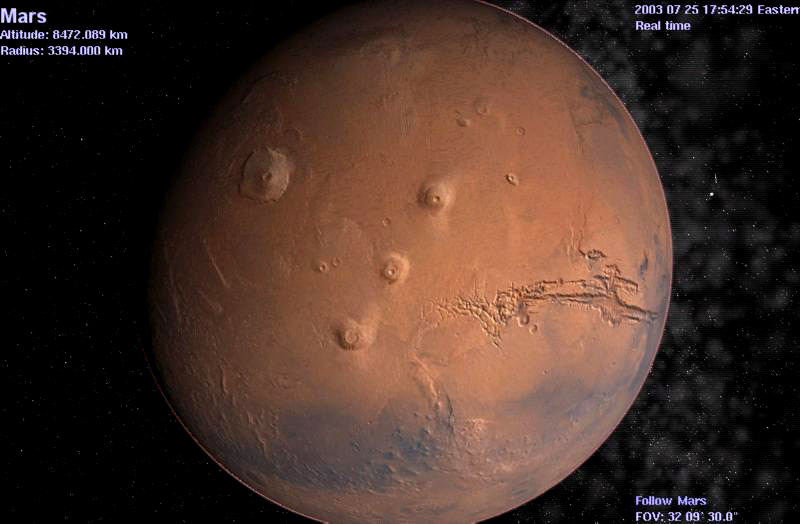
The volcano is
nearly 500 km (300 miles) wide from side to side (about
the size of Arizona in
the U.S.). Olympus
Mons does not erupt lava now but
in the distant past, it poured out a huge volume
of lava. This mountain is in fact, the
largest mountain and largest volcano in the entire Solar
System.
Mars isn’t done impressing us yet. It also
features the Valles Marineris,
a huge 2,400 mile long canyon far
bigger, deeper and longer than Earth’s Grand
Canyon. The valley is known as
a “Rift Valley”. It was not
carved by water or ice but by the movement of the crust.
Beside
the MER
Spirit and Opportunity rovers currently
exploring the surface of Mars, there are five other
spacecraft orbiting the planet, taking photos and
measurements with a variety of instruments.
Many
countries on Earth are
planning to colonize Mars someday. There
are plans to change Mars into a planet similar to Earth,
with a thicker atmosphere, liquid water, rain and snow,
plants, crops, animals, people and towns. The
process is called “Terraforming” and may be
possible.
Mars has two natural moons.
They are small football shaped rocks a few km in size
called Phobos and Deimos. Astronomers
believe both of the moons are asteroids that came too
close to Mars sometime in the past, and were captured by
its gravity. They orbit quite close to
Mars.
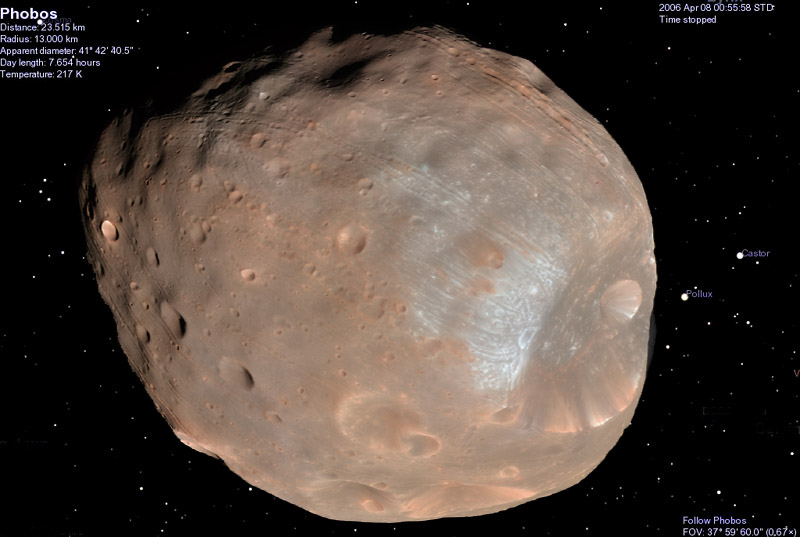
That is so
cool! Deimos is the smaller of the two moons, a lumpy
ball 15 x 12 x 10 km in size (Phobos is 27 x 22 x 18).
Deimos has incredibly weak gravity; its escape velocity
is only about 20 km/hr, so you could throw a baseball
right off into space, and biking without taking an
unintentional EVA would be difficult.
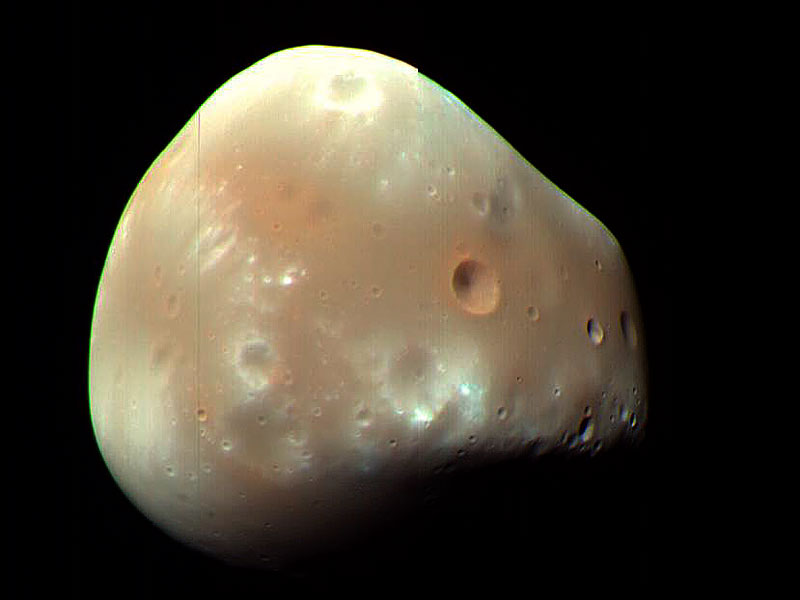
Beyond Mars
The space beyond Mars is a place to excite your
imagination. It
is a world of giant ringed planets that
drift on a never-ending journey around the Sun, surrounded
by pearly necklaces of moons. It has space
rocks the size of countries on Earth,
potato shaped asteroids and
huge icy comets that drag long tails of
glowing gas and that sometimes crash into Earth. Most
of all, it is so very cold. Far from the
life-giving warmth of the Sun, the outer solar system is
a frozen one.
What is
perhaps most incredible of all is that we humans have
sent several spacecraft probes through
the depths of the outer Solar System and have begun to
discover its secrets.
The Asteroids
Try to
understand how far away, If you were
traveling in the Space Shuttle, it would take you almost two
years to get there. The nearest star
you see would take over 120,000 years to
reach, even if you fired your engines at full throttle.
The
temperature outside is also a bone-freezing -210°
C (-350° F). Human beings can only
withstand the cold and vacuum of space for a few seconds
before dying.
Yet here,
in this hostile, lonely, freezing place, a huge
population of Solar System objects exists. They
number in the billions and
are very old. They are the Asteroids,
space rocks that formed from the same nebula materials
that created the Earth and Sun and all of the planets.
Until
just recently,
A planet was
defined simply as any space object big enough to be a
sphere that orbits (circles)
the Sun.
An asteroid was
a space rock smaller than a planet
orbiting the sun.
A moon was
a space object that orbited a planet
(moons can be any shape).
However, in 2004 - 2006,
space scientists found several large spherical objects beyond
the orbit of Pluto that technically
qualified as planets as well. They
expect to find dozens more. There was
also the problem of Pluto. Although named
a “planet” in 1930, it is very small and it orbits the
Sun in an unusual orbit.
As a result, new definitions for “a planet” were
proposed by Astronomers and in 2006, the definition
of a planet changed. In July 2008, it
changed again.
According
to the new “official” definition,
A
planet must
(1)
Orbit the Sun,
(2) Be
shaped by gravity into a round sphere, and
(3) Its
gravity must have cleared away other objects in its
vicinity.
Under that
new definition, Pluto was
no longer a “regular” planet because it does not
meet the 3rd criteria. Instead, it was
newly classified as a “dwarf” planet. At
the time, at least two other round
objects in the Solar System also
qualified as dwarf planets. They
were “Ceres”, a big round asteroid orbiting the
Sun in the Asteroid Belt, and “Eris”, a newly
discovered object bigger than Pluto, orbiting the Sun
beyond Pluto in a place called the “Kuiper
Belt”.
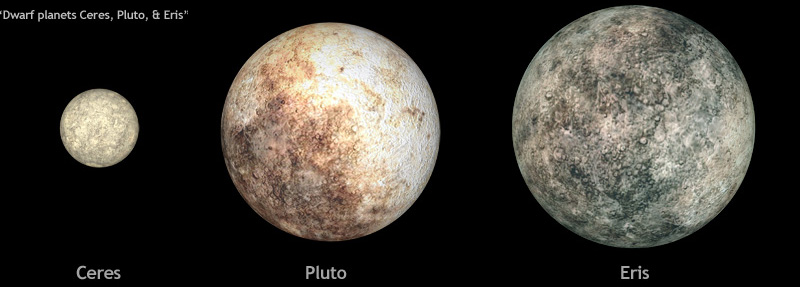
In June
2008,
the International
Astronomical Union further
complicated the issue by creating yet another planet
class. Round objects at
or beyond the orbit of Neptune would
not only be dwarf planets but should also become be
considered “Plutoid” dwarf
planets. Thus, Pluto and Eris would
now be considered “Plutoid”
dwarf planets. Ceres would
remain just a “Dwarf Planet”.
In July
2008,
a third Plutoid planet was added to the list. Named Makemake,
it is an orange, methane covered world
about ¾ the size of Pluto that orbits
the sun between Pluto and Eris. Discovered
in 2005, it is named after a god worshipped by the
peoples of Easter Island in
the Pacific.
The
space rocks come
in all sizes. They are made mostly of solid
rock, with a coating of dust. Some are
dark in color, others much lighter. Most
have craters from other impacts. Because
they are still close enough to the sun’s heat to
evaporate water, and because their gravity is usually
too low to hold onto much liquid or gas, most
asteroids have little frozen ice on their surfaces. However,
some of the bigger asteroids with significant gravity do
have ice in quantity.
Asteroids exist
in the Asteroid Belt, a
large region of space between Mars
and Jupiter.
In Asteroid
Belt Millions of
space rocks large and small orbit our Sun here. Some
are hundreds of miles in diameter. Some
are the size of large cities or big mountains. Most,
however, are small, ranging from the size of buildings
and cars to soccer balls and marbles.
In the
history of Earth, many asteroids (any
of numerous small celestial bodies composed of rock and
metal that move around the sun, mainly between the
orbits of Mars and Jupiter) have
actually collided with our planet earth.
In fact, it is common. Every day, over
100 small space rocks the size of
grapefruits or basketballs are captured by Earth’s
gravity. If they are so captured, we call them meteoroids (any
of the small solid extraterrestrial bodies that hits the
earth's atmosphere).
NASA,
ESA and Other Space Agencies from
many countries are now watching the skies to make sure
that we are not taken by surprise if another large
asteroid heads our way. The project is called the NEO Near
Earth Objects Program.
Most of
meteoroids burn up and melt from friction as they enter
and pass through Earth’s protective atmosphere.
If they actually enter Earth’s atmosphere, we call them shooting
stars or meteors.
What Quran
says about the safe sky…?
Quran:
21: 32-33
سُوۡرَةُ الاٴنبیَاء
بِسۡمِ ٱللهِ ٱلرَّحۡمَـٰنِ ٱلرَّحِيمِ
وَجَعَلۡنَا ٱلسَّمَآءَ سَقۡفً۬ا مَّحۡفُوظً۬اۖ
وَهُمۡ عَنۡ ءَايَـٰتِہَا مُعۡرِضُونَ (٣٢)
Al-Anbiya 21:32-33
And we have made the sky a roof withheld (from them).
Yet they turn away from its portents. (32)
اور آسمان کو محفوظ چھت بنایا۔ اس پر بھی وہ ہماری نشانیوں
سے منہ پھیر رہے ہیں (۳۲)
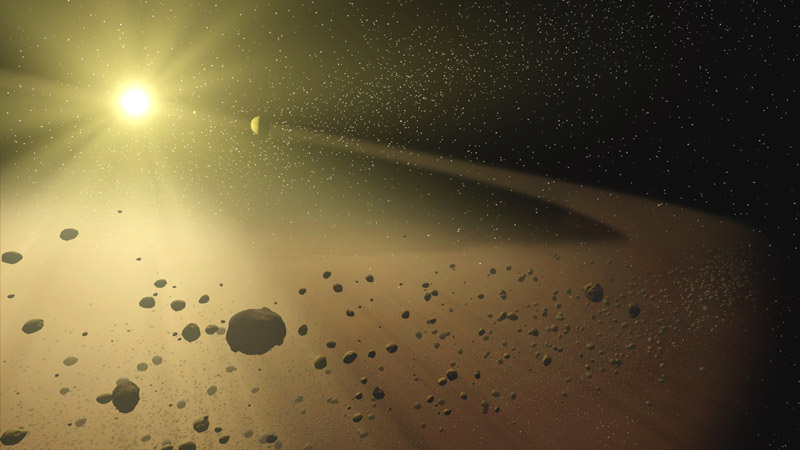
They
formed here at the birth of our Solar System 4.6 billion
years ago. Over
time, they might have come together by gravity to form
another planet except … scientists believe that the
presence of Jupiter’s gravity prevented a planet from
forming.
The Belt
is quite thin.
Let’s examine one of the Solar System’s larger asteroids
A
funny-shaped asteroid named Gaspra is
a large beige colored space rock about 9 km (5½ miles)
wide.
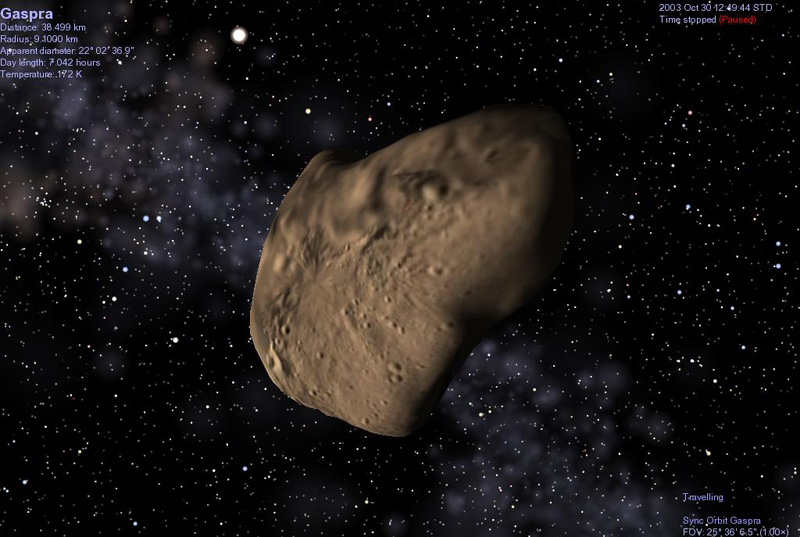
Gaspra is
a common asteroid. The Asteroid Belt is
full of similar rocks, all moving at high speeds through
the vast emptiness of space. However,
it is not the biggest asteroid. Until
recently, the biggest “asteroid” was
named “Ceres”. At 900
km (580 miles) in diameter, it is
spherical and orbits the sun here in the Asteroid Belt. Under
the new “Dwarf Planet” definition, however, Ceres
is now a Dwarf Planet”. The largest
asteroid now is Vesta (560
km). Recently, even bigger objects
have been discovered far beyond the orbit of Pluto. They
also meet the new definition of dwarf planets.
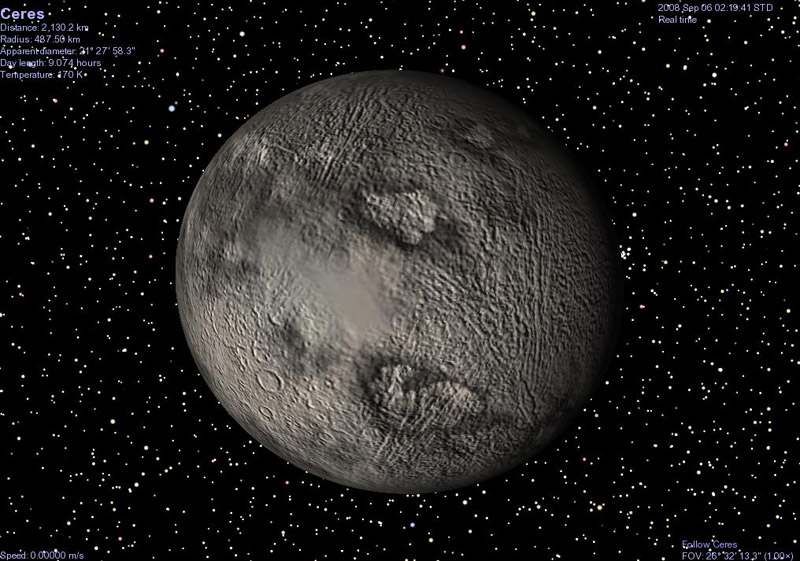
Ceres may
now be a “Dwarf Planet”, but it is essentially a big
rock, pockmarked with thousands of holes called
“Craters”. As you saw in Activity 3, these
craters are caused by other asteroids and space rocks
slamming into Ceres at high speed over billions of years
and leaving dents in the surface.
Ceres is
moving fast as its orbits the Sun. It is
traveling over 11 miles/sec (18 km/s).
Occasionally, big
asteroids collide with each other in space. When
that happens, they can break into smaller pieces, or
they can be knocked off their former course and head in
a new direction. Both possibilities occur
in space.
Once in
a great while,
an asteroid finds itself knocked into a new orbital path
headed toward the Sun and planets of the inner Solar
System, including Earth.
In the
history of Earth, many asteroids have actually collided
with our world. In
fact, it is common. Every day, over
100 small space rocks the size of
grapefruits or basketballs are captured by Earth’s
gravity. If they are so captured, we call them meteoroids.
Most burn
up and melt from friction as they enter and pass through
Earth’s protective atmosphere. If they
actually enter Earth’s atmosphere, we call them shooting
stars or meteors.
Let’s
visit another asteroid. It is an unusual
one called Ida.
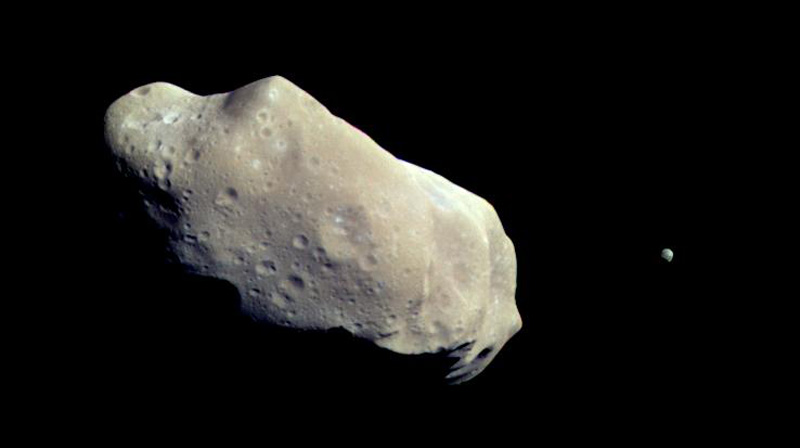
What a
strange potato-shaped space rock Ida is. It
is actually very big. It is 58 km long (about
36 miles) and 24 km (15 miles) wide. If
it ever collided with Earth, it would extinguish all
life on the planet.
Ida is
an asteroid that has its own small moon
orbiting it. In
fact, over 60 asteroids having small
moons have been located by Earth-based telescopes.
Al-Anbiya 21:32-33
In the name of Allah, the Beneficent, the Merciful
And we have made the sky a roof withheld (from them).
Yet they turn away from its portents. (32)
سورة الاٴنبیَاء
شروع الله کے نام سے جو بڑا مہربان نہایت رحم والا ہے
اور آسمان کو محفوظ چھت بنایا۔ اس پر بھی وہ ہماری نشانیوں
سے منہ پھیر رہے ہیں (۳۲)
5-10
bigger asteroid rocks,
however, don’t completely melt and are able to reach the
ground every day. If they do hit the
ground, we call them meteorites. When
they hit, they can leave holes or
craters in the ground. Most
meteorites go unnoticed, but one or two each year crash
inside populated areas. They even hit
houses and cars. No human
has ever been killed by one that we know of, but
several years ago, a dog was hit and killed by a
meteorite, and a woman had one crash through her house
roof and land in her lap (it bruised her legs badly, but
she survived OK). In 1983, a piece of
an asteroid slammed into the trunk of a car parked in a
girl’s driveway in New Jersey, and in 2003, a meteorite
crashed through the roof of a home in Texas and came to
rest in the downstairs family room.
Every
few million years,
a “BIG” asteroid the size of a mountain falls
to Earth like a giant cannon ball. When it
hits, the damage can be horrible. The
last such impact occurred about 100 years ago. In
1908, an asteroid or comet impacted an isolated area of
Siberia (part of Russia). No
one was living there at the time, but the impact
destroyed thousands of square miles of forest, and
killed thousands of animals and birds.
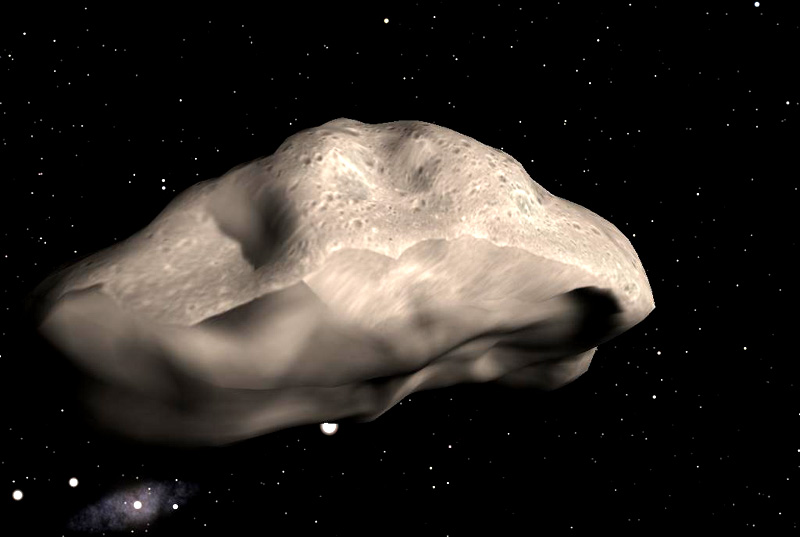
Al-Qamar 54:1-2
In the name of Allah, the Beneficent, the
Merciful
The hour drew nigh and the moon was rent in
twain. (1) And if they behold a portent they
turn away and say: Prolonged illusion. (2)
سورة القَمَر
شروع الله کے نام سے جو بڑا مہربان نہایت رحم والا
ہے
قیامت قریب آ پہنچی اور چاند شق ہوگیا
(۱)
اور اگر (کافر) کوئی نشانی دیکھتے ہیں تو منہ پھیر
لیتے ہیں اور کہتے ہیں کہ یہ ایک ہمیشہ کا جادو ہے
(۲)
Saba 34:9
In the name of Allah, the Beneficent, the Merciful
Have they not observed what is before them and what is
behind them of the sky and the earth? If We will, We can
make the earth swallow them, or cause obliteration from
the sky to fall on them. Lo! herein surely is a portent
for every slave who turneth (to Allah) repentant. (9)
سورة سَبَإ
شروع الله کے نام سے جو بڑا مہربان نہایت رحم والا ہے
کیا انہوں نے اس کو نہیں دیکھا جو ان کے آگے اور پیچھے ہے
یعنی آسمان اور زمین۔ اگر ہم چاہیں تو ان کو زمین میں
دھنسا دیں یا ان پر آسمان کے ٹکڑے گرا دیں۔ اس میں ہر بندے
کے لئے جو رجوع کرنے
والا ہے ایک نشانی ہے (۹)
Al-Naml 27:88
In the name of Allah, the Beneficent, the Merciful
And thou seest the hills thou deemest solid flying with
the flight of clouds: the doing of Allah Who perfecteth
all things. Lo! He is Informed of what ye do. (88)
سورة النَّمل
شروع الله کے نام سے جو بڑا مہربان نہایت رحم والا ہے
اور تم پہاڑوں کو دیکھتے ہو تو خیال کرتے ہو کہ (اپنی جگہ
پر) کھڑے ہیں مگر وہ (اس روز) اس طرح اُڑے پھریں گے جیسے
بادل۔ (یہ) خدا کی کاریگری ہے جس نے ہر چیز کو مضبوط
بنایا۔ بےشک وہ تمہارے سب افعال سے باخبر ہے (۸۸)
Ash-Shura 42:5
In the name of Allah, the Beneficent, the Merciful
Almost might the heavens above be rent asunder
سورة الشّوریٰ
شروع الله کے نام سے جو بڑا مہربان نہایت رحم والا ہے
قریب ہے کہ آسمان اوپر سے پھٹ پڑیں
65
million years ago,
an unnamed asteroid about the size of Gaspra (10
km) hit Earth in the Gulf of Mexico off the Yucatan Peninsula. It
left a giant hole (crater) in the ground over
200 km (125 mi) wide and 12 km (8 miles) deep. At
that time, there were no people. It was
the age of the dinosaurs and giant reptiles ruled the
land and the seas. The impact was so
terrible that life on Earth changed forever.
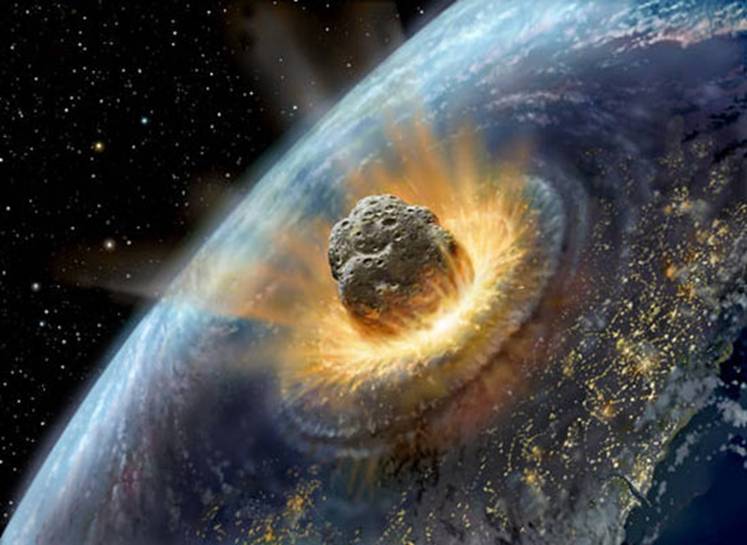
First, a
giant tidal wave (a tsunami),
was thrown up to a height of 300 meters (1000
ft), and raced in all directions for thousands of miles,
drowning everything in its path. That was nothing,
however, compared to what happened next. The
blast was so powerful that the crust of the Earth
cracked and lava poured out underwater. Enormous
amounts of melted rock, dust, steam and gases were
thrown high into the air and spread by winds. These
hot fragments fell back to Earth on forested areas and
set them on fire. Within weeks, the
skies over Earth darkened from ash, dust and smoke, and
temperatures plunged as sunlight was blocked out. The
rain became acidic from all the air pollution and the
ozone layer that protects our planet from excessive UV
radiation from the Sun was badly damaged, allowing
harmful UV to reach the ground.
Within
a few months, plant
and animal life began to die from the darkness, cold,
acid rain, radiation and lack of food. The
dinosaurs never recovered and they all died out. It
was the end of an era. In fact,
it is estimated that over 70%
of all life on Earth (plant and animal) was snuffed out
by this collision. It was a
true extinction level event
(ELE). Our
official name for it is the Cretaceous-Tertiary
Extinction.
Al-Anbiya 21: 11-12
In the name of Allah, the Beneficent, the Merciful
How many a community that dealt unjustly have We
shattered, and raised up after them another folk! (11)
And, when they felt Our might, behold them fleeing from
it! (12)
سورة الاٴنبیَاء
شروع الله کے نام سے جو بڑا مہربان نہایت رحم والا ہے
اور ہم نے بہت سی بستیوں کو جو ستمگار تھیں ہلاک کر مارا
اور ان کے بعد اور لوگ پیدا کردیئے (۱۱)
جب انہوں نے ہمارے (مقدمہ) عذاب کو دیکھا تو لگے اس سے
بھاگنے (۱۲)
Occasionally, big
asteroids collide with each other in space. When
that happens, they can break into smaller pieces, or
they can be knocked off their former course and head in
a new direction. Both possibilities occur
in space. Once in a great while, an
asteroid finds itself knocked into a new orbital path
headed toward the Sun and planets of the inner Solar
System, including Earth.
Watch a video clip of an asteroid collision impact on
earth
http://www.youtube.com/watch?v=poOE5woDpIE
Al-Baqara 2: 24
In the name of Allah, the Beneficent, the Merciful
Guard yourselves against the Fire prepared for
disbelievers, whose fuel is of men and stones. (24)
سورة البَقَرَة
شروع الله کے نام سے جو بڑا مہربان نہایت رحم والا ہے
اس آگ سے ڈرو جس کا ایندھن آدمی اور پتھر ہوں گے (اور جو)
کافروں کے لیے تیار کی گئی ہے (۲۴)
At-Tahrim 66:6
In the name of Allah, the Beneficent, the Merciful
O ye who believe! Ward off from yourselves and your
families a Fire whereof the fuel is men and stones
سورة التّحْریم
شروع الله کے نام سے جو بڑا مہربان نہایت رحم والا ہے
مومنو! اپنے آپ کو اور اپنے اہل عیال کو آتش (جہنم) سے
بچاؤ جس کا ایندھن آدمی اور پتھر
Hud 11:82
In the name of Allah, the Beneficent, the Merciful
So when Our commandment came to pass We overthrew (that
township) and rained upon it stones of clay, one after
another, (82)
سورة هُود
شروع الله کے نام سے جو بڑا مہربان نہایت رحم والا ہے
تو جب ہمارا حکم آیا ہم نے اس (بستی) کو (اُلٹ کر) نیچے
اوپر کردیا اور ان پر پتھر کی تہہ بہ تہہ (یعنی پےدرپے)
کنکریاں برسائیں (۸۲)
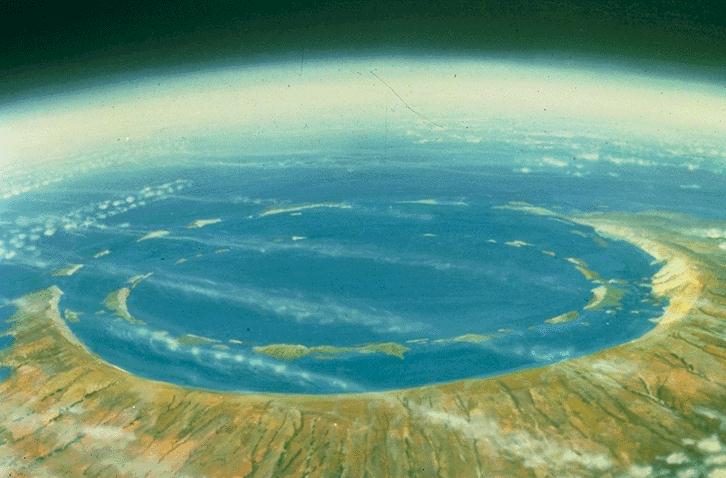
What is fascinating to realize is
that who can stop this extinction level event
ELE in future?
In
February, 2000, a special camera aboard the Space
Shuttle photographed what is left of that giant crater
(called the Chicxulub crater (what
a name!). It is filled in now with
millions of years of mud and sediment but is still just
visible (we’ve placed a faint circle on figure to
show you where it is).
Earth
has experienced at least 6
major extinctions throughout
the record of life on the planet. How many
of them were caused by other meteorite impacts is
unknown. However,
it is clear that asteroid collisions with Earth occur on
a regular basis, and another large one will head toward
a collision course with Earth again someday. It
could be millions of years from now, or it could be next
month.
Al-Anbiya 21:40
In the name of Allah, the Beneficent, the Merciful
Nay, but it will come upon them unawares so that it will
stupefy them, and they will be unable to repel it,
neither will they be reprieved. (40)
سورة الاٴنبیَاء
شروع الله کے نام سے جو بڑا مہربان نہایت رحم والا ہے
بلکہ قیامت ان پر ناگہاں آ واقع ہوگی۔ اور ان کے ہوش کھو
دے گی۔ پھر نہ تو وہ اس کو ہٹا سکیں گے اور نہ ان کو مہلت
دی جائے گی (۴۰)
This Article describes how the dooms day is going to
occur End
of Times!
Dooms Day…is
on its way!
...
Ash-Shura 42:17
In the name of Allah, the Beneficent, the Merciful
Allah it is Who hath revealed the Scripture with truth,
and the Balance. How
canst thou know? It may be that the Hour is nigh. (17)
سورة الشّوریٰ
شروع الله کے نام سے جو بڑا مہربان نہایت رحم والا ہے
خدا ہی تو ہے جس نے سچائی کے ساتھ کتاب نازل فرمائی اور
(عدل وانصاف کی) ترازو۔
اور تم کو کیا معلوم شاید قیامت قریب ہی آ پہنچی ہو (۱۷)
NASA, ESA and space agencies from
other nations are now watching the skies to make sure we
are not taken by surprise if another large asteroid
heads our way. The project is called the Near
Earth Objects Program.
NEO has
found that at least 2,500
asteroids exist in an orbit that
could conceivably bring them into a collision course
with Earth. Unfortunately, only 20% of
them have been properly identified to date. Hopefully,
we will find the other 80% before it is too late.
The Near
Earth Objects program has
discovered several asteroids that have passed by Earth
recently (fortunately without hitting us). One
of them almost smacked into Earth in March 2004, missing
us by only 3 Earth diameters (about 25,000 miles).
In 2029 (hopefully,
we’ll all still be alive and well) another asteroid is
going to pass even closer to Earth. In
fact, its close encounter may swing it on a new
trajectory around the sun that will give it a small
chance of hitting Earth
when we again meet up with it in 2036. It
is about 280 meters or 1/6 mile wide, and is moving very
fast. Its name is Apophis (also
known as 2004 MN4).
Using
binoculars on Earth, you should be able to see it pass
by for real in 2029. If we are very
unlucky, it will hit Earth in 2036, and everyone will
know what that will be like!!! If it did,
it most likely would smack into the ocean, creating a
huge tidal wave (tsunami). Sweeping out
from the impact site, it could drown thousands of miles
of coastline.
Humans are
not helpless when it comes to asteroids. It
is possible that if one on a collision course with Earth
was found soon enough, we could launch spacecraft that
could nudge its course enough to cause it to miss an
impact with Earth. However, we have no
such technical capability yet.\
Near-Earth Object Deflection Strategies
Strategies fall into two basic sets: destruction
and delay.
Destruction concentrates on rendering the impactor
harmless by fragmenting it and scattering the fragments
so that they miss the Earth or burn up in the
atmosphere. As will be shown, this does not always solve
the problem, as sufficient amounts of material hitting
the Earth at high speed can be devastating even if they
are not collected together in a single body.
Delay exploits the fact that both the Earth and the
impactor are in orbit. An impact occurs when both reach
the same point in space at the same time, or more
correctly when some point on Earth's surface intersects
the impactor's orbit when the impactor arrives. Since
the Earth is approximately 12,750 km in diameter and
moves at approx. 30 km per second in its orbit, it
travels a distance of one planetary diameter in about
425 seconds, or slightly over seven minutes. Delaying,
or advancing the impactor's arrival by times of this
magnitude can, depending on the exact geometry of the
impact, cause it to miss the Earth. By the same token,
the arrival time of the impactor must be known to this
accuracy in order to forecast the impact at all, and to
determine how to affect its velocity.
Nuclear weapons
One of the often proposed solutions is firing nuclear
missiles at the oncoming asteroid to vaporize all or
most of it. If not completely vaporized, the resulting
reduction of mass from the blast combined with the
radiation blast and rocket exhaust effect from ejecta
could produce positive results. The largest problem with
this solution is that if the asteroid breaks into
fragments, any fragment larger than 35 m across would
not burn up in the atmosphere and itself could impact
Earth. Tracking of the thousands of fragments that could
result would prove daunting.
Another proposed solution is to detonate a series of
smaller nuclear devices alongside the asteroid, far
enough away as not to fracture the object. Providing
this was done far enough in advance, the relatively
small forces from any number of nuclear blasts could be
enough to alter the object's trajectory enough to avoid
an impact. This is a form of nuclear pulse propulsion.
In 1967, students at the Massachusetts Institute of
Technology designed a system using nuclear explosions to
prevent a hypothetical impact on Earth by the asteroid
1566 Icarus. This design study was later published as
Project Icarus (MIT Press, 1968), which served as the
inspiration for the 1979 film Meteor.
Kinetic Impact
An alternative means of deflecting an asteroid is to
attempt to directly alter its momentum by sending a
spacecraft to collide with the asteroid.
The European Space Agency is already studying
preliminary design of a space mission able to
demonstrate this futuristic technology. The mission,
named Don Quijote, is the first real asteroid deflection
mission ever designed.
In the case of 99942 Apophis it has been demonstrated by
ESA's Advanced Concepts Team that deflection could be
achieved by sending a simple spacecraft weighing less
than one ton to impact against the asteroid. During a
trade-off study one of the leading researchers argued
that a strategy called 'kinetic impactor deflection' was
more efficient than others.
Asteroid gravitational tractor
The major alternative to explosive deflection is to move
the asteroid slowly over a period of time. Tiny constant
thrust accumulates to deviate an object sufficiently
from its predicted course. Edward T. Lu and Stanley G.
Love have proposed using a large heavy unmanned
spacecraft hovering over an asteroid to gravitationally
pull the latter into a non-threatening orbit. The
spacecraft and the asteroid mutually attract one
another. If the spacecraft counters the force towards
the asteroid by, e.g., an ion thruster, the net effect
is that the asteroid is accelerated towards the
spacecraft and thus slightly deflected from its orbit.
While slow, this method has the advantage of working
irrespective of the asteroid composition or spin rate rubble
pile asteroids would be difficult or impossible to
deflect by means of nuclear detonations while a pushing
device would be hard or inefficient to mount on a fast
rotating asteroid. A gravity tractor would likely have
to spend several years beside the asteroid to be
effective.
Use of focused solar energy
NASA study
of a solar sail. The sail would be 0.5 km wide.
H. Jay Melosh proposed to deflect an asteroid or comet
by focusing solar energy onto its surface to create
thrust from the resulting vaporization of material, or
to amplify the Yarkovsky effect. Over a span of months
or years enough solar radiation can be directed onto the
object to deflect it.
Mass driver
A mass driver is an (automated) system on the asteroid
to eject material into space thus giving the object a
slow steady push and decreasing its mass. A mass driver
is designed to work as a very low Specific Impulse
system, which in general uses a lot of propellant, but
very little power.
The idea is that when using local material as
propellant, the amount of propellant is not as important
as the amount of power, which is likely to be limited.
A mass driver can impart a lot more momentum to an
asteroid than a rocket carried there.
Conventional Rocket Motor
Attaching any spacecraft propulsion device would have a
similar effect of giving a steady push, possibly forcing
the asteroid onto a trajectory that takes it away from
Earth. An in-space rocket engine that is capable of
imparting an impulse of 1E6 m-sec (E.g. adding 1 km/sec
to a 1 ton vehicle), will have a relatively small effect
on a relatively small asteroid that weighs roughly a
million times more.
Other proposals
Wrapping the asteroid in a sheet of reflective plastic
such as aluminized PET film, or dusting the object with
titanium dioxide to alter its trajectory via radiation
pressure
Dusting the object with soot to alter its trajectory via
the Yarkovsky effect
Attaching a large enough solar sail directly to the
object, thus using solar pressure to shift the object's
orbit
Chapman, Durda & Gold's white paper calculates
deflections using existing chemical rockets, delivered
to the asteroid, then push it sideways, assuming
sufficient fuel also delivered
The late Eugene Shoemaker in 1996 proposed deflecting a
potential impactor by releasing a cloud of steam in the
path of the object, hopefully gently slowing it. Nick
Szabo in 1990 sketched a similar idea, "cometary
aerobraking", the targeting of a comet or ice construct
at an asteroid, then vaporizing the ice with nuclear
explosives to form a temporary atmosphere in the path of
the asteroid.
Deflection technology concerns
Carl Sagan, in his book Pale Blue Dot, expressed
concerns about deflection technology: that any method
capable of deflecting impactors away from
Earth could also be abused to divert non-threatening
bodies toward the
planet. Considering the history of genocidal political
leaders and the possibility of the bureaucratic
obscuring of any such project's true goals to most of
its scientific participants, he judged the Earth at
greater risk from a man-made impact than a natural one.
Sagan instead suggested that deflection technology
should only be developed in an actual emergency
situation.
Analysis of the uncertainty involved in nuclear
deflection shows that the ability to protect the planet
does not imply the ability to target the planet. A
nuclear bomb which changed an asteroid's velocity by 10
meters/second (plus or minus 20%) would be adequate to
push it out of an earth-impacting orbit. However, if the
uncertainty of the velocity change was more than a few
percent, there would be no chance of directing the
asteroid to a particular target.
Find more at http://en.wikipedia.org/wiki/Asteroid_deflection_strategies also http://neo.jpl.nasa.gov
Now Read Carefully what Allah said in Quran…
سُوۡرَةُ إبراهیم
بِسۡمِ ٱللهِ ٱلرَّحۡمَـٰنِ ٱلرَّحِيم
وَقَدۡ مَكَرُواْ مَڪۡرَهُمۡ وَعِندَ ٱللَّهِ مَڪۡرُهُمۡ
وَإِن كَانَ مَڪۡرُهُمۡ لِتَزُولَ مِنۡهُ ٱلۡجِبَالُ (٤٦)
فَلَا تَحۡسَبَنَّ ٱللَّهَ مُخۡلِفَ وَعۡدِهِۦ رُسُلَهُ ۥۤۗ
إِنَّ ٱللَّهَ عَزِيزٌ۬ ذُو ٱنتِقَامٍ۬ (٤٧)
يَوۡمَ تُبَدَّلُ ٱلۡأَرۡضُ غَيۡرَ ٱلۡأَرۡضِ
وَٱلسَّمَـٰوَٲتُۖ
وَبَرَزُواْ لِلَّهِ ٱلۡوَٲحِدِ ٱلۡقَهَّارِ ِ
Ibrahim 14: 46-47
Verily they have plotted their plot, and
their plot is with Allah, though
their plot were such whereby the mountains should be
moved. (46) So think not that Allah
will fail to keep His promise to His messengers. Lo!
Allah is Mighty, Able to Requite (the wrong). (47)
اور انہوں نے (بڑی بڑی) تدبیریں کیں اور ان کی (سب)
تدبیریں خدا کے ہاں (لکھی ہوئی) ہیں گو
وہ تدبیریں ایسی (غضب کی) تھیں کہ ان سے پہاڑ بھی ٹل جائیں (۴۶)
تو ایسا خیال نہ کرنا کہ خدا نے جو اپنے پیغمبروں سے وعدہ
کیا ہے اس کے خلاف کرے گا بےشک خدا زبردست (اور) بدلہ لینے
والا ہے (۴۷)
Watch a video clip of an asteroid collision impact on
earth
http://www.youtube.com/watch?v=poOE5woDpIE
Al-Anbiya 21:37-40
In the name of Allah, the Beneficent, the Merciful
Man is made of haste. I shall show you My portents, but
ask Me not to hasten. (37) And they say: When will this
promise (be fulfilled), if ye are truthful? (38) If
those who disbelieved but knew the time when they will
not be able to drive off the fire from their faces and
from their backs, and they will not be helped! (39) Nay,
but it will come upon them unawares so that it will
stupefy them, and they will be unable to repel it,
neither will they be reprieved. (40)
سورة الاٴنبیَاء
شروع الله کے نام سے جو بڑا مہربان نہایت رحم والا ہے
انسان (کچھ ایسا جلد باز ہے کہ گویا) جلد بازی ہی سے بنایا
گیا ہے۔ میں تم لوگوں کو عنقریب اپنی نشانیاں دکھاؤں گا تو
تم جلدی نہ کرو (۳۷)
اور کہتے ہیں کہ اگر تم سچے ہو تو (جس عذاب کا) یہ وعید
(ہے وہ) کب (آئے گا)؟ (۳۸)
اے کاش کافر اس وقت کو جانیں جب وہ اپنے مونہوں پر سے
(دوزخ کی) آگ کو روک نہ سکیں گے اور نہ اپنی پیٹھوں پر سے
اور نہ ان کا کوئی مددگار ہوگا (۳۹)
بلکہ قیامت ان پر ناگہاں آ واقع ہوگی۔ اور ان کے ہوش کھو
دے گی۔ پھر نہ تو وہ اس کو ہٹا سکیں گے اور نہ ان کو مہلت
دی جائے گی (۴۰)
Jupiter
Galileo’s
observations helped to launch a scientific revolution of
discovery in Europe. To
honor him, NASA launched a spacecraft in 1989 to orbit
and to explore Jupiter, and named it “Galileo”. It
arrived in Jupiter space in 1995 and studied this
amazing planet and its many moons until
September, 2003, when it finally plunged into the
atmosphere of Jupiter and burned up. To
see one of Galileo’s dramatic
encounters in space as it orbited Jupiter in 2001, Galileo will
fly past you at 1/2500th its
real speed.
What an
amazing looking world.
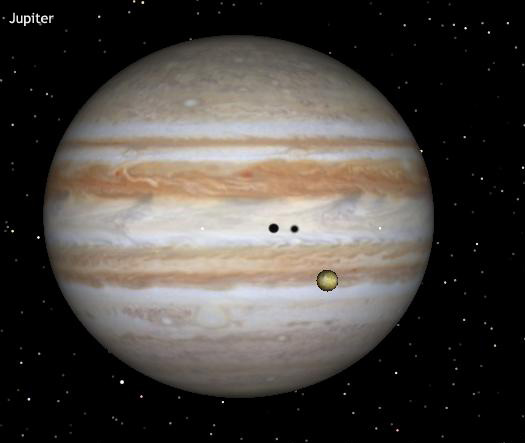 Jupiter
was named over 2,000 years ago in
honor of Jupiter Optimus
Maximus, the supreme god of the Roman empire. It
is one of the four giant gas planets; huge
balls of gas, liquid/frozen slush and rock. It has a
rocky core made of all the heavy elements of the Solar
System. Surrounding that core is thousands of miles
of mostly frozen, liquid and gaseous Hydrogen (90% of
Jupiter), the lightest and most common element
in the universe. Above it is the planet’s gas
atmosphere, made of thousands of miles of hydrogen,
helium and traces of methane, ammonia, sulfur and
water.
Jupiter
was named over 2,000 years ago in
honor of Jupiter Optimus
Maximus, the supreme god of the Roman empire. It
is one of the four giant gas planets; huge
balls of gas, liquid/frozen slush and rock. It has a
rocky core made of all the heavy elements of the Solar
System. Surrounding that core is thousands of miles
of mostly frozen, liquid and gaseous Hydrogen (90% of
Jupiter), the lightest and most common element
in the universe. Above it is the planet’s gas
atmosphere, made of thousands of miles of hydrogen,
helium and traces of methane, ammonia, sulfur and
water.
Jupiter has no clear solid surface surrounded
by thin clouds of hydrogen, helium, methane and ammonia.
It has 63
moons.
No one
knew Jupiter had a ring like Saturn until
the 1970’s, when it was discovered by a spacecraft named Voyager
1 as it flew past Jupiter. It
is very faint and not visible from Earth, but can be
made out when you get close to the planet.
Planetary
rings are made of rock debris, dust and
ice particles that have been caught in
the planet’s gravitational field. Jupiter’s
wispy rings appear to be dust grains captured by its
gravity; going too fast to fall into the planet, but too
slow to escape into space, orbiting the planet on an
endless merry-go-round. Eventually, pieces
of ring will fall into the planet’s atmosphere, burning
up as meteors. Over millions of years,
Jupiter’s current ring will slowly disappear. Someday
another may form.
Jupiter is
our Solar System’s largest planet. It is 11
times wider than Earth and over 320
times more massive. Over 1,400 Earths
could fit inside its volume. Its gravity
is 2.5 times greater
than on Earth so a 130 lb person would weigh 325 lbs.
The Red
spot is a huge rotating, hurricane type of storm that
has been raging for over 300 years in that same place. No
one knows how it formed or why it keeps blowing at over
2,000 km/hr (1200 mph). However, it is
HUGE. The entire Earth would fit inside it
with room to spare.
Because it
is farther from the Sun, Jupiter takes 11.9
years to travel once in its revolution around
the Sun. Jupiter also spins incredibly
fast. It rotates once
on its axis in only 9.9 hours. That
is an ENORMOUS speed. Its spin has caused
the planet to bulge at its midsection (equator). Its
cloud tops are whizzing around the planet … are you
ready for this … at 28,200 miles/hr
(45,400 km/hr)
Jupiter’s four major moons
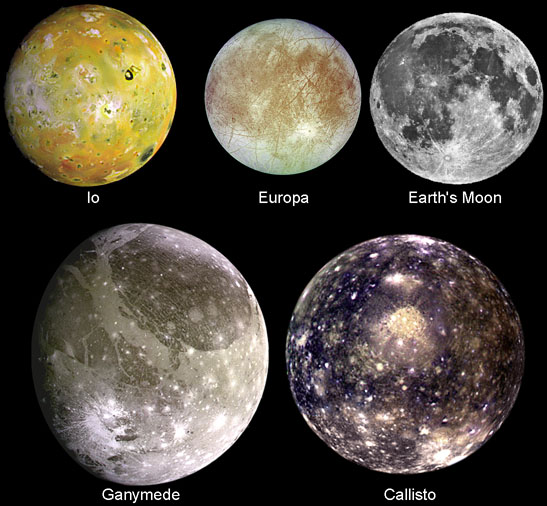 For
virtually all of human history, no one knew Jupiter even
had moons, let alone how many it had! In
1609, Galileo Galilee designed
the world’s first refractor telescope. One
dark night, he pointed it at Jupiter and discovered that
the planet had four large moons orbiting it. Over
time, Galileo confirmed the Heliocentric theory of
the Solar System, that is; that the Sun
is the center of our Solar System and the planets (and
moons) circle the Sun and each other. Galileo
was not the first to propose that idea. In
fact, Nicolas Copernicus also
made major contributions to the theory.
For
virtually all of human history, no one knew Jupiter even
had moons, let alone how many it had! In
1609, Galileo Galilee designed
the world’s first refractor telescope. One
dark night, he pointed it at Jupiter and discovered that
the planet had four large moons orbiting it. Over
time, Galileo confirmed the Heliocentric theory of
the Solar System, that is; that the Sun
is the center of our Solar System and the planets (and
moons) circle the Sun and each other. Galileo
was not the first to propose that idea. In
fact, Nicolas Copernicus also
made major contributions to the theory.
Today, the
four moons that Galileo discovered are named the Galilean
moons in his honor.
There are
many strange worlds in our Solar System. The
first Galilean moon, named Io, is
one of them.
Io is
an amazing place. What do you notice on
the dark side of Io? Although it is far
from the Sun and is frigidly cold (-140° C or -220° F),
it has over 300 active volcanoes. Many
of them erupt every few weeks. In front of
you now in fact, there are at least 50 volcanoes
erupting lava, and one of them, a volcano named “Pele”,
is actively spewing huge jets of sulfur ash. You
can see it off on the left.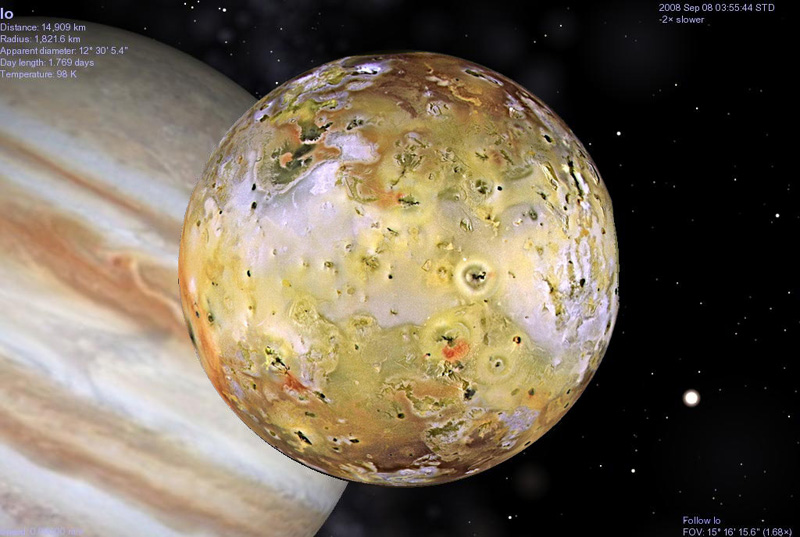
Io is
so close to Jupiter that
Jupiter’s gravity tugs on it and flexes it, like you
squeezing a rubber tennis ball. The
gravitational flexing forces Io’s rocks
to rub against each other deep within the moon. If
you landed on it, you would feel Io groaning and
creaking. That rubbing generates
frictional heat. Internally, the heat
melts some of its rock. The result is a
semi-molten interior and volcanic eruptions on the
surface.
In
fact, there are four places in our Solar System where
active eruptions occur. They
are Earth, Io, Enceladus,
a moon of Saturn, and Triton, a
moon of Neptune (more
on them later). However, what comes out of
these eruptions is very different. On
Earth, molten rock, lava and water steam erupt. On Io,
eruptions contain very hot molten rock, with lots of
sulfur gases but no water. On Enceladus,
the eruptions are cold liquid. We think it
may be water geysers. On Triton,
the eruptions are super-ice cold, frigid liquid
nitrogen (at a temperature below
-200° C).
Jupiter’s second Galilean moon is ever more exciting
Drifting
before you is dramatic Europa. See
all those cracks? Europa appears
to be covered in a vast frozen ocean
of water. We think those are BIG
cracks in that ocean’s ice. Under that
ice, far below, some scientists believe there may be
a liquid ocean. That
is because Europa also flexes in Jupiter’s gravity and
is, therefore, warm internally … warm enough to melt ice
into water. Where there is liquid water,
perhaps there is life!
Jupiter’s third Galilean satellite has its own claim to
fame.
The world
before you is the Solar System’s largest
moon. Ganymede is
bigger than Pluto and Mercury and is almost 1½ times
bigger than our moon. It too is made of
ice and rock and has craters. Notice,
however, that the craters seem to be filled in. Also,
do you notice places where the ice looks like it melted
and flowed as water channels, at least for a few days? They
probably did! Check it out!
If Ganymede had not been
captured by Jupiter’s gravity a long time ago, it would
still be in orbit around the Sun, not Jupiter, and would
qualify as a Solar System planet.
Callisto is
an average sized moon but it is F-U-L-L
of craters. It looks like it has a bad
case of acne. It has more craters than
any other moon in the Solar System. Remember
that craters are caused by impacts from asteroids. Callisto must
have been in the way of a swarm of millions of asteroids
sometime long ago. As you can see, its
craters are mostly filled in, proving that its surface
also has ice that melted and refroze in the craters.
The Voyager and Galileo spacecraft
have discovered that Jupiter has 63
moons. Many are small, and they
orbit the planet in a wide range of positions. They
are all made of rocks and/or ice and are probably
captured asteroids or comets that strayed too close to
Jupiter during the formation of the Solar System, and
became trapped by it’s gravity. From time
to time, another asteroid may be captured on its journey
around the Sun by Jupiter’s powerful gravity and become
yet another moon.
Saturn
On to Saturn! What
a view!
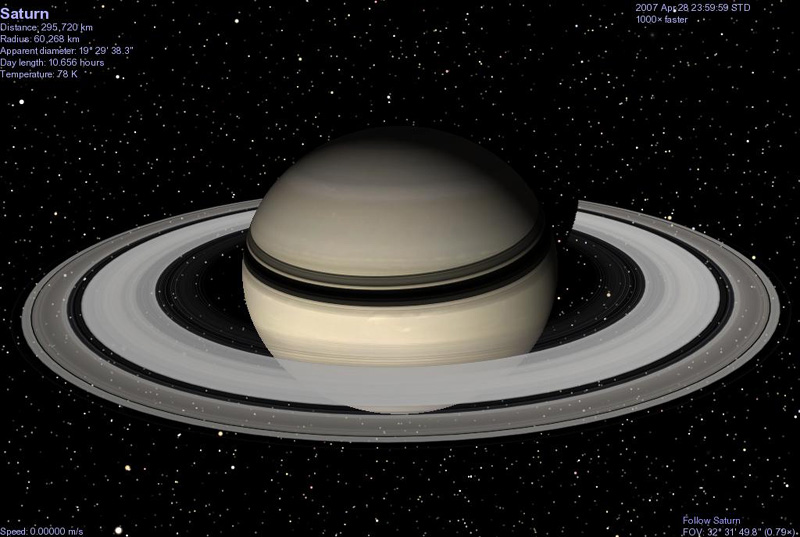
WOW! What
a dramatic world! Just
watch it for a minute to enjoy its beauty.
Saturn is
named after another God of Roman Mythology. Many
folks feel Saturn is the most beautiful of the planets. It
is a large planet, very bright in the night sky of
Earth. Its famous rings can be seen even
in a small telescope.
Saturn
is also a big gas planet that
formed like Jupiter 4.6 billion years
ago. It too is made of a rocky core
surrounded by thousands of miles of mostly hydrogen,
plus helium, methane, ammonia and sulfur gases. It
also has no solid surface.
Its color
is different from Jupiter due to different
concentrations of ammonia and methane in its outer
atmosphere.
Saturn is 9
au from the Sun and takes 29.46
years to go around the Sun once. An Astronomical
Unit (au) is the
distance from the Earth to the Sun, and equals
a whopping 93,000,000 miles (150,000,000 km). Saturn
is, therefore, nine times further away from the Sun than
is Earth.
What is
most amazing about Saturn and
the other gas planets of the outer Solar System are
their speeds. They are all spinning like
tops. Saturn, for example, turns once on
its axis every 10.67 hours,
just slightly slower than Jupiter.
Pan: a
moon of Saturn.
The United
States has
sent four spacecraft to Saturn so far. In
the late 1970’s, Pioneer 11 became
the first spacecraft to ever fly past the planet. The
following two years, Voyager 1 and Voyager
2 both made flybys. Their
spectacular photos documented much about Saturn and
discovered its many moons.
However,
the fourth American/European spacecraft is the newest
and most exciting visitor to Saturn. Its
name is “Cassini”, named in honor
of the man who discovered Saturn’s rings through a
telescope in 1675. On June
30, 2004, it arrived at Saturn after a seven-year
voyage from Earth and went into orbit around the ringed
planet. That journey is the most amazing
and complex feat of celestial mechanics man has ever
achieved.
Cassini has
instruments to study Saturn, its rings and moons,
magnetic fields and composition. Cassini also
carried a probe (called Huygens)
that detached from the main spacecraft in January 2005
and parachuted down into the atmosphere of one of
Saturn’s fascinating moons, Titan.
Saturn’s Moons
Saturn is a large planet and its gravity has captured
many passing asteroids and comets, swinging them into
orbits around Saturn as moons. At last
count, it has 62 moons. Most
consist of small, spherical or irregular shaped rocks
with impact craters and ice that were captured by
Saturn’s immense gravity.
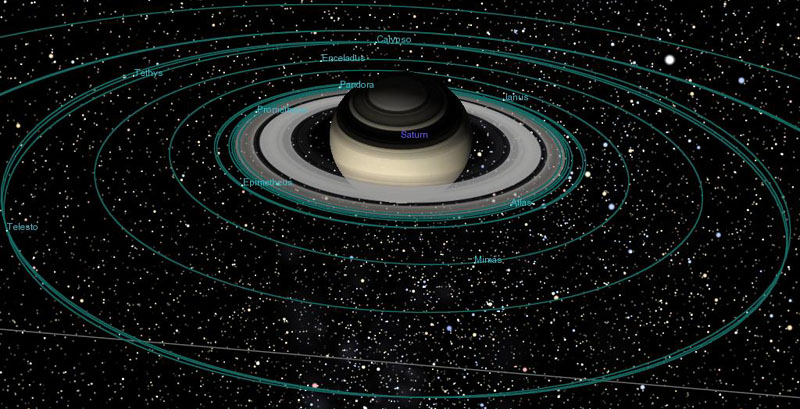
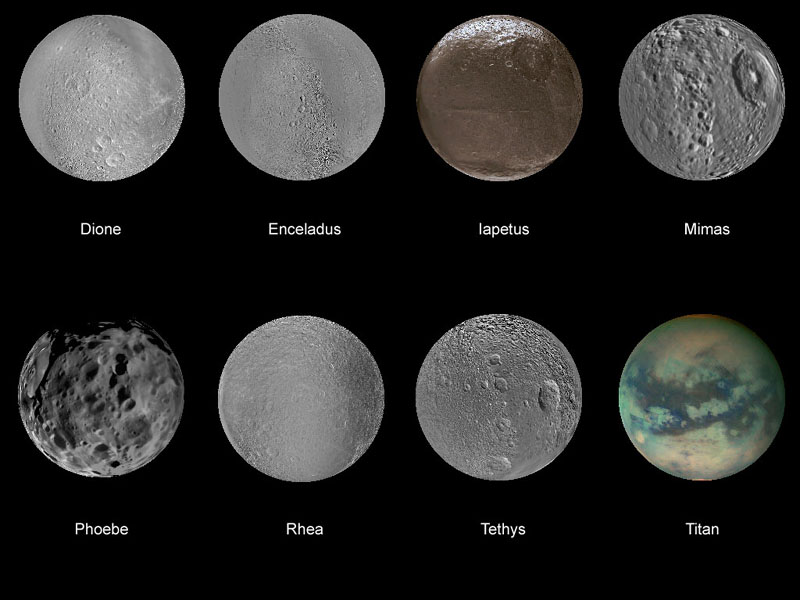
Saturn’s largest moon
is Titan, Some
Astronomers feel Titan may be the most exciting object
in the Solar System.
Titan is
smaller than Ganymede but larger than both Mercury and
Pluto. At 5,150 km (3200 miles), it also
is
large enough to be a planet were it orbiting the
Sun instead of Saturn.
Titan
possesses something rare for any moon; a thick atmosphere. Its
atmosphere is actually denser than Earth’s air. That
colored haze is mostly nitrogen gas, mixed with
hydrocarbon gases rich in methane and ethane, the same
compounds we use here on Earth for fuel. Its
atmosphere is an un-breathable, natural type of smog! It
is so thick that we cannot see Titan’s surface
in visible light.
Titan also
has some other features that
are frankly, really strange. It is so
cold in its orbit that some of its gas
vapors have condensed into a liquid. Ethane
for example, is a liquid at Titan’s temperature. It
is, therefore, probable that there are liquid
lakes of hydrocarbons on Titan,
like big lakes of gasoline. In fact, at
times, nitrogen, hydrocarbon and methane snowdrifts may
cover part of this crazy moon’s rocky and icy surface.
If the
atmosphere contains flammable gases, then could Titan catch
fire? The answer is “No”. The
gases are not concentrated enough and there is no
oxygen, which is needed for combustion. Its surface is
frozen at over -300o F, and is
covered in brown hydrocarbon ices and slush. Behind
it is a liquid lake of methane. Somewhere above those
dense clouds is the sun.
Titan’s
atmosphere is so thick that
you cannot ever see any stars or objects in space from
the surface. Even Saturn is not visible.
Titan greatly
excites space scientists. Nitrogen
is the same gas our atmosphere is made of. It
is also a key component of proteins, which are the
building blocks of all life on Earth. Methane
is made of carbon. So is life on Earth. Titan also
has water, although it’s frozen as ice. Put
nitrogen, water, carbon and sunlight energy together and
you have four key elements for life. Could
this moon of Saturn have life forms on it? Many
people want to find out! All that methane
is a tantalizing hint. Methane is
frequently produced by living things, at least here on
Earth. Is the same true on Titan?
In 2007, one of Saturn’s bigger moons also made news. The Cassini
spacecraft discovered that the moon Enceledus was
erupting a liquid geyser of … water. It
appears that its closeness to Saturn flexes Enceledus,
generating enough internal heat to melt some ice and
create liquid ground water inside the moon. On
Enceledus, sometimes … that water squirts out, only to
freeze on the surface.
How beautiful! its cracks and few craters. The
cracks are blue because frozen ice absorbs light in such
a way that the ice looks blue (glacier ice on Earth also
looks blue)
We are
going to visit one more moon in Saturn space Iapetus
As you
can see now, there is no shortage of water in the outer
solar system. Virtually all moons have
lots of it, as do the comets…
An-Nahl 16:10-12
In the name of Allah, the Beneficent, the Merciful
He it is Who sendeth down water from the sky, whence ye
have drink, and whence are trees on which ye send your
beasts to pasture. (10) Therewith He causeth crops to
grow for you, and the olive and the date-palm and grapes
and all kinds of fruit. Lo! herein is indeed a portent
for people who reflect. (11) And He hath constrained the
night and the day and the sun and the moon to be of
service unto you, and the stars are made subservient by
His command. Lo! herein indeed are portents for people
who have sense. (12)
سورة النّحل
شروع الله کے نام سے جو بڑا مہربان نہایت رحم والا ہے
وہی تو ہے جس نے آسمان سے پانی برسایا جسے تم پیتے ہو اور
اس سے درخت بھی (شاداب ہوتے ہیں) جن میں تم اپنے چارپایوں
کو چراتے ہو (۱۰)
اسی پانی سے وہ تمہارے لیے کھیتی اور زیتون اور کھجور اور
انگور (اور بےشمار درخت) اُگاتا ہے۔ اور ہر طرح کے پھل
(پیدا کرتا ہے) غور کرنے والوں کے لیے اس میں (قدرتِ خدا
کی بڑی) نشانی ہے (۱۱)
اور اسی نے تمہارے لیے رات اور دن اور سورج اور چاند کو
کام میں لگایا۔ اور اسی کے حکم سے ستارے بھی کام میں لگے
ہوئے ہیں۔ سمجھنے والوں کے لیے اس میں (قدرت خدا کی بہت
سی) نشانیاں ہیں (۱۲)
Uranus
7th planet
from the Sun, Uranus (pronounced
YOURanos)
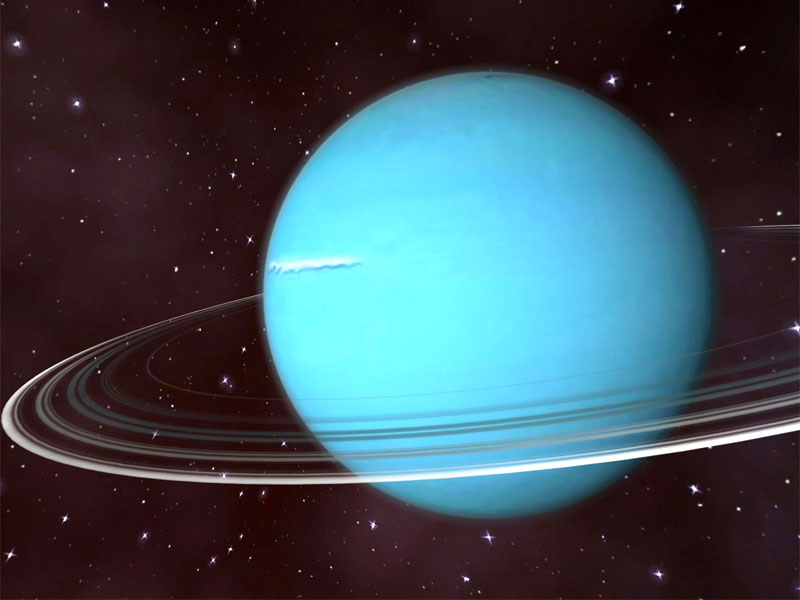
Uranus is
the third of the four giant gas planets. Its
name comes from the Greek for their supreme God, Uranus,
the father of all Gods. Like Jupiter and
Saturn, it is 4.6 billion years old, has a small rocky
core with no solid surface and is composed primarily of
frigidly cold liquid hydrogen, helium, methane, ammonia
and water slush that becomes gas nearer its cloud tops. However, it
has more methane in its thick atmosphere than either
Jupiter or Saturn, which gives it a beautiful pale blue
color (methane absorbs red light and
reflects blue light).
In
1986, NASA’s Voyager 2 spacecraft was
the only spacecraft from Earth ever to fly close to
Uranus. It took spectacular pictures. One
of the reasons it took a long time to get even one
spacecraft out to Uranus is its distance from the Sun. It
is almost 2 billion miles from
its warmth. It is so cold that the
temperature near the cloud tops of Uranus is -220°
C, or -365° F.
That
distance requires a great deal of time to cover. Uranus
takes 84 years to
revolve around (orbit) the Sun just once. It
is amazing that the Sun’s gravitational force is strong
enough to hold onto it.
Uranus
has thick icy clouds and
a dense atmosphere thousands of miles thick. It
rotates very fast, making one turn on its axis in 17.25
hours. You can imagine what it
would be like to be inside but near the top of Uranus’s
frozen blue cloud atmosphere.
Uranus
also has a small faint ring. It
formed long ago by collision of moons that were at one
time, orbiting Uranus.
Like
all planets,
Uranus is tilted on an imaginary axis running from its
North to its South Pole. However, Uranus
is tilted more than 90° in relation to its rotation. That
could not form at the time of the planet’s formation,
because the nebula from which the Sun and all planets
formed rotated in only one direction, called the “ecliptic
plane”. That rotation also gave
the Sun and planets their spin.
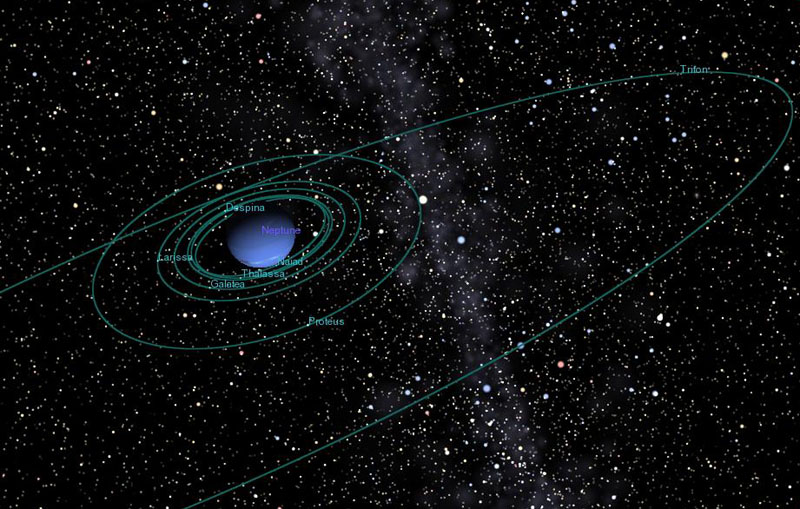
Uranus,
however, is severely tilted in relation to that plane. Further,
notice that its moons are also going
around Uranus in a direction at right angles from
the other moons around the other planets. Scientists
believe that the only explanation that fits these facts
is a dramatic one. A long time ago,
Uranus must have had a great encounter with another
planet. The force was so strong that
it knocked the planet on its side and swung its moons on
a different track. In fact, there is good
evidence that Earth may also have been hit by a giant
planetary collision that resulted in the formation of
our moon. If true, there
were lots of planets in our Solar System at one time.
Uranus
also has many moons. It took the flyby by Voyager
2 and powerful telescope surveys from
Earth to determine that Uranus has at least 27
moons (discovered so far). Its
largest moon is named, Titania. It
is about 40% the size of our Moon.
Another
moon is a real strange one. The moon is Miranda. It
seems to be in pieces cemented together with ice with
cracks all over it and material sticking out in
different directions. It is probable that
Miranda broke into pieces long ago by collision with
another moon and then came together again by gravity
into a new round shape.
Neptune
What a
beautiful planet. It really is that blue!
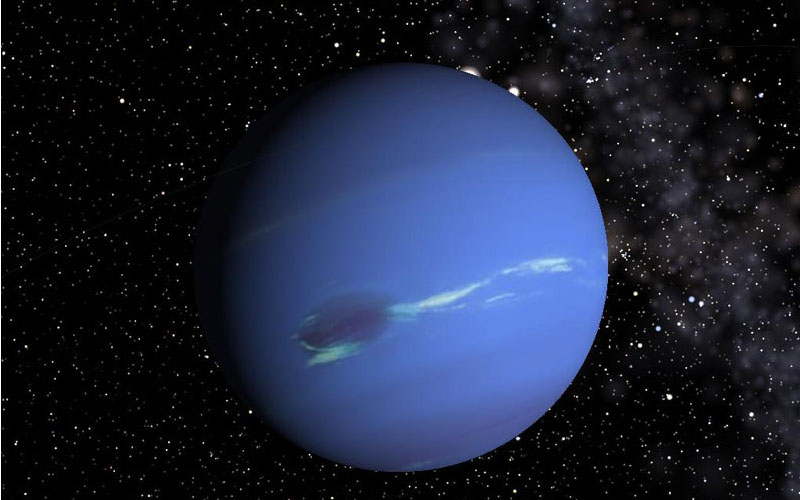
Neptune is
the last of the four giant gas planets. It
formed identically to Jupiter, Saturn and Uranus, 4.6
billion years ago. It too is made
of a small rocky core surrounded by trillions of tons of
liquid and gaseous hydrogen and helium, with
traces of water, methane and ammonia. Consequently,
like the other gas giants, Neptune has
no solid “surface”. However, its rock/ice
core is larger than is typical for the other gas giants,
so in a sense, Neptune is
both a solid, liquid and gas world.
Its
beautiful deep blue color is
the result of extra amounts of
methane gas in its atmosphere,
which absorbs the red part of the light of the Sun while
letting more blue come through.
Like the
other gas giants, it is thickly covered in clouds. The
cloud droplets are frozen ices. It
never rains or snows on Neptune but
methane, ammonia and water ice particles move around at
high speed due to the fast rotation of the planet. Neptune is
in a perpetual gloomy deep-freeze. The
temperature of its outer clouds reach a bone-chilling
-230° C (-380° F). They are so cold
that if you somehow exposed your arm to them, your arm
would freeze absolutely solid in a minute or two.
Neptune turns
once every 16.1 hours,
creating clouds at the top of the planet that zip
through space at over 12,000 mph. Deeper
down, winds blow the fastest in the Solar System. In
fact, that big dark spot you see is a giant rotating
hurricane just like the Great
Red Spot of
Jupiter. The storm on Neptune,
however, is called the “Great Dark Spot”.
Unlike Jupiter’s Red Spot, which has been there for at
least 300 years, the Great Dark Spot comes
and goes. It was present in 1989, but in
1992 it vanished, only to reappear in 1996 and vanish
again after that. .
As you can
imagine, Neptune is
so far from the Sun that it takes a VERY
long time to orbit the Sun once. Its
orbital revolution period is 164.8
years. Think about how long that
is. The last time Neptune was in the
position it is today, the year was 1844 and slavery was
still a practice in America.
Neptune also
has a thin ghostly ring. That
makes all four gas giant planets with rings. It
is probably made of dust & ice captured by Neptune’s
gravity.
Neptune has 13
moons. All but one of them has
been discovered only in the last 25 years. Most
are small, rocky and ice covered.
Imagine
its constant frozen journey around this giant world,
forever trapped in Neptune’s
powerful gravity. This moon name is Galatea.
Neptune’s
largest moon Nereid is
very unusual. One of them, far away from the planet, is
moving differently from the others.
Rocky moon
covered in ice named Triton (not
… Titan … that’s
Saturn’s moon. This one is Triton).
We believe Triton was
a planet of our Solar
System orbiting the Sun in the vicinity of Neptune. Long
ago, it had a close encounter with another planet or
moon and was slowed down in its orbit around the Sun,
allowing Neptune to capture it by gravity as a new moon,
with the final path it took around Neptune being
opposite to the normal path of Neptune’s
moons.
Triton is
a world of rock and ice. It
is covered in both and even has ice cliffs. However,
on Triton, scientists
believe the ice is not frozen water … but
frozen nitrogen. If you look closely,
you will also see dark smudges on
the colored ice. Those smudges were first
discovered in 1989 when Voyager
2 flew past Triton.
After a
great deal of study, scientists finally figured out that
they are geysers …
jets of liquid and gas … just like the
hot water geysers in Yellowstone
National Park in America or in
Iceland. However, on Earth, geysers
erupt hot steam and
water. On Triton,
however, its geysers erupt ice cold semi-liquid
nitrogen. The fountains are like
snow cones of wet slush shooting out of the ground of
the moon under high pressure to heights of thousands of
feet.
If that
was not weird enough, Triton’s temperature
has been recorded as the coldest ever measured for a
solar system body. Its temperature
near those geysers is -240° C (-400° F). If
you somehow had the bad fortune to land on Triton and
walk out in a spacesuit to stand under one of them, your
entire body would be freeze solid in
seconds. You would stand as a nitrogen
ice covered frozen statue for possibly millions of
years, frozen in time and space.
The Voyager spacecrafts are
both leaving our Solar System behind, never to return. Today,
they are far beyond the orbits of Neptune and Pluto
traveling in different directions toward very distant
stars. Thus, they are our
first ambassadors into space. Neither
spacecraft has yet officially left the Solar System
because our system includes the comets,
and comets orbit the Sun far beyond Pluto. In
fact, it will be over 20,000 years
before Voyager 2 travels
beyond the orbit of the last comet. By
then, its power supplies will have long ago died and it
will be a dead, silent machine sailing forever into the
void of the universe, a true emissary of man.
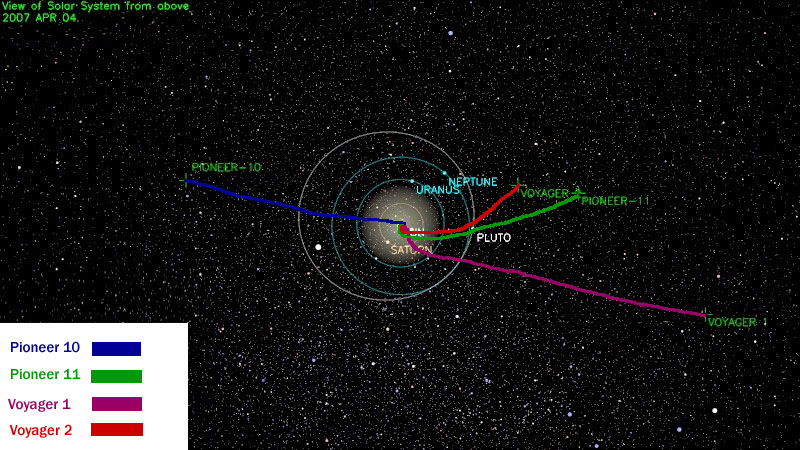
Voyager at
its true speed of 37,000 mph, Perhaps there is nothing
more amazing about our universe than this. The
Sun and our Earth are just small lonely dots to the Voyager spacecraft
now. As you watch Voyager
2 speed away, realize that it will
travel for millions of years through
space. Earth and the race of human beings
who built this humble craft will have greatly changed. If
humans are still around, we will have lost track of the Voyagers over
the millennia, forgetting them as they journey to places
far beyond our imagination.
Because
the Voyagers are
headed into deep space, it is possible that someday,
far, far into the future, an alien intelligent race (if
they exist) could encounter one for examination. If
that occurs, they will find a message attached
to the spacecraft. It is a gold-plated
copper 12” phonograph record (like a big CD). Designed
by a team of scientists led by famed Astronomer Carl
Sagan, the record contains songs, sounds and voices from
around the world, greetings in many languages and
scientific facts. Etched on the record is
a set of coded sketches to teach an intelligent alien
examining the disc who we are, where it came from, and
how to play it (parts for the record player are also
attached to the spacecraft). Exactly how
do you communicate with an alien intelligence that does
not speak any Earth languages and has never seen a
record or player (it may not even have eyes!)?
Consider that if an alien society ever finds Voyager,
millions of years will have passed on Earth and the
species who designed that disc will certainly no longer
be around. We either will have evolved
into a new type of human, or will have killed our
species off with our wars and bombs.
Pluto and its Moons
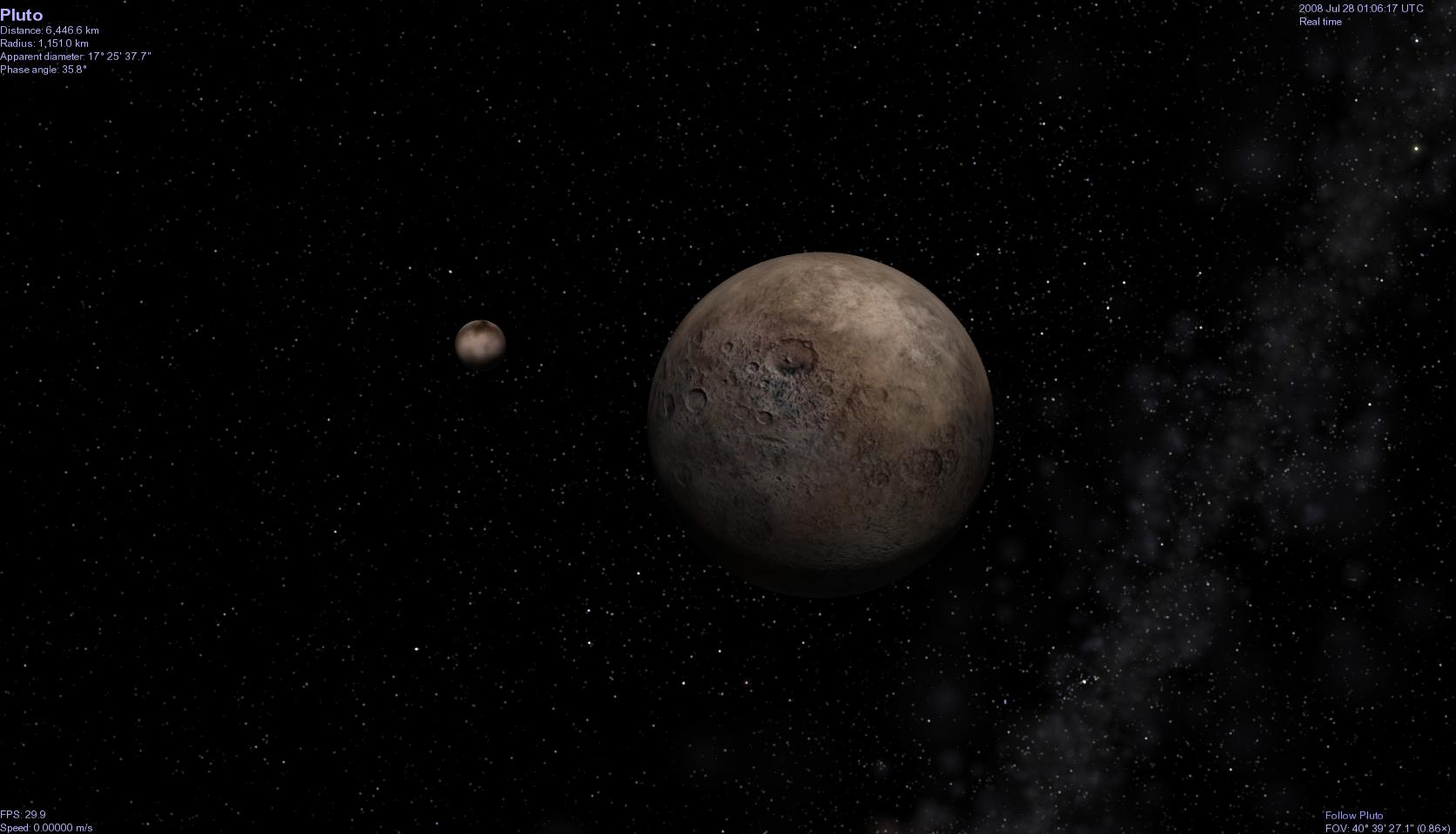
We have
arrived at a far outpost of our Solar System. Like
a lonely sentinel guarding our system’s planetary
members, Pluto is indeed isolated. Named
after the Roman God of the underworld (Hades in Greek
mythology), Pluto was discovered by accident by
Clyde Tombaugh in 1930 while searching for another
larger planet he thought might be in the night sky.
Swing
Pluto around
so you are behind its dark side, and locate the Sun. It’s
just a tiny dot so far away. Feel the cold
… and the isolation. It is so frigid and
lonely out here … isn’t it!
Pluto is
not a typical “planet”. It is tiny,
smaller than seven of our Solar System’s moons. If
it were orbiting another planet rather than the Sun,
Pluto would be a common moon.
Secondly,
it has a major moon of its own named Charon that
is ½ its size, making it highly unlikely that they
formed together at the same time. More
likely, Charon formed around Pluto like our Moon formed
around Earth, that is; long ago, another planet or
asteroid hit Pluto and knocked a big piece off into
space that reformed by gravity into Charon.
In late
October 2005, the Hubble Space Telescope discovered two
new moons of Pluto. They are
several hundred km in diameter each. They follow an
orbit around Pluto similar to Charon.
One of
them is called “Hydra”. Time
is speeded up. Notice how close to Pluto
and Charon it is. In the distance beyond
Pluto is moon # 3, officially named “Nix”. Scientists
are not sure how these moons got there, but suspect they
too may be pieces of rubble from an ancient collision
that reformed by gravity into its three moons. Alternatively,
Pluto’s gravity may have captured passing comets into
orbiting the planet.
The third
major anomaly about Pluto is its orbit around the Sun. It
takes an incredible 248 years to
make just one circuit of the Sun. What is
unusual, however, is the shape of that orbit. It
is highly elliptical and tilts dramatically in relation
to the rest of the Solar System.
The fourth
anomaly is its rotation. Pluto is tilted
at right angles to the plane of the ecliptic just like
Uranus, and it also spins in a retrograde
rotation, as we saw with Uranus and Triton. That
is, it turns from right to left, not left to right as
the Sun, the Earth and most other bodies in the Solar
System rotate. It takes 6.39 days to
turn once on its axis.
The last
unique point about the system is that Charon does not
orbit Pluto like a normal moon. Rather, they
orbit each other by circling an empty
spot between them called the “common center of mass”. In
fact, Pluto and Charon always face each other. They
are like two lovers who fear they will lose each other
in the darkness of space. It is called “Synchronous
Rotational Lock”, and it is common in the Solar
System. Our Moon for example, always shows
us the same face. However, Pluto
and Charon are both locked
on each other, which is unusual. The
cause is due to the forces of gravity from both worlds
interacting over time.
Pluto,
Charon, Hydra and Nix are giant balls of frozen rock and
solid water ice. Latest
estimates put them at about 70% rock and 30% water ice,
with frozen methane, ammonia and nitrogen present.
Pluto
has a tiny atmosphere but
it is so cold (-240° C or -400° F),
that its weak atmosphere freezes and falls to the ground
as a frost for most of its journey around the Sun. Only
during a small period when Pluto’s orbit brings it
closer to the Sun does a little of that frost evaporate
and become a bit of gas collecting above the planet.
In
January 2006, the U.S. launched
the first spacecraft to Pluto. Named New
Horizons, it cost a whopping $625
million, and will take 9 years to reach Pluto space. After
flying by Pluto and Charon, it will continue on into the
space beyond to explore the Kuiper Belt.
In
August 2006, Pluto technically lost its designation as
the ninth “planet” in our Solar System. As
mentioned earlier and as discussed in the next section,
a conference of Astronomers met to hash out the
definition of a “planet”. Discoveries in
2003, 2004, 2005 and 2006 all revealed that our Solar
System has more large round objects orbiting the Sun
than the nine we had called the planets. See
the next section.
Because of
the meeting, Pluto is now officially a “Dwarf
Plutoid Planet”. However, many
Astronomers are challenging the new definitions. We
will have to see how it all turns out.
The new “Planets” of the Kuiper Belt
In 2004,
yet another round object was located far beyond Pluto’s
orbit. It has been named Orcus. It
is about ½ the diameter of Pluto and it too has its own
moon.
In 2005,
yet another object was discovered. Originally
named simply 2005 FY9, it is now
officially named Makemake,
after a Polynesian god of the peoples of Easter
Island in the Pacific.
Now you
can see the problem. It is likely we will
find at least one more of these round space objects
every year or two for many years to come. If
they all became planets, we will have dozens of planets,
and millions of textbooks, maps, posters, software and
classroom tests will have to be changed every few years. It
will cost billions of dollars.
To deal
with the problem, a meeting of hundreds of Astronomers
was called by the International
Astronomical Union (IAU) in July
2006. After sometimes-bitter debate,
new definitions were developed for what constitutes
planets and other space objects. The
results were:
PLANET - (1)
Spherical Object (2) Orbits the Sun (3)
Has cleared a path in space in its vicinity
DWARF
PLANET - (1)
Spherical Object (2) Orbits the Sun (3)
May have other objects nearly
OTHER
SOLAR SYSTEM BODIES - (Asteroids,
Comets): Non-round objects orbiting the
sun
MOON /
SATELLITE – Anything
that orbits a planet, dwarf planet or other system body.
Based
on the above definitions, Mercury
through Neptune are
still “Planets” (eight of them). Pluto,
Ceres and Eris became “Dwarf Planets”. Moons
stay as moons, and everything else in the solar system
(asteroids, comets, etc.) become “Other Solar System
Bodies”.
In June
2008, this definition changed again. Dwarf
planets were sub-divided into two groups. Dwarf
planets inside the orbit of Neptune would
still be called just “Dwarf Planets”. However,
dwarf planets beyond the orbit of Neptune would
now be called “Dwarf Plutoid planets”. Since
Pluto, and Eris now fit that definition, they became
dwarf Plutoid planets. In July 2008,
Makemake was officially also declared a Dwarf Plutoid
Planet.
Thus, as of July 2008, the solar system has 8 planets, 1
dwarf planet (Ceres), 3 dwarf Plutoid planets (Pluto,
Eris and Makemake), and lots of asteroids and comets.
Since we
are not yet certain if Quaoar, Sedna and Orcus are
spherical, they have not yet been officially named Dwarf
Plutoid Planets. Most likely, their names
will be added to the list.
These
definitions may … or may not stand. Many
Astronomers are not happy with them. The
next meeting of the IAU is in 2009.
Let’s
visit Eris and Sedna. First
… Eris. It’s out there
somewhere, not too far away. Because the
light is very dim this far from the Sun, there is little
reflected light to see. That’s why it has
taken hundreds of years to find these big planet-sized
objects.
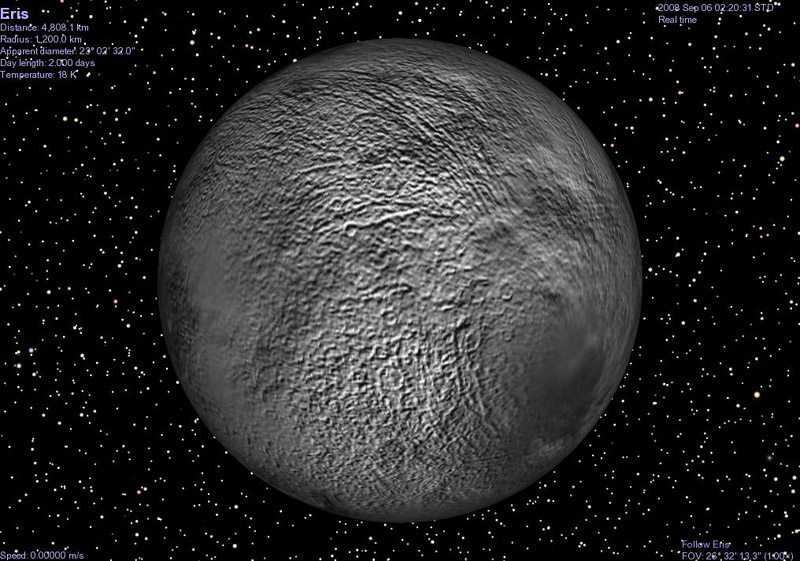
Its
temperature is near -420o F
(-250oC). Imagine! You
were alive when a new dwarf planet was found far out in
our own Solar System.
See its
daughter moon Dysnomia, Notice how
close to Eris it is!
Take a
look to Sedna. Frozen
in space and time, Sedna has
been traveling its isolated journey around the Sun since
the formation of the Solar System.
It is
currently at Perihelion (closest distance to the sun),
so there is some light on it to reflect into our
telescopes. Imagine how cold and dark it
gets on Sedna when it is at aphelion (the farthest part
of its orbit) thousands of years from now? It
will be completely invisible, even with our biggest
telescopes.
The Comets and the Oort Cloud
The
Solar System is a big place. Our
tour has been extensive, stretching from
the Sun to Pluto and beyond. However,
what lies beyond Pluto, far from the Sun, is the realm
(home) of the Comets. A
comet is a mixture of rocks, water ice and frozen
hydrocarbons packed densely together. Think
of a comet as a hard very dirty snowball.
Comets
are as old as the Solar System itself. They
formed from the same nebula as the rest of the Solar
System, fashioned by gravity and drifting in space ever
since. What is so amazing is that there
are so many of them. One
estimate puts their number at over 1 trillion comets.
Comets
come in all sizes, from tiny iceballs the size of a
baseball to huge moon sized objects hundreds of miles
across. They
generally orbit the Sun in two areas of concentration. One
is the Kuiper Belt, which we’ve
already introduced.
The other
zone is called the Oort Cloud. It
is VERY far away from the Sun. Some
estimates put its outer reaches at over 1 light-year
away. If true, then the size of our Solar
System and the gravitational influence of our Sun are
enormous – 6 trillion miles
or more in radius.
You may be
surprised to realize that you encounter comet material
every day. In fact, you are made of the
stuff. During the early days of our Solar
System, comets were numerous in the inner Solar System. They
fell to Earth by the millions every year. Today,
comets occasionally collide with each other or get
disturbed in their distant orbits. When
that happens, they can be knocked into a new orbit,
sometimes bringing them close to or on a collision
course with Earth or another planet.
Al-Anbiya 21:32-33
In the name of Allah, the Beneficent, the Merciful
And we have made the sky a roof withheld (from them).
Yet they turn away from its portents. (32) And He it is
Who created the night and the day, and the sun and the
moon. They float, each in an orbit. (33)
سورة الاٴنبیَاء
شروع الله کے نام سے جو بڑا مہربان نہایت رحم والا ہے
اور آسمان کو محفوظ چھت بنایا۔ اس پر بھی وہ ہماری نشانیوں
سے منہ پھیر رہے ہیں (۳۲)
اور وہی تو ہے جس نے رات اور دن اور سورج اور چاند کو
بنایا۔ (یہ) سب (یعنی سورج اور چاند اور ستارے) آسمان میں
(اس طرح چلتے ہیں گویا) تیر رہے ہیں (۳۳)
If a big one hits us, it can have the same devastating
effect on Earth as an asteroid, causing an extinction
event. Fortunately,
those are very rare. However, even today,
a handful of baseball sized comets are striking Earth
every day. Since they are made of water
ice and rock, their water merges with the water already
on Earth. The next time you take a sip of
water, you will actually be consuming a bit of a comet
with each gulp! FAR OUT!
An-Nahl 16:10-12
In the name of Allah, the Beneficent, the Merciful
He it is Who sendeth down water from the sky, whence ye
have drink, and whence are trees on which ye send your
beasts to pasture. (10) Therewith He causeth crops to
grow for you, and the olive and the date-palm and grapes
and all kinds of fruit. Lo! herein is indeed a portent
for people who reflect. (11) And He hath constrained the
night and the day and the sun and the moon to be of
service unto you, and the stars are made subservient by
His command. Lo! herein indeed are portents for people
who have sense. (12)
سورة النّحل
شروع الله کے نام سے جو بڑا مہربان نہایت رحم والا ہے
وہی تو ہے جس نے آسمان سے پانی برسایا جسے تم پیتے ہو اور
اس سے درخت بھی (شاداب ہوتے ہیں) جن میں تم اپنے چارپایوں
کو چراتے ہو (۱۰)
اسی پانی سے وہ تمہارے لیے کھیتی اور زیتون اور کھجور اور
انگور (اور بےشمار درخت) اُگاتا ہے۔ اور ہر طرح کے پھل
(پیدا کرتا ہے) غور کرنے والوں کے لیے اس میں (قدرتِ خدا
کی بڑی) نشانی ہے (۱۱)
اور اسی نے تمہارے لیے رات اور دن اور سورج اور چاند کو
کام میں لگایا۔ اور اسی کے حکم سے ستارے بھی کام میں لگے
ہوئے ہیں۔ سمجھنے والوں کے لیے اس میں (قدرت خدا کی بہت
سی) نشانیاں ہیں (۱۲)
In July
1994, a huge comet actually impacted Jupiter. It
was named Comet Shoemaker-Levy 9,
after the two people who found it. When
the impacts finally came, the world watched on
television as Jupiter reeled from the blows of each
fragment. Giant impact clouds were blown
from Jupiter’s gas atmosphere thousands of miles into
space. Wounds in the planet’s gaseous
layer were so large that the entire Earth could fit into
many of them.
Ash-Shura 42:5
In the name of Allah, the Beneficent, the Merciful
Almost might the heavens above be rent asunder
سورة الشّوریٰ
شروع الله کے نام سے جو بڑا مہربان نہایت رحم والا ہے
قریب ہے کہ آسمان اوپر سے پھٹ پڑیں
Had Comet Shoemaker-Levy
9 hit Earth, it would have extinguished
most of the life on our planet. Hollywood even
made a hit movie about a comet impact (called “Deep
Impact”).
Let’s
visit a famous comet whose orbit starts in the Kuiper
Belt but angles in toward the Sun and
Earth (fortunately, it’s not at risk of colliding with
anything). Halley’s Comet (named
after the person who discovered.
Kuiper Belt
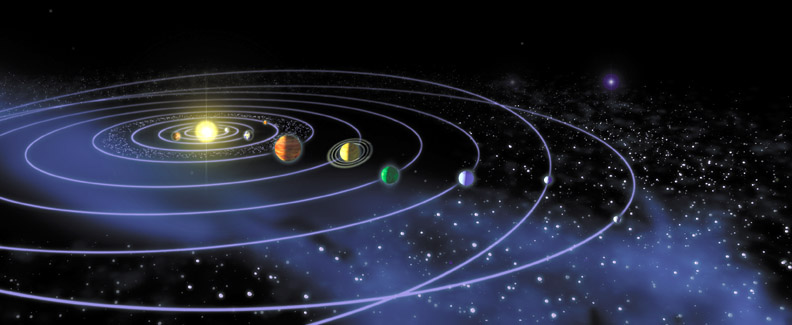
Comet
Halley as
it orbits the Sun in 1986. Its beautiful colored
tail of gas and dust is steaming away behind it. In the
distance is our Sun, surrounded by five of its planets. http://en.wikipedia.org/wiki/Halley's_Comet
 Notice
that its pale lavender tail of
gases is streaming directly away from the Sun.
When the heat from the Sun hits a comet, it melts part
of the ice. What you see streaming away from the
comet is vaporized gases, water and comet dust, pushed
away by the radiation from the Sun. Notice that a comet
is simply a big, dirty iceball (called
the Nucleus), surrounded by a
haze of vaporized gas and dust called a “Coma”.
The tail streams
out behind the coma.
Notice
that its pale lavender tail of
gases is streaming directly away from the Sun.
When the heat from the Sun hits a comet, it melts part
of the ice. What you see streaming away from the
comet is vaporized gases, water and comet dust, pushed
away by the radiation from the Sun. Notice that a comet
is simply a big, dirty iceball (called
the Nucleus), surrounded by a
haze of vaporized gas and dust called a “Coma”.
The tail streams
out behind the coma.
It’s about 28
km in diameter (17 miles).
Halley's nucleus is relatively small (barely 15
kilometers long, 8 kilometers wide and perhaps 8
kilometers thick; JPL lists its average diameter as only
11 km). Yet it is a massive object. If it ever hit
Earth, its collision effects would wipe
out all life on our planet.
Halley orbits the Sun just as Earth does, but much
farther away. Halley
swings in an orbit that takes it relatively close to the
Sun every 76 years. However, most comets orbit the
Sun in two large zones or “belts” much farther away.
These zones are called the Kuiper Belt (pronounced
“kyper”), and the Oort Cloud.
Within these two areas of space may exist over
1 trillion comets.
As you
can see, comets seem to have pretty “tails” of gas
streaming from them in all directions and you will
discover that the tail always points away from
something. What does it point away
from?
The
main part of the comet is at the bright front of
that tail. The big chunk of rock you
see is the comet itself and is called the comet Nucleus.
and look at Halley from all sides. Surrounding
Halley will be a lavender haze, which represents
water vapor and hydrocarbon gases, droplets of water
ice and particles of rock dust that are being blown
off of the comet from the Sun’s heat. This
surrounding haze is called the comet Coma.
As the
Sun’s radiation hits the comet, it blows its coma
out into a long “comet Tail”. Thus,
a comet tail is caused by the sun’s heat melting the
comet’s ice and pushing its tail away from the sun.
Please
note that when a comet is far from the Sun, there is
not enough heat to melt any ice. Neither
a coma nor a tail will form. It is
only when its orbit takes it inside the orbit of
Jupiter that the Sun’s heat is enough to create a
tail.
Halley
is a large comet with lots of ice, so it develops a
big, bright, visible tail when it enters the inner
Solar system. It is on an orbital path
that takes it around the Sun every 76
years. The last time it came
by the vicinity of Earth was 1986, so it will be
another 58 years before it returns. How
old will you be then?
To see
Halley’s orbit, far above the plane of the Solar
System. Halley’s orbit is red. Remember
that the tail will only develop when it is inside
the orbit of Jupiter.
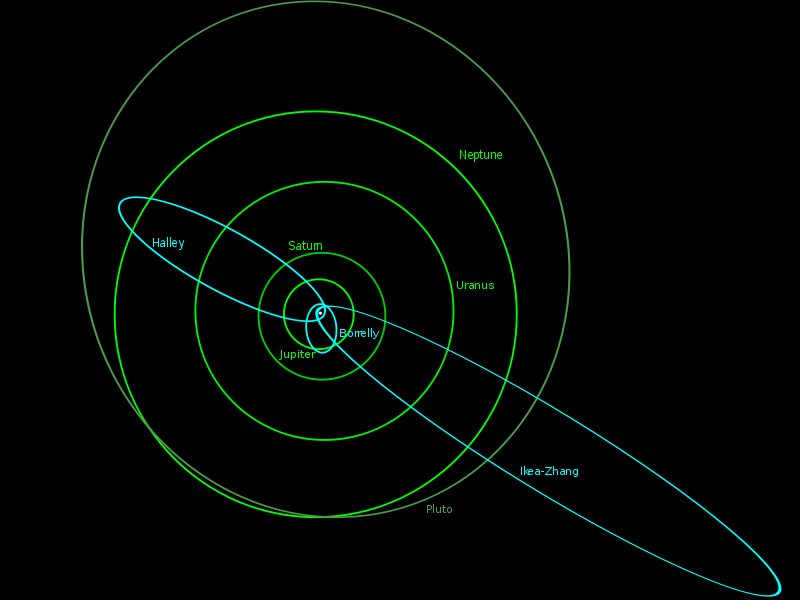
Last
stop in this extended tour of the Solar System is
the Oort Cloud, the last remote
outpost of our Solar System. Here, far out
in space, a trillion comets may orbit. None
of them can be seen from Earth. They
are too dim to be picked up even with our best
telescopes and they are too cold to have tails. Their
presence is estimated, based upon the collective
gravity they give off, and calculations of comets
closer to us that could only have once come from far
beyond Pluto.
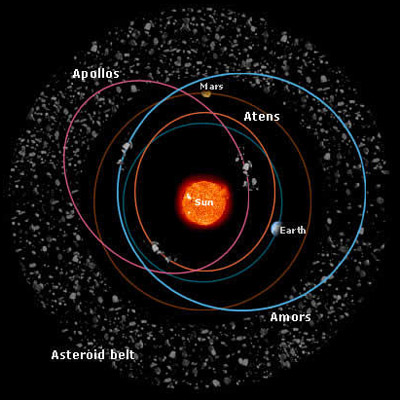
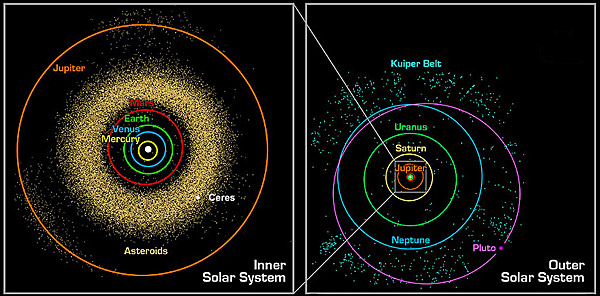
kuiper-belt Objects Comparison with Earth
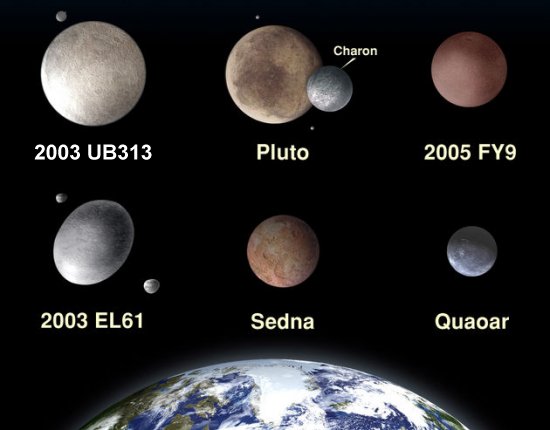
Another
dark, frozen, billions of comets in it called Oort cloud,
far from our Sun and its family of planets.
Within
these two areas of space may exist over
1 trillion comets.
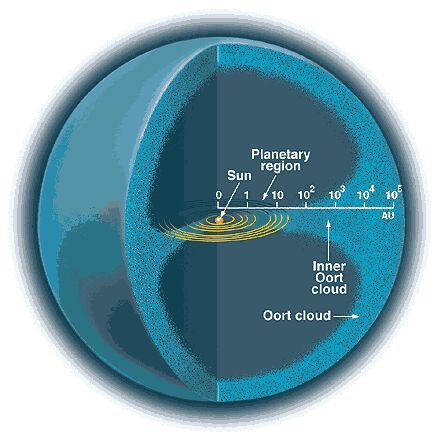
To witness
the Oort cloud comets slowly orbiting the Sun. At
this distance, it takes hundreds
of thousands of years for a distant comet in the Oort
cloud to orbit the Sun just once. Amazingly,
the Sun’s gravity is powerful enough to capture and hold
onto comets even at this great distance.
If we
started our trip from Earth and flew to comet Oort at
the speed of our family car, it would take … well … it
would take over 8 MILLION YEARS to
get here.
Yes! It’s true! Yet, we are not even
out of our own Solar System.
Our
journey into the universe has barely
even begun!
It is over
3 trillion miles/km from the Sun and from Earth.
Here in the loneliness of space there is no heat left
from the Sun, and the comet has no tail or coma of
vaporized gases. Everything is frozen. The
temperature is -420º F (-240º C) below
zero. If you somehow found yourself outside of
your spaceship without a heated spacesuit, you would die
and freeze completely solid in minutes. There is
also absolutely no sound outside of your spaceship.
Sound needs a medium such as air or water to travel
through and there is no air outside your hull.
Beyond comet Oort in
the far distance is a faint band of haze.
That … is the rest of our galaxy Milky Way.
سُوۡرَةُ لقمَان
بِسۡمِ ٱللهِ ٱلرَّحۡمَـٰنِ ٱلرَّحِيم
وَلَوۡ أَنَّمَا فِى ٱلۡأَرۡضِ مِن شَجَرَةٍ أَقۡلَـٰمٌ۬
وَٱلۡبَحۡرُ يَمُدُّهُ ۥ مِنۢ بَعۡدِهِۦ سَبۡعَةُ
أَبۡحُرٍ۬ مَّا نَفِدَتۡ كَلِمَـٰتُ ٱللَّهِۗ
إِنَّ ٱللَّهَ عَزِيزٌ حَكِيمٌ۬ (٢٧) ِ
[031:027] And
if all the trees on earth were pens and the ocean (were
ink), with seven oceans behind it to add to its
(supply), yet would not the words of God be exhausted
(in the writing): for God is Exalted in Power, full of
Wisdom.
اور اگر یوں ہو کہ زمین میں جتنے درخت ہیں (سب کے سب) قلم
ہوں اور سمندر (کا تمام پانی) سیاہی ہو (اور) اس کے بعد
سات سمندر اور (سیاہی ہو جائیں) تو خدا کی باتیں (یعنی اس
کی صفتیں) ختم نہ ہوں۔ بیشک خدا غالب حکمت والا ہے (۲۷)
Are you ready to explore our universe and find
How BIG is the
Universe?
Is it small or large? Is it “infinite” or
does it “end” somewhere? If so, what is beyond its outer
boundary? How long has it been in existence?
http://www.findpk.com/zahid/universe.htm